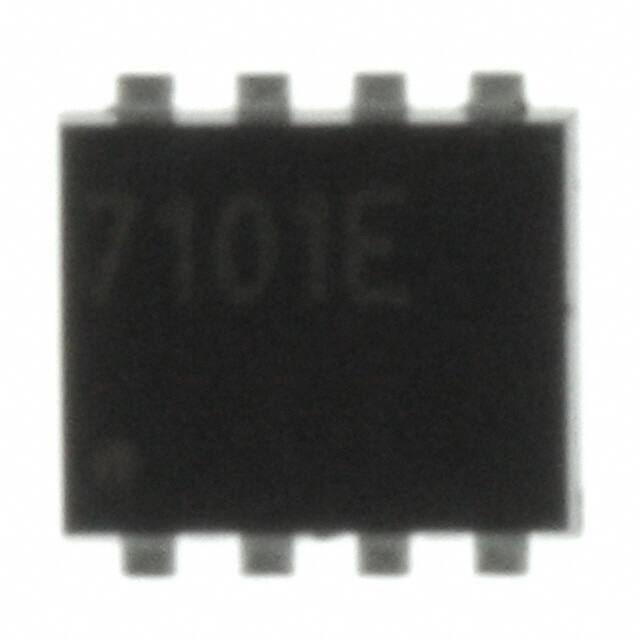
TB7101F(T5L3.3,F)
Toshiba BiCD Integrated Circuit
Silicon Monolithic
TB7101F(T5L3.3,F)
Buck DC-DC Converter IC
The TB7101F is a single-chip buck DC-DC converter IC. The
TB7101F contains high-speed and low-on-resistance power
MOSFETs for the main switch and synchronous rectifier to
achieve high efficiency.
Features
Enables up to 1 A of load current (IOUT) with a minimum of
external components.
Fixed output voltage: VOUT 3.3 V (typ.)
A high 1-MHz oscillation frequency (typ.) allows the use of small external components.
Uses only an inductor and two capacitors to achieve high efficiency.
Allows the use of a small surface-mount ceramic capacitor as an output filter capacitor.
Housed in a small surface-mount package (PS-8) with a low thermal resistance.
Undervoltage lockout (UVLO), thermal shutdown (TSD) and overcurrent protection (OCP)
Parts Marking
Weight: 0.017 g (typ.)
Pin Assignment
Parts Marking
Lot No.
LX
VFB
N.C.
N.C.
8
7
6
5
7101E
*
The dot (•) on the top surface indicates pin 1.
*:
1
2
3
4
PGND
VIN
EN
SGND
The lot number consists of three digits. The first digit represents the last digit of the year of manufacture, and the
following two digits indicates the week of manufacture between 01 and either 52 or 53.
Manufacturing week code
(The first week of the year is 01; the last week is 52 or 53.)
Manufacturing year code (last digit of the year of manufacture)
This product has a MOS structure and is sensitive to electrostatic discharge. Handle with care.
The product(s) in this document (“Product”) contain functions intended to protect the Product from temporary
small overloads such as minor short-term overcurrent, or overheating. The protective functions do not necessarily
protect Product under all circumstances. When incorporating Product into your system, please design the system (1)
to avoid such overloads upon the Product, and (2) to shut down or otherwise relieve the Product of such overload
conditions immediately upon occurrence. For details, please refer to the notes appearing below in this document and
other documents referenced in this document.
1
2011-09-29
�TB7101F(T5L3.3,F)
Ordering Information
Part Number
Shipping
TB7101F(T5L3.3,F)
Embossed tape (3000 units per reel)
Block Diagram
VIN
Undervoltage
lockout & soft-start
reference voltage
EN
Current detection
Oscillator
Driver
PWM comparator
Slope
compensation
LX
Control logic
Driver
VFB
Error amplifier
PGND
Phase
compensation
VCOMP
0.8V (typ.)
Thermal
shutdown
SGND
Pin Description
Pin No.
Symbol
Description
1
PGND
2
VIN
Input pin
This pin is placed in the standby state if VENB low. Standby current is 1 A or less.
3
EN
Enable pin
This pin is connected to an on-chip CMOS inverter. When EN 3.5 V (@VIN 5 V), the control logic is
allowed to operate and thus enable the switching operation of the output section.
4
SGND
5
N.C.
No-connect
6
N.C.
No-connect
7
VFB
Feedback pin
Output voltage is set to 3.3 V (typ.) internally.
8
LX
Ground for the output section
Ground for the control logic
Switch pin
This output is connected to the high-side P-channel MOSFETs and low-side N-channel MOSFET.
2
2011-09-29
�TB7101F(T5L3.3,F)
Timing Chart
Normal Operation
OSC
0
IOUT
0
VOUT
0
VCOMP
0
IL
0
VLX
TON
OSC : Internal oscillator output signal
IOUT : Converter output current
VOUT : Converter output voltage
VCOMP : Output voltage of error amplifier
: Inductor current
IL
: Switch pin voltage
VLX
T
3
2011-09-29
�TB7101F(T5L3.3,F)
Absolute Maximum Ratings (Ta 25°C)
Characteristics
Symbol
Rating
Unit
Input voltage
VIN
0.3 to 6
V
Enable pin voltage
VEN
0.3 to 6
V
VEN VIN
VEN VIN 0.3
V
Feedback pin voltage
VFB
0.3 to 6
V
Switch pin voltage
VLX
0.3 to 6
V
ILX
1.3
A
PD
0.7
W
Tjopr
40 to 125
°C
Tj
150
°C
Tstg
55 to 150
°C
VENVIN voltage difference
Switch pin current
Power dissipation
(Note 1)
Operating junction temperature
Junction temperature
(Note 2)
Storage temperature
Note: Using continuously under heavy loads (e.g. the application of high temperature/current/voltage and the
significant change in temperature, etc.) may cause this product to decrease in the reliability significantly
even if the operating conditions (i.e. operating temperature/current/voltage, etc.) are within the absolute
maximum ratings and the operating ranges.
Please design the appropriate reliability upon reviewing the Toshiba Semiconductor Reliability Handbook
(“Handling Precautions”/“Derating Concept and Methods”) and individual reliability data (i.e. reliability test
report and estimated failure rate, etc)
Thermal Resistance Characteristic
Characteristics
Symbol
Thermal resistance, junction and ambient
Rth (j-a)
Max
178.6 (Note 1)
Unit
°C/W
Note 1:
Glass epoxy board
Material: FR-4
25.4 25.4 0.8
(Unit: mm)
Note 2: The TB7101F may go into thermal shutdown at the rated maximum junction temperature. Thermal design is
required to ensure that the rated maximum operating junction temperature, Tjopr, will not be exceeded.
4
2011-09-29
�TB7101F(T5L3.3,F)
Electrical Characteristics (unless otherwise specified: Tj 25°C and VIN 4.3 to 5.5 V)
TB7101F (T5L3.3, F)
Characteristics
Operating input voltage
Operating current
Standby current
EN threshold voltage
EN input current
VFB input voltage
Symbol
Test Condition
Min
Typ.
Max
Unit
VIN (OPR)
4.3
5.5
V
IIN1
VIN 5 V, VEN 5 V, VFB 5 V
0.68
0.9
mA
IIN2
VIN 4.3 V, VEN 4.3 V, VFB 4.3 V
0.64
0.775
mA
IIN (STBY)
VIN 5 V, VEN 0 V, VFB 0 V
1
A
VIH (EN) 1
VIN 5 V
3.5
V
VIH (EN) 2
VIN 4.3 V
3.01
V
VIL (EN) 1
VIN 5 V
1.5
V
VIL (EN) 2
VIN 4.3 V
1.29
V
IIH (EN) 1
VIN 5 V, VEN 5 V
7.6
12.4
A
IIH (EN) 2
VIN 4.3 V, VEN 4.3 V
6.54
10.66
A
VFB1
VIN 5 V, VEN 5 V, IOUT 10 mA
3.201
3.3
3.399
V
VFB2
VIN 4.3 V, VEN 4.3 V, IOUT 10 mA
3.201
3.3
3.399
V
High-side switch on-state resistance
RDS (ON) (H)
VIN 5 V, VEN 5 V, ILX 0.5 A
0.27
Low-side switch on-state resistance
RDS (ON) (L)
VIN 5 V, VEN 5 V, ILX 0.5 A
0.27
High-side switch leakage current
ILEAK (H)
VIN 5 V, VEN 0 V, VLX 0 V
1
A
Low-side switch leakage current
ILEAK (L)
VIN 5 V, VEN 0 V, VLX 5 V
Oscillation frequency
Soft-start time
Thermal
shutdown (TSD)
Undervoltage
lockout (UVLO)
LX current limit
Detection
temperature
Hysteresis
1
A
fosc1
VIN 5 V, VEN 5 V
0.85
1
1.15
MHz
fosc2
VIN 4.3 V, VEN 4.3 V
0.85
1
1.15
MHz
tss1
VIN 5 V, VEN 5 V, IOUT 0 A
1
2
ms
tss2
VIN 4.3 V, VEN 4.3 V, IOUT 0 A
1.2
2.4
ms
TSD
VIN 5 V
160
°C
TSD
VIN 5 V
20
°C
Detection voltage
VUV
VIN VEN
2.2
2.4
2.6
V
Recovery voltage
VUVR
VIN VEN
2.3
2.5
2.7
V
Hysteresis
VUV
VIN VEN
0.1
V
ILIM
VIN 5 V
1.3
2.8
A
Note on Electrical Characteristics
The test condition Tj 25°C means a state where any drifts in electrical characteristics incurred by an increase in
the chip’s junction temperature can be ignored during pulse testing.
5
2011-09-29
�TB7101F(T5L3.3,F)
Application Circuit Example
VIN
VIN
VFB
TB7101F (T5L3.3, F)
SGND
LX
PGND
L
VOUT
COUT
CC
CIN
EN
GND
GND
Figure 1 TB7101F(T5L3.3,F) Application Circuit Example
Component values (@TB7101F (T5L3.3, F), VIN 5 V, Ta 25°C)
These values are presented only as a guide.
CIN: Input filter capacitor = 10 F
(ceramic capacitor: GRM21BB30J106K from Murata Manufacturing Co., Ltd.)
COUT: Output filter capacitor = 10 F
(ceramic capacitor: GRM21BB30J106K from Murata Manufacturing Co., Ltd.)
L:
Inductor = 3.3 H (NP04SB3R3N from Taiyo Yuden Co., Ltd.)
Component values need to be adjusted, depending on the TB7101F’s input/output conditions and the board layout.
Application Notes
Inductor Selection
The inductance required for inductor L can be calculated as follows:
VIN : Input voltage (V)
VIN VOUT VOUT
VOUT : Output voltage (V)
L
········· (1)
fosc IL
VIN
fosc
: Oscillation frequency 1 MHz (typ.)
IL
: Inductor ripple current (A)
*: Generally, IL should be set to approximately 30% of the maximum output current. Since the maximum output
current of the TB7101F is 1 A, IL should be 0.3 A or so. Therefore, the inductor should have a current rating
greater than the peak output current of 1.15 A. If the inductor current rating is exceeded, the inductor becomes
saturated, leading to an unstable DC-DC converter operation.
L
VIN VOUT VOUT
fosc IL
VIN
5.0 V 3.3 V 3.3 V
······ (2)
1 MHz 300 mA 5 V
IL
When VIN 5 V, the required inductance can be calculated as follows. Be sure to select an appropriate inductor,
taking the VIN range into account.
IL
0
T
3.7 H
1
fosc
V
TON Τ OUT
VIN
Figure 2 Inductor Current Waveform
6
2011-09-29
�TB7101F(T5L3.3,F)
Output Capacitor Selection
Use a ceramic capacitor as the output filter capacitor. Since a ceramic capacitor is generally sensitive to
temperature, choose one with excellent temperature characteristics (such as the JIS B characteristic). As a rule
of thumb, its capacitance should be 10 F or greater. The capacitance should be set to an optimal value that
meets the system's ripple voltage requirement and transient load response characteristics. Since the ceramic
capacitor has a very low ESR value, it helps reduce the output ripple voltage; however, because the ceramic
capacitor provides less phase margin, it should be thoroughly evaluated.
Undervoltage Lockout (UVLO)
The TB7101F has undervoltage lockout (UVLO) protection circuitry. The TB7101F does not provide output
voltage (VOUT) until the input voltage has reached VUVR (2.5 V typ.). UVLO has hysteresis of 0.1 V (typ.). After
the switch turns on, if VIN drops below VUV (2.4 V typ.), UVLO shuts off the switch at VOUT.
Undervoltage lockout
recovery voltage: VUVR
Undervoltage lockout
detection voltage: VUV
VIN
Hysteresis: VUV
GND
Switching operation starts
VOUT
GND
Soft start
Switching operation stops
Figure 4 Undervoltage Lockout Operation
Thermal Shutdown (TSD)
The TB7101F provides thermal shutdown. When the junction temperature continues to rise and reaches TSD
(160°C typ.), the TB7101F goes into thermal shutdown and shuts off the power supply. TSD has a hysteresis of
about 20°C. The device is enabled again when the junction temperature has dropped by approximately 20°C from
the TSD trip point. The device resumes the power supply when the soft-start circuit is used upon recovery from
the TSD state.
Thermal shutdown is intended to protect the device against abnormal system conditions. It should be ensured
that the TSD circuit will not be activated during normal operation of the system.
TSD Detection threshold: TSD
Recovery from TSD
Hysteresis: TSD
Tj
0
Switching operation starts
VOUT
GND
Switching operation stops
Soft start
Figure 5 Thermal Shutdown Operation
7
2011-09-29
�TB7101F(T5L3.3,F)
Usage Precautions
The input voltage, output voltage, output current and temperature conditions should be considered when
selecting capacitors and inductors. These components should be evaluated on an actual system prototype for best
selection.
External components such as capacitors and inductor should be placed as close to the TB7101F as possible.
The TB7101F has an ESD diode between the EN and VIN pins. The voltage between these pins should satisfy
VEN VIN 0.3 V.
Operation might become unstable due to board layout. In that case, add a decoupling capacitor (CC) of 0.1 F to
1F between the SGND and VIN pins.
The overcurrent protection circuits in the Product are designed to temporarily protect Product from minor
overcurrent of brief duration. When the overcurrent protective function in the Product activates, immediately
cease application of overcurrent to Product. Improper usage of Product, such as application of current to Product
exceeding the absolute maximum ratings, could cause the overcurrent protection circuit not to operate properly
and/or damage Product permanently even before the protection circuit starts to operate.
The thermal shutdown circuits in the Product are designed to temporarily protect Product from minor
overheating of brief duration. When the overheating protective function in the Product activates, immediately
correct the overheating situation. Improper usage of Product, such as the application of heat to Product
exceeding the absolute maximum ratings, could cause the overheating protection circuit not to operate properly
and/or damage Product permanently even before the protection circuit starts to operate.
8
2011-09-29
�TB7101F(T5L3.3,F)
Typical Performance Characteristics
IIN – VIN
IIN – Tj
0.8
1.0
(mA)
Operating current,
Operating current,
IIN
0.6
IIN
(mA)
VIN 2.7 V
0.4
0.2
VEN VFB VIN
VEN VFB 2.7 V
0.8
0.6
0.4
0.2
Tj 25°C
0
0
2
4
Input voltage,
VIN
0
6
-50
-25
(V)
25
50
Junction temperature,
IIN – Tj
1.0
0
75
VIH(EN), VIL(EN) – Tj
3
VIN 5 V
VIN 2.7 V
0.8
EN threshold voltage,
VIH(EN), VIL(EN) (V)
(mA)
IIN
Operating current,
125
Tj (°C)
VEN VFB 5 V
0.6
0.4
2
VIH(EN)
1
VIL(EN)
0.2
0
0
-50
-25
0
25
50
Junction temperature,
75
100
-50
125
-25
Tj (°C)
0
25
VIH(EN), VIL(EN) – Tj
75
50
Junction temperature,
100
125
Tj (°C)
IIH(EN) – VIN
20
5
VIN 5.5 V , Tj 25°C
VIN 5.5 V
16
4
VIH(EN)
EN input current,
IIH(EN) (A)
EN threshold voltage,
VIH(EN), VIL(EN) (V)
100
3
2
VIL(EN)
8
4
1
0
12
0
-50
-25
0
25
50
Junction temperature,
75
100
125
0
Tj (°C)
1
2
3
4
EN input voltage, VEN
9
5
6
(V)
2011-09-29
�TB7101F(T5L3.3,F)
IIH(EN) – Tj
20
VUV, VUVR – Tj
2.6
VIN 5 V , VEN 5 V
Undervoltage detection voltage,
VUV, VUVR (V)
Recovery voltage VUVR
(A)
IIH(EN)
2.5
12
8
Detection voltage VUV
2.4
4
VEN VIN
0
2.3
-50
-25
0
25
50
75
Junction temperature,
100
125
-50
-25
Tj (°C)
0
(MHz)
Oscillation frequency, fosc
(MHz)
Oscillation frequency, fosc
1.1
1
0.9
0.8
2
3
4
Input voltage,
5
125
Tj (°C)
VIN
1.1
1
0.9
-25
0
25
50
Junction temperature,
(V)
75
100
125
Tj (°C)
VOUT – VIN
VOUT – IOUT
30
10
Output voltage,
0
(mV)
L 3.3 H , COUT 10 F
20
VOUT
VIN 5V , Ta 25°C
(mV)
100
VIN 5V
0.8
-50
6
30
VOUT
75
1.2
Tj 25°C
10
50
focs – Tj
focs – VIN
20
25
Junction temperature,
1.2
Output voltage,
EN input current,
16
-10
-20
0
0.2
0.4
0.6
Output current, IOUT
0.8
1
L 3.3 H , COUT 10 F
0
-10
-20
-30
-30
IOUT 0.2A , Ta 25°C
2
3
4
Input voltage,
(A)
10
5
VIN
6
(V)
2011-09-29
�TB7101F(T5L3.3,F)
– IOUT
100
Efficiency, (%)
80
60
40
VIN 5V , Ta 25°C
20
L 3.3 H , COUT 10 F
0
0
0.2
0.4
0.6
Output current, IOUT
0.8
1
(A)
11
2011-09-29
�TB7101F(T5L3.3,F)
Board Layout Example
Component side silk
Solder side silk
Component side pattern
Solder side pattern
12
2011-09-29
�TB7101F(T5L3.3,F)
TP1
TP4
IC1
VIN
C1
P1
1
P2
GND
TP3
2
JP1
1 PGND
2 V
IN
FB
3 EN
4 SGND
N.C.
N.C.
3
VOUT
P3
L1
Lx 8
7
V
C2
6
5
P4
GND
TP2
Figure 6 Circuit of the Board Layout Example
External Component Examples
Label
Vendor
Part Number
IC1
Toshiba Corporation
TB7101F(T5L3.3,F)
C1
Murata Manufacturing Co., Ltd.
GRM21BB30J106K
C2
Murata Manufacturing Co., Ltd.
GRM21BB30J106K
L1
Taiyo Yuden Co., Ltd.
NP04SB3R3N
13
2011-09-29
�TB7101F(T5L3.3,F)
Package Dimensions
Weight: 0.017 g (typ.)
14
2011-09-29
�TB7101F(T5L3.3,F)
RESTRICTIONS ON PRODUCT USE
Toshiba Corporation, and its subsidiaries and affiliates (collectively “TOSHIBA”), reserve the right to make changes to the information
in this document, and related hardware, software and systems (collectively “Product”) without notice.
This document and any information herein may not be reproduced without prior written permission from TOSHIBA. Even with
TOSHIBA’s written permission, reproduction is permissible only if reproduction is without alteration/omission.
Though TOSHIBA works continually to improve Product’s quality and reliability, Product can malfunction or fail. Customers are
responsible for complying with safety standards and for providing adequate designs and safeguards for their hardware, software and
systems which minimize risk and avoid situations in which a malfunction or failure of Product could cause loss of human life, bodily
injury or damage to property, including data loss or corruption. Before customers use the Product, create designs including the Product,
or incorporate the Product into their own applications, customers must also refer to and comply with (a) the latest versions of all
relevant TOSHIBA information, including without limitation, this document, the specifications, the data sheets and application notes for
Product and the precautions and conditions set forth in the “TOSHIBA Semiconductor Reliability Handbook” and (b) the instructions for
the application with which the Product will be used with or for. Customers are solely responsible for all aspects of their own product
design or applications, including but not limited to (a) determining the appropriateness of the use of this Product in such design or
applications; (b) evaluating and determining the applicability of any information contained in this document, or in charts, diagrams,
programs, algorithms, sample application circuits, or any other referenced documents; and (c) validating all operating parameters for
such designs and applications. TOSHIBA ASSUMES NO LIABILITY FOR CUSTOMERS’ PRODUCT DESIGN OR APPLICATIONS.
Product is intended for use in general electronics applications (e.g., computers, personal equipment, office equipment, measuring
equipment, industrial robots and home electronics appliances) or for specific applications as expressly stated in this document.
Product is neither intended nor warranted for use in equipment or systems that require extraordinarily high levels of quality and/or
reliability and/or a malfunction or failure of which may cause loss of human life, bodily injury, serious property damage or serious public
impact (“Unintended Use”). Unintended Use includes, without limitation, equipment used in nuclear facilities, equipment used in the
aerospace industry, medical equipment, equipment used for automobiles, trains, ships and other transportation, traffic signaling
equipment, equipment used to control combustions or explosions, safety devices, elevators and escalators, devices related to electric
power, and equipment used in finance-related fields. Do not use Product for Unintended Use unless specifically permitted in this
document.
Do not disassemble, analyze, reverse-engineer, alter, modify, translate or copy Product, whether in whole or in part.
Product shall not be used for or incorporated into any products or systems whose manufacture, use, or sale is prohibited under any
applicable laws or regulations.
The information contained herein is presented only as guidance for Product use. No responsibility is assumed by TOSHIBA for any
infringement of patents or any other intellectual property rights of third parties that may result from the use of Product. No license to
any intellectual property right is granted by this document, whether express or implied, by estoppel or otherwise.
ABSENT A WRITTEN SIGNED AGREEMENT, EXCEPT AS PROVIDED IN THE RELEVANT TERMS AND CONDITIONS OF SALE
FOR PRODUCT, AND TO THE MAXIMUM EXTENT ALLOWABLE BY LAW, TOSHIBA (1) ASSUMES NO LIABILITY
WHATSOEVER, INCLUDING WITHOUT LIMITATION, INDIRECT, CONSEQUENTIAL, SPECIAL, OR INCIDENTAL DAMAGES OR
LOSS, INCLUDING WITHOUT LIMITATION, LOSS OF PROFITS, LOSS OF OPPORTUNITIES, BUSINESS INTERRUPTION AND
LOSS OF DATA, AND (2) DISCLAIMS ANY AND ALL EXPRESS OR IMPLIED WARRANTIES AND CONDITIONS RELATED TO
SALE, USE OF PRODUCT, OR INFORMATION, INCLUDING WARRANTIES OR CONDITIONS OF MERCHANTABILITY, FITNESS
FOR A PARTICULAR PURPOSE, ACCURACY OF INFORMATION, OR NONINFRINGEMENT.
Do not use or otherwise make available Product or related software or technology for any military purposes, including without limitation,
for the design, development, use, stockpiling or manufacturing of nuclear, chemical, or biological weapons or missile technology
products (mass destruction weapons). Product and related software and technology may be controlled under the Japanese Foreign
Exchange and Foreign Trade Law and the U.S. Export Administration Regulations. Export and re-export of Product or related software
or technology are strictly prohibited except in compliance with all applicable export laws and regulations.
Please contact your TOSHIBA sales representative for details as to environmental matters such as the RoHS compatibility of Product.
Please use Product in compliance with all applicable laws and regulations that regulate the inclusion or use of controlled substances,
including without limitation, the EU RoHS Directive. TOSHIBA assumes no liability for damages or losses occurring as a result of
noncompliance with applicable laws and regulations.
15
2011-09-29
�