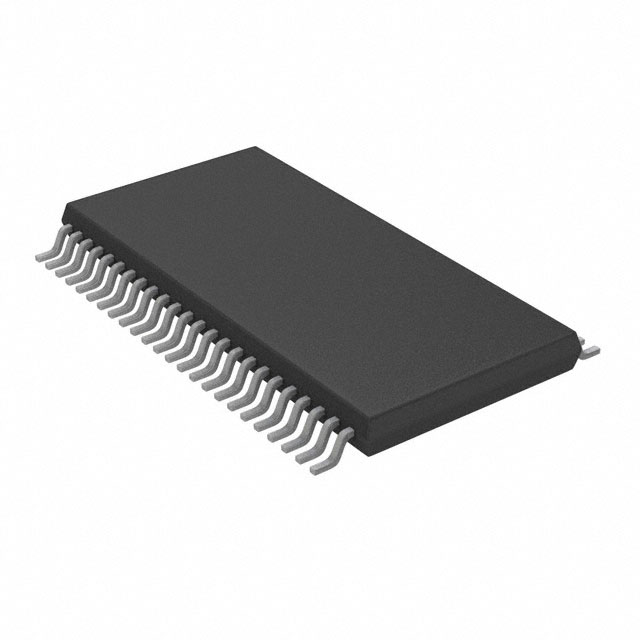
TC78S122FNG
TOSHIBA CD Process Integrated Circuit Silicon Monolithic
TC78S122FNG
PWM Chopper Type Dual-Stepping Motor Driver
The TC78S122FNG is a PWM chopper type dual-stepping motor driver.
Two stepping motor drivers can drive up to four brushed DC
motors. Incorporating two pairs of H-bridge drivers, the
TC78S122FNG can drive two DC motors or a single stepping
motor.
Features
●
Single-chip motor driver for bipolar stepping motor
HTSSOP48-P-300-0.50
control
●
Monolithic IC structured by CD process.
●
Low ON-resistance: Ron = 0.6 Ω
Weight: 0.212 (g)
In large mode, ON-resistance of combined H-bridges (Ron) is 0.3 Ω.
●
Over-current detection (ISD), thermal shutdown (TSD) and VM power-on reset circuits
●
Since the IC incorporates the VCC regulator for internal circuit operation, an external power supply (5 V)
is not required.
●
Package:HTSSOP48
●
Maximum output withstand voltage: 40 V (max)
●
Output current: 2.0 A (max) in DC Motor (S) mode; 1.5 A (max) in Stepping Motor (S) mode
●
Chopping frequency can be set by external capacitor and resistor. High-speed chopping is possible at
100 kHz or higher.
© 2016-2017
Toshiba Electronic Devices & Storage Corporation
1
2017-09-15
�TC78S122FNG
Block Diagram(Stepping Motor(S) × 2-ch Control Mode)
CW/CCW_X
CLK_X
X_MODE1
X_MODE2
MODE0
MODE1
MODE2
ENABLE_X
RESET_X
SLEEP
VMR Detect
Step Decoder
(Input Logic)
Chopper OSC
OSCM
OSC
ALERT
VREF_X
VCC
VCC Voltage
Regulator
Current Level Set
2bit D/A
(Angle Control)
Torque Control
CR-CLK
Converter
Current Feedback (×2)
VM
RS_A
RS_B
VRS1
RS COMP1
VRS2
RS COMP2
Output Control
(Mixed Decay Control)
RS_C
RS_D
ISD
Output
(H-Bridge ×2)
Output
(H-Bridge ×2)
VM
TSD
VMR
Detect
Detection Circuit
Stepping
Motor
Stepping
Motor
* "X" means the ellipsis of AB / CD of each Ch. (CW/CCW_X, CLK_X, X_MODE1, X_MODE2,
ENABLE_X, and RESET_X)
Note: GND wiring: We recommend that a heat sink be grounded at all points, and the board be grounded at
only one GND pin for single point ground. Take the heat dissipation into consideration when designing
the board. When in controlling the setting pins for each mode by SW, those pins should be pulled up to
power supply like VCC or pulled down to GND not to go into a high-impedance (Hi-Z) state.
Utmost care is necessary in the design of the output line, VM line and GND line since IC may be
destroyed due to short-circuit between outputs, to supply, or to ground.
Especially for those pins that are connected to power supply and get a large current flow (such as VM,
RS, OUT and GND), they should be properly wired; otherwise troubles including destruction may
occur to this IC. If the logic input pins are not wired properly, malfunction that would destroy the IC
may occur due to a large current exceeding the absolute maximum ratings. Care should be taken in the
design of board layouts and implementation of the IC.
2
2017-09-15
�TC78S122FNG
Pin Assignment
PIN No.
Pin n ame
1
2
3
4
5
6
7
8
9
10
11
12
13
14
15
16
17
18
19
20
21
22
23
24
25
26
27
28
29
30
31
32
33
34
35
36
37
38
39
40
41
42
43
44
45
46
47
48
VM
VM
SLEEP
ALERT
CLK_AB
ENABLE_AB
CLK_CD
ENABLE_CD
OUT_ARS_A
RS2 _A
OUT_A+
OUT_B+
RS2 _B
RS_B
OUT_BD_TBLANK_AB
D_TBLANK_CD
MODE2
NC
MODE1
MODE0
VM
VM
CW/ CCW_AB
MO_AB
AB_MODE2
AB_MODE1
NC
CW/ CCW_CD
MO_CD
CD_MODE2
OUT_CRS_C
RS2 _C
OUT_C+
OUT_D+
RS2 _D
RS_D
OUT_DCD_MODE1
VREF_A
VREF_B
VREF_C
VREF_D
OSCM
VCC
GND
(1 )Ste ppe r(S)×2
(2 )DC(L)×2
(3 )Ste ppe r(L)
(5 )DC(S)×4
(5 )DC(L)+ Ste ppe r(S)
VM powe r in pu t pin
VM powe r in pu t pin
Sle e p pin
Ale rt pin
ABc h CLK in pu t
ABc h PWM pin
CLK in pu t
Ac h PWM pin
ABc h ENABLE in pu t
ENABLE in pu t
Bc h PWM pin
CDc h CLK in pu t
CDc h PWM pin
Cc h PWM pin
CDc h ENABLE in pu t
Dc h PWM pin
ABc h ou tpu t pin (- )
Ac h ou tpu t pin (- )
Ac h ou tpu t pin (- )
Ac h se n sin g
Ac h se n sin g Rs c on n e c tion pin
ABc h se n sin g Rs c on n e c tion pin
Rs c on n e c tion pin
ABc h ou tpu t pin (+ )
Ac h ou tpu t pin (+ )
Ac h ou tpu t pin (+ )
ABc h ou tpu t pin (+ )
Bc h ou tpu t pin (+ )
Bc h ou tpu t pin (+ )
Bc h se n sin g
Bc h se n sin g Rs c on n e c tion pin
ABc h se n sin g Rs c on n e c tion pin
Rs c on n e c tion pin
ABc h ou tpu t pin (- )
Bc h ou tpu t pin (- )
Bc h ou tpu t pin (- )
T BLANK se t t in g pin
TBLANK se ttin g pin
ABc h De c ay se ttin g pin
T BLANK se t t in g pin De c ay se ttin g pin TBLANK se ttin g pin
CDc h De c ay se ttin g pin
" H" in pu t fixe d
" H" in pu t fixe d " H" in pu t fixe d
" H" in pu t fixe d
NC
" H" in pu t fixe d
" H" in pu t fixe d
" L" in pu t fixe d
" L" in pu t fixe d
" H" in pu t fixe d
" L" in pu t fixe d
" H" in pu t fixe d
" L" in pu t fixe d
VM powe r in pu t pin
VM powe r in pu t pin
ABc h CW/ CCW pin
ABc h IN 2 pin
CW/ CCW pin
Ac h IN 2 pin
ABc h MO pin
ABc h IN 1 pin
MO pin
Ac h IN 1 pin
ABc h ste p re solu tion mode se ttin g
Mode se ttin g
Bc h IN 2 pin
ABc h ste p re solu tion mode se ttin g
Mode se ttin g
Bc h IN 1 pin
NC
CDc h CW/ CCW pin
CDc h IN 2 pin
Cc h IN 2 pin
CDc h MO pin
CDc h IN 1 pin
Cc h IN 1 pin
CDc h ste p re solu tion mode se ttin g
Dc h IN 2 pin
CDc h ou tpu t pin (- )
Cc h ou tpu t pin (- )
(6 )DC(S)×2
+
Ste ppe r(S)
ABc h PWM pin
Ac h PWM pin
Bc h PWM pin
CDc h CLK in pu t
CDc h CLK in pu t
CDc h ENABLE in pu t CDc h ENABLE in pu t
ABc h ou tpu t pin (- )
Ac h ou tpu t pin (- )
ABc h se n sin g
Ac h se n sin g
Rs c on n e c tion pin
Rs c on n e c tion pin
ABc h ou tpu t pin (+ )
Ac h ou tpu t pin (+ )
ABc h ou tpu t pin (+ )
Bc h ou tpu t pin (+ )
ABc h se n sin g
Bc h se n sin g
Rs c on n e c tion pin
Rs c on n e c tion pin
ABc h ou tpu t pin (- )
Bc h ou tpu t pin (- )
TBLANK se ttin g pin
CDc h De c ay se ttin g pin
" L" in pu t fixe d
" L" in pu t fixe d
" H" in pu t fixe d
" H" in pu t fixe d
ABc h IN 2 pin
ABc h IN 1 pin
-
" H" in pu t fixe d
" L" in pu t fixe d
Ac h
Ac h
Bc h
Bc h
2
1
2
1
pin
pin
pin
pin
CDc h CW/ CCW pin
CDc h MO pin
CDc h ste p re solu tion mode se ttin g
Cc h ou tpu t pin (- )
Cc h se n sin g Rs c on n e c tion pin
CDc h se n sin g Rs c on n e c tion pin
Cc h se n sin g Rs c on n e c tion pin
Cc h ou tpu t pin (+ )
Dc h ou tpu t pin (+ )
CDc h ou tpu t pin (+ )
CDc h ou tpu t pin (+ )
Cc h ou tpu t pin (+ )
Dc h ou tpu t pin (+ )
Dc h se n sin g Rs c on n e c tion pin
CDc h se n sin g Rs c on n e c tion pin
Dc h se n sin g Rs c on n e c tion pin
Dc h ou tpu t pin (- )
CDc h ste p re solu tion mode se ttin g
Ac h Vre f in pu t
Bc h Vre f in pu t
Cc h Vre f in pu t
Dc h Vre f in pu t
IN
IN
IN
IN
CDc h ou tpu t pin (- )
Dc h ou tpu t pin (- )
CDc h ste p re solu tion mode se ttin g
Dc h IN 1 pin
ABc h Vre f in pu t
Ac h Vre f in pu t
ABc h Vre f in pu t
Ac h Vre f in pu t
Bc h Vre f in pu t
Bc h Vre f in pu t
CDc h Vre f in pu t
Cc h Vre f in pu t
Cc h Vre f in pu t
Cc h Vre f in pu t
Dc h Vre f in pu t
Dc h Vre f in pu t
Dc h Vre f in pu t
Se ttin g pin of osc illation c irc u it fre qu e n c y for c h oppin g
Mon itorin g pin for in te rn al ge n e rate d 5 V bias
GND
* When Large mode is used, please use to connect the corresponding pins to each other.
3
2017-09-15
�TC78S122FNG
■Descriptions of Motor Drive Modes
(1)
Stepping Motor (S) × 2 control mode pin name and assignment
(2)
DC Motor (L) × 2 control mode pin name and assignment
(3)
Stepping Motor (L) × 1 control mode pin name and assignment
(4)
DC Motor (S) × 4 control mode pin name and assignment
(5)
Stepping Motor (S) × 1 control mode + DC Motor (L) × 1 control mode pin name and assignment
(6)
Stepping Motor (S) × 1 control mode + DC Motor (S) × 2 control mode pin name and assignment
* In the modes that include DC Motor (S) mode, the D_TBLANK can be separately set for each channel pair,
channels A and B and channels C and D.
Channels A and B: D_TBLANK_AB pin
Channels C and D: D_TBLANK_CD pin
The motor drive Mode (2, 1, 0) = (L, L, H) is provided only for production test and must not be used during
normal operation.
Note 1:
In Combination mode, such as Stepping Motor (L) and DC Motor (L) modes, the impedance
outside the IC should be balanced.
Note 2:
In Large mode, if the impedance of wiring to mutually connected output transistors is unbalanced,
the current that flows through the transistor also becomes unbalanced and may exceed the absolute
maximum rating of the transistor, thus permanently damaging the transistors.
4
2017-09-15
�TC78S122FNG
■H-bridge Combination (connection method) for Each Type of Motor Driver
●
Stepping Motor (S) Combination
Ach
VM
Bch
OUT_A+
OUT_A-
VM
Example
OUT_B+
OUT_B-
Load
Load
RS pin
RS pin
RRS
RRS
GND
GND
Stepping Motor (S) for single channel
●
DC Motor (S) Combination
VM
Example
Ach
OUT_A+
Load
OUT_A-
RS pin
RRS
GND
DC Motor (S) for single channel
…Indicates an IC output pin connected to a motor.
5
2017-09-15
�TC78S122FNG
●
Stepping Motor (L) Combination
VM
OUT_LAB+
(OUT_A+)
Example
Bch
Ach
Load
OUT_LAB+
(OUT_B+)
OUT_LAB(OUT_A-)
RS Pin
OUT_LAB(OUT_B-)
RS pin
RRS
Dch
Cch
OUT_LCD+
(OUT_C+)
Load
GND
VM
OUT_LCD+
(OUT_D+)
OUT_LCD(OUT_C-)
RS pin
OUT_LCD(OUT_D-)
RS pin
RRS
Stepping Motor (L) for single channel
6
GND
2017-09-15
�TC78S122FNG
DC Motor (L) Combination
VM
Bch
Ach
OUT_LAB+
(OUT_A+)
Load
Example
OUT_LAB+
(OUT_B+)
OUT_LAB(OUT_A-)
RS pin
OUT_LAB(OUT_B-)
RS pin
RRS
GND
DC Motor (L) for single channel
…Indicates an IC output pin connected to a motor.
7
2017-09-15
�TC78S122FNG
Output Control Circuit, Current Feedback Circuit, and Current Setting Circuit for Motor Driver
Note:
Logic input pins are internally connected to pull-down resistors of about 100 kΩ.
Chopping reference
generating circuit
Output control circuit
Current
feedback
circuit
Decay
mode
NF set current
reached signal
Mixed decay
timing circuit
OSCM
counter
Mixed
decay
timing
OSC selector
Charge start
Current
setting
circuit
U1
Output stop signal
U2
Output control circuit
Output circuit
L1
L2
Output stop signal
Detection circuit
Output circuit
ISD
circuit
VM
VMR
circuit
VCC
Stop signal
select
circuit
VCCR
circuit
ISD (over current detection) circuit: When the IC detects an
over current, the operation of the output block is turned off.
Reassert the VM power supply or use the standby mode to
release this function.
TSD (thermal shut down) circuit: When the IC detects an over
temperature (150°C (typ.)), the internal circuit turns off the
output MOSFETs. Reassert the VM power supply or use the
standby mode to release this function.
VMR (VM power monitor) circuit: When the VM exceeds the
specified value, it outputs high level. When the VM is less
than the specified value, it outputs low level (internal status).
TSD
circuit
VCCR: VCC power monitor
VMR: VM power monitor
Detection circuit
ISD: Over current detection circuit
Detection circuit
TSD: Thermal shutdown detection
latched-data clear signal
circuit
VCCR (VCC power monitor) circuit: When the VCC exceeds
the specified value, it outputs high level. When the VCC is
less than the specified value, it outputs low level (internal
status).
Logic
POR (Power On Reset) circuit: When both VMR and VCCR
output high level, the logic circuit is activated. Otherwise, the
logic circuit is turned off.
8
2017-09-15
�TC78S122FNG
Output Equivalent Circuit of A/B-phase (C/D conforms to A/B.)
VM
VM
Power supply
for upper drive
output
(UGATE)
From output
control circuit
U1
U2
U1
U2
L1
L2
Output driver
circuit
OUT_A
L1
L2
OUT_A-
A-phase
RS_A
Power supply
for upper drive
output
(UGATE)
U1
U2
U1
U2
From output L1
control circuit L2
Output driver
circuit
RRSA
OUT_B
L1
L2
M
OUT_B-
B-phase
RS_B
9
RRSB
2017-09-15
�TC78S122FNG
1.
Function Table for Motor Drive Mode Selection
Motor drive modes can be selected depending on the type of motors to be driven.
The configuration of H-bridge drivers and control category are changed according to the selected mode.
There is basically no need to change drive modes during motor operation. Thus, the TC78S122FNG does not support dynamic
mode switching.
Changing the settings of these pins changes the functions and timing of control pins.
The setting of mode select pins must not be changed after the TC78S122FNG is powered on.
Mode 0
Mode 1
Mode 2
Drive Mode
H
H
H
Stepping Motor (S) × 2
L
H
H
DC Motor (L) (Combination) × 2
H
L
H
Stepping Motor (L) (Combination) × 1
L
L
H
DC Motor (S) × 4
H
H
L
DC Motor (L) (Combination) × 1 + Stepping Motor (S)
L
H
L
DC Motor (S) × 2 + Stepping Motor (S)
H
L
L
Inhibited (For production test only)
L
L
L
Standby mode
10
2017-09-15
�TC78S122FNG
2.
●
Stepping Motor Mode
This mode is used to drive stepping motors.
The tBLANK time is specified as a fixed analog value (about 300 ns).
Each motor is controlled via two logic control inputs, PHASE (current direction) and ENABLE
(ON/OFF), and via the Vref input for constant-current control.
●
Brushed DC Motor Mode
This mode is used to drive brushed DC motors.
The tBLANK time can be specified as a fixed analog value, or as four OSC cycles in digital tBLANK
mode, where OSC is a reference signal for chopper circuit.
When DC motors are driven under PWM control, a discharge current spike can occur due to a varistor.
To prevent this current spike from erroneously tripping the constant-current sensor, the constant-current
sensor is digitally blanked for a period of time that is determined by tBLANK, which is derived from the
OSC signal.
Using this blanking function enables constant-current limiter control, as well as external PWM control.
An over-current can be observed only during blank times.
●
Combination Mode
The Combination mode, such as DC Motor (L) and Stepping Motor (L) modes, can be selected when two
units of H-bridges with the same characteristics are operated in parallel.
In this mode, the actual ON-resistance is reduced by half while the current capability is doubled.
(Specifications actually include the thermal capacitance as well. See electrical characteristics for more
details.)
To use this mode, the power supply, ground, and output pins that have identical names should be shorted
together on the board.
At the same time, the wirings of a board should be routed to balance the impedance at each pin.
Otherwise, the shorted pins may experience a current imbalance and more current may flow into either
one of them than the other.
Stepping Motor mode Function
(1)
CLK Function
The electrical angle leads one by one in the manner of the clocks. The clock signal is reflected to the
electrical angle on the rising edge.
CLK_AB
Function
CLK_CD
(2)
Rise
The electrical angle leads one by one on the rising edge.
Fall
Remains at the same position.
ENABLE Function
The ENABLE pin controls whether the current is allowed to flow through a given phase for a stepper
motor drive. This pin selects whether the motor is stopped in off mode or activated. The pin should be
fixed to the low level at power-on or power-off of the TC78S122FNG.
ENABLE_AB
Function
ENABLE_CD
H
Output transistors are enabled (Normal operation mode).
L
Output transistors are disabled (High impedance: Z).
11
2017-09-15
�TC78S122FNG
(3)
CW/CCW Function and output pin function (Output logic at charge starting)
The CW/CCW pin switches rotation direction of stepping motors.
CW/CCW_AB
Input function
OUT (+)
OUT (-)
X
L
OFF
OFF
H
Clock-wise
H
L
L
Counter clock-wise
L
H
CW/CCW_CD
X: Don’t care
(4)
Step resolution Mode Select Function
AB_MODE1
AB_MODE2
CD_MODE1
CD_MODE2
L
L
L
H
Half step
H
L
Full step
H
H
Quarter step
Function
Fixed electrical angle
(Initial setting of Full step: 45°)
In the case of AB/CD_MODE1=L, and AB/CD_MODE2=L, the electrical angle is reset and fixed to 45°, which is the
initial value in the full step mode.
3.
D_TBLANK Function (DC Motor MODE only)
D_TBLANK_AB
Motor Drive Mode
D_TBLANK_CD
L
OFF: Digital tBLANK Time = OSC × 0
H
ON: Digital tBLANK Time = OSC × 4
* If it is set to “L”, only analog tBLANK width can be available.
4.
Decay Switching Function (Stepping Motor MODE only)
D_TBLANK_AB
D_TBLANK_CD
Constant current control mode
L
Mixed Decay:37.5% fixed
H
Mixed Decay: 12.5 %( During the current decay is 37.5%)
12
2017-09-15
�TC78S122FNG
5.
Control Signal Functions in Brushed DC Motor Mode
Control Input
State of the Output Stage
MO_X
CW/CCW_X
CLX_X
X_MODE1
X_MODE2
ENABLE_X
H
H
L
H
H
L
L
L
H
L
H
L
H
L
H
L
OUT_X+ OUT_X-
Mode
L
L
Short brake
L
L
H
L
OFF
(Hi-z)
H
L
L
L
OFF
(Hi-z)
Forward/reverse
Short brake
Reverse/forward
Short brake
Stop
Note: "X" means the ellipsis of AB/CD of each Ch. (CW/CCW_X, X_MODE1, X_MODE2, MO_X,
CLX_X and ENABLE_X)
●
External PWM Control Function
The motor speed can be controlled by applying 0V and 5V (higher than TTL level) PWM signals to the
PWM pin.
In PWM mode, the PWM chopper circuit alternates between on and short brake.
When the PWM speed control is not required, the PWM pin (short brake pin) should be held high level.
When the constant-current limiter is used, the TC78S122FNG enters 37.5% Mixed Decay mode after an
output current reaches the predefined current value. Since the dead band time is internally inserted to
prevent a shoot-through current eliminating, the special arrangement is not required.
The short brake function is disabled in Stepping Motor mode (Large or Small).
Stepping motors can also be driven in Brushed DC motor mode.
To perform such operation, the short brake function should not be used and the D_TBLANK pin should
be set the low level.
At the same time, input signal functions should also be confirmed.
6.
SLEEP Function
In the SLEEP pin, it is possible to control the low power consumption mode (VCC OFF) and the normal
operation mode (VCC ON).
When SLEEP pin is low level, VCC regulator is turned OFF, completely logic will stop.
After SLEEP pin is set to high level, it can return to the normal operation mode in 1ms.
SLEEP
Function
L
Low power consumption mode (VCC OFF)
H
Normal operation mode (VCC ON)
13
2017-09-15
�TC78S122FNG
7.
ALERT Function
The ALERT pin outputs low level when an error occasion (TSD/ISD) is detected.
5V
10kΩ
The ALERT is an open drain output pin. When the output pin is pulled up to the VCC with resistance, the low
level is output (MOSFET ON) at the Reset, and the high level (internal Hi-Z) is output at the non-reset.
Please connect it to the VCC.
14
2017-09-15
�TC78S122FNG
Absolute Maximum Ratings (Ta=25°C)
Characteristics
Symbol
Rating
Unit
Motor power supply
VM
40
V
Motor output voltage
VOUT
40
V
IOUT_(ST_S)
2.0
A
IOUT_(ST_L)
3.0
A
IOUT_(DC_S)
3.5
A
(tw ≤ 500ns)
IOUT_(DC_L)
5.0
A
(tw ≤ 500ns)
VCC
6.0
V
VIN(H)
6.0
V
VIN(L)
-0.4
V
Power dissipation (single) (Note 2)
PD
1.3
W
Operating temperature
TOPR
-20 to 85
°C
Storage temperature
TSTR
-55 to 150
°C
Junction temperature
Tj(max)
150
°C
Motor output current (Note 1)
Internal Logic power supply
Logic input voltage
Note 1:
Note 2:
Ta:
Topr:
Tj:
Remarks
As a guide, the maximum output current should be kept below 1.4 A per phase. The maximum
output current may be further limited in view of thermal considerations, depending on ambient
temperature and board conditions.
Stand-alone (Ta =25°C)
When Ta exceeds 25°C, it is necessary to do the derating with 10.4mW/°C.
Ambient temperature
Ambient temperature while the TC78S122FNG is active
Junction temperature while the TC78S122FNG is active. The maximum junction temperature is
limited by the thermal shutdown (TSD) circuitry.
It is advisable to keep the maximum current below a certain level so that the maximum junction temperature,
Tj (MAX), will not exceed 120°C.
Caution) Absolute maximum ratings
The absolute maximum ratings of a semiconductor device are a set of ratings that must not be exceeded, even
for a moment. Do not exceed any of these ratings.
Exceeding the rating (s) may cause device breakdown, damage or deterioration, and may result in injury by
explosion or combustion.
The value of even one parameter of the absolute maximum ratings should not be exceeded under any
circumstances. The TC78S122FNG does not have overvoltage detection circuit. Therefore, the device is
damaged if a voltage exceeding its rated maximum is applied.
All voltage ratings, including supply voltages, must always be followed. The other notes and considerations
described later should also be referred to.
15
2017-09-15
�TC78S122FNG
Operation Ranges(Ta=0 to 85°C)
Characteristics
Symbol
Internal logic power supply
voltage
VCC
Motor power supply
voltage
Test
Test Condition
Min
Typ.
Max
Unit
DC
(Automatically generated)
4.5
5.0
5.5
V
VM
DC
—
8
24
38
V
Iout
(ST_S)
DC
Ta = 25°C per phase
—
0.8
1.5
Iout
(ST_L)
DC
Ta = 25°C per phase
—
1.5
2.1
Iout
(DC_S)
DC
Ta = 25°C per phase
—
1.0
2.0
Iout
(DC_L)
DC
Ta = 25°C per phase
—
2.0
3.8
Logic input voltage
VIN
DC
—
GND
3.3
5.0
V
Chopping frequency
setting range
fchop
DC
VCC=5.0V
40
100
150
kHz
Vref voltage
Vref
DC
VM=24V
GND
3.0
4.0
V
Current detect pin voltage
VRS
DC
VM=24V
0
±1.0
±1.5
V
Motor output current
Note:
Circuit
A
Use the maximum junction temperature (Tj) at 120°C or less. The Maximum current cannot be used
under certain thermal conditions.
16
2017-09-15
�TC78S122FNG
Electrical Characteristics 1 (Unless otherwise specified, Ta=25°C, VM=24 V)
Characteristics
Symbol
Logic input voltage
High
VIH
(Other than SLEEP pin)
Low
VIL
Logic input voltage
High
VIH
(SLEEP pin only)
Low
VIL
Logic input hysteresis voltage
His
Current consumption
Typ.
Max
DC
Logic input pins
2.2
—
5.5
(Other than SLEEP pin)
GND
—
0.8
2.0
—
5.5
GND
—
0.6
Unit
V
DC
Logic input pins
0.3
0.4
0.5
VIN=5V, Input pins with
—
50
75
resistor
—
—
1
IOL=4mA output: Low
—
—
0.5
IM1
Output=OPEN
(ENABLE ALL=L),
MOSFET=OFF
—
2
3
IM2
Output=OPEN,
fPWM=100kHz
Logic operate,
MOSFET=OFF
—
3.5
5
—
8
10
—
10
20
μA
-1
—
—
μA
VM=Vout=24V,
ENABLE ALL=L
—
—
1
μA
VOL
DC
DC
DC
(VM pin)
Output=OPEN
IM3
Function mode(Full step)
SLEEP=L
IM4
Output leakage current
Min
SLEEP pin only
IIN(L)
MO,ALERT output voltage
Test Condition
Circuit
DC
IIN(H)
Logic input current
Test
Upper
side
IOH
Lower
side
IOL
VCC regulator = OFF
VM=24V, Vout=0V,
ENABLE ALL=L
DC
V
V
μA
V
mA
Output current differential
∆Iout1
DC
Iout=1.0A
-5
—
5
%
Output current setting differential
∆Iout2
DC
Iout=1.0A
-5
—
5
%
RS pin current
IRS
DC
VRS=0V, VM=24V,
ENABLE ALL=L
(MOSFET = OFF)
—
—
10
μA
Iout=1.0A,
Tj=25°C, Drain-source,
(Upper + Lower)
Small Mode
0.4
0.6
0.8
Iout=1.0A,VCC=5.0V,
Tj=25°C, Drain-source,
(Upper + Lower)
Large Mode
—
Ron (DS:
H-side +
Output transistor drain-source
L-side) S
ON-resistance (H-side + L-side)
Ron (DS:
H-side +
L-side) L
DC
17
Ω
0.3
0.4
2017-09-15
�TC78S122FNG
Electrical Characteristics 2 (Unless otherwise specified, Ta=25°C, VM=24 V)
Characteristics
Test
Symbol
Circuit
Test Condition
Min
Typ.
Max
Unit
Vref input voltage
VREF
DC
VM=24V,VCC=5V
GND
3.0
4.0
V
Vref input current
IREF
DC
VREF=3.0V
—
0
1
μA
VCC output voltage
VCC
DC
ICC=5.0mA
4.5
5.0
5.5
V
VCC output current
ICC
DC
VCC=5.0V
—
2.5
5
mA
Vref attenuation ratio
VREF(gain)
DC
VREF=2.0V
1/5.2
1/5.0
1/4.8
—
TjTSD
DC
—
140
150
170
°C
VMR
DC
—
6.8
7.0
7.3
V
ISD
DC
—
2.1
4.0
5.0
A
TSD temperature (Note 1)
VM return voltage
Detection current of over-current detection circuit
(Note 2)
Note 1:
Thermal shut down (TSD) circuit
When the IC junction temperature reaches the specified value and become overheated under irregular conditions
causing the TSD circuit to be activated, the internal halt circuit is activated shutting down all the outputs to off.
When the temperature is set between 140 °C (min) to 170 °C (max), the TSD circuit operates (design target value).
When the TSD circuit is operating, the output operation can be returned by re-starting the VM power supply or
setting the standby mode. The TSD function aims at detecting abnormal heating of ICs. Please avoid positively
using the TSD function.
Note 2:
Over-current detection (ISD) circuit
When the current exceeding the specified value flows to the output under irregular conditions, the internal halt
circuit is activated switching all the outputs to off. The dead band time is set to avoid the incorrect operation by
switching. (For details, refer to “ISD Dead Band Time and ISD Operating Time.”) When the ISD function is
operating, the output is stopped until power-on-reset of the VM power supply. The output operation can be returned
by re-starting the VM power supply or setting the standby mode. The ISD function aims at detecting abnormal
current of ICs. Please avoid positively using the ISD function.
Note 3:
The circuit is designed to avoid EMF or leakage current when the logic signal is inputted in the state that the VM
voltage is not supplied. But for fail-safe, please control the logic signal timing correctly in order that the motor may
not operate before the VM power is resupplied.
Back-EMF
●
While a motor is rotating, there is a timing at which power is fed back to the power supply. At that
timing, the motor current recirculates back to the power supply due to the effect of the motor back-EMF.
If the power supply does not have enough sink capability, the power supply and output pins of the
device might rise above the rated voltages. The magnitude of the motor back-EMF varies with usage
conditions and motor characteristics. It must be fully verified that there is no risk that the device or other
components will be damaged or fail due to the motor back-EMF.
Cautions on Overcurrent Shutdown (ISD) and Thermal Shutdown (TSD)
●
The ISD and TSD circuits are only intended to provide temporary protection against irregular conditions
such as an output short circuit; they do not necessarily guarantee complete IC safety.
●
If the device is used beyond the specified operating ranges, these circuits may not operate properly: then
the device may be damaged owing to an output short circuit.
●
The ISD circuit is only intended to provide temporary protection against an output short circuit. If such a
condition persists for a long time, the device may be damaged owing to overstress. Overcurrent
conditions must be removed immediately by external hardware.
IC Mounting
Do not insert devices in the wrong orientation or incorrectly. Otherwise, it may cause device breakdown,
damage and/or deterioration.
18
2017-09-15
�TC78S122FNG
AC Electrical Characteristics (Unless otherwise specified, Ta = 25°C, VM = 24V, Load = 6.8
mH/5.7Ω)
Characteristics
Symbol
Test
Circuit
Test Condition
Min
Typ.
Max
Unit
Logic input frequency
fLogic
AC
—
1.0
—
200
kHz
AC
—
300
—
—
250
—
—
60
120
200
30
70
130
Between Signal and OUT
—
120
500
Output load: 6.8 mH/5.7 Ω
—
120
500
CLK input internal filter width
tCLK(H)
tCLK(L)
tr
Output transistor switching
characteristic
tf
tpLH
Output load: 6.8 mH/5.7 Ω
AC
tpHL
Iout=0.6A,VM=24V,
ns
ns
tBLANK_AB(L)
tBLANK_CD(L)
AC
Analog tBLANK width
450
550
700
ns
tBLANK_AB(H)
tBLANK_CD(H)
AC
Iout=0.6A,OSC=1.6MHz,
4×OSC setting
2.0
2.5
3.0
μs
OSCM reference signal oscillation
frequency
fOSCM
AC
COSC=270pF,ROSC=120kΩ
1200
1600
2000
kHz
Chopping frequency range
fchop
AC
Output operation (Iout=1.0A)
40
100
150
kHz
Chopping frequency
fchop
AC
Output operation (Iout=1.0A)
OSC=1.6MHz
—
100
—
kHz
Noise rejection dead band time
19
2017-09-15
�TC78S122FNG
Decay Mode1:Charge to Slow to Fast
CR pin
Internal CLK
Waveform
fchop
DECAY MODE 1
Setting current
NF
37.5%
MIXED
DECAY
MODE
MDT
CHARGE MODE → NF: Reach setting current → SLOW MODE
→ MIXED DECAY TIMMING → FAST MODE → Monitoring current
→ (Setting current > Output current) CHARGE MODE
Charge
RNF
Fast
Slow
20
2017-09-15
�TC78S122FNG
Mixed Decay Mode / Detecting zero point
CR pin
Internal CLK
Waveform
fchop
DECAY MODE 1
Setting current
NF
37.5%
MIXED
DECAY
MODE
MDT
CHARGE MODE → NF: Reach setting current → SLOW MODE →
MIXED DECAY TIMMING → FAST MODE → Monitoring current →
(In case setting current > Outputting current) CHARGE MODE
Charge
Charge
RNF
Fast
Slow
Fast
Slow
(1)
(2)
Iout=0
OFF
Blanking time
The [NF] shows the point where the output current reaches the setting current value. The [Charge] shows the
different value depending on the step resolution characteristics (inductance or resistance).
Status (1): When Fast -> Charge operation starts before reaching zero point (Iout = 0A)
Status (2): When reaching zero point (Iout = 0A)
Mixed Decay mode: Charge -> NF: Reaching setting current -> Slow -> Fast -> Charge -> ...
21
2017-09-15
�TC78S122FNG
Output Transistor Operating Modes
VM
VM
RRS
VM
RRS
RS Pin
RRS
RS Pin
RS Pin
U1
U2
U1
U2
U1
U2
ON
OFF
OFF
OFF
OFF
ON
Load
Load
Load
L1
L2
L1
L2
L1
L2
OFF
ON
ON
ON
ON
OFF
PGND
PGND
Charge Mode
A current flows into the motor
coil.
PGND
Fast Mode
The energy of the motor coil
is fed back to the power
Slow Mode
A current circulates around
the motor coil and this device.
Output Transistor Operating Function
Note:
CLK
U1
U2
L1
L2
Charge Mode
ON
OFF
OFF
ON
Slow Mode
OFF
OFF
ON
ON
Fast Mode
OFF
ON
ON
OFF
This table shows an example of when the current flows as indicated by the arrows in the figures
shown above. If the current flows in the opposite direction, refer to the following table.
CLK
U1
U2
L1
L2
Charge Mode
OFF
ON
ON
OFF
Slow Mode
OFF
OFF
ON
ON
Fast Mode
ON
OFF
OFF
ON
The TC78S122FNG switches among Charge, Slow-Decay and Fast-Decay modes automatically for constant-current control.
The equivalent circuit diagrams may be simplified or some parts of them may be omitted for explanatory purposes.
22
2017-09-15
�TC78S122FNG
Calculation of the Setting Output Current
For PWM constant-current control, the TC78S122FNG uses a clock generated by OSCM oscillator. The peak
output current can be set via the current-sensing resistor (RRS) and the reference voltage (Vref), as follows:
Iout (Max) = Vref (gain) x
Vref (V)
RRS (Ω)
Vref (gain): Vref decay ratio is 1 / 5.0 (typ.).
Ex.: In case of 100% setting,
When Vref = 3.0 V, Torque = 100%, and RRS = 0.51 Ω,
constant current output of the motor (peak current) is calculated as follows;
Iout = 3.0 V / 5.0 / 0.51 Ω= 1.18 A.
OSCM oscillation frequency
For OSCM oscillation frequency, the frequency can be changed by an external capacitor and a resistor.
By changing the frequency of the OSCM, the chopping frequency can be also changed.
Please perform the adjustment of chopping frequency referring to the following table.
Chopping frequency [kHz]
150
140
130
120
110
100
90
80
70
60
50
40
23
C [pF]
150
180
180
220
180
270
330
330
390
470
560
820
R [kΩ]
180
100
150
100
220
120
68
130
130
120
180
68
2017-09-15
�TC78S122FNG
PD – Ta (Package Power Dissipation)
PD – Ta
3.5
Power dissipation PD (W)
3
2.5
(2)
2
1.5
(1)
1
0.5
0
0
25
50
75
100
125
150
Ambient temperature Ta ( °C )
(1)
IC only: Rth (j-a): 113°C/W
(2)
When mounted on the board (100 mm × 200 mm × 1.6 mm: 37°C/W (typ.))
24
2017-09-15
�TC78S122FNG
Operating Time for Over-current Detection Circuit
ISD Dead Band Time and ISD Operating Time
CR oscillation
(Chopping reference waveform)
MIN
(Dead band time)
ISD BLANK time
MIN
Output stops
MAX
MAX
ISD operation time
When over-current starts to flow into the output stage (Over-current state starts)
The over-current detection circuit has a dead band time to prevent erroneous detection of IRR or spike current
at switching. The dead band time being synchronized with the frequency of the OSC for setting chopping
frequency is expressed as follows.
Dead band time =4 × CR time
Time required to stop the output after over-current flows into the output stage is expressed as follows.
Minimum time: 4 × CR time
Maximum time: 8 × CR time
Note that the above-mentioned operating times are achieved only when over-current flows as it is expected.
Depending on the timing of output control mode, the circuit may not be triggered.
Thus, to ensure safe operation, please insert a fuse in the motor power supply.
The capacity of the fuse is determined according to the usage conditions. Please select one whose capacity
does not exceed the power dissipation for the IC to avoid any operating problems.
25
2017-09-15
�TC78S122FNG
● tBLANK (noise rejection dead band time)
The TC78S122FNG has two different dead band times (blank times) for different motors to be driven so as to
prevent malfunctions because of switching noise.
(1) Analog tBLANK Functions (in Stepping Motor Mode)
The noise rejection dead band time (analog tBLANK) defined by the AC characteristics of the motor block is
fixed within the IC. It is mainly used to avoid misjudging the IRR (diode recovery current) when a stepping
motor is driven by constant current.
It is fixed within the IC and thus cannot be altered.
(2) Digital tBLANK (in Brushed DC Motor mode)
In addition to analog tBLANK, the digital tBLANK time, which is set in the initial mode select, is generated
digitally from an external chopping period. This blank time is used to prevent false detections of over-current
conditions due to recovery currents of a varistor generated during PWM operation of DC motors in DC Motor
mode.
When Stepping Motor mode is selected via the mode select pins, the digital tBLANK time is nullified (0 μs)
and the analog tBLANK time, which is internally fixed, becomes effective.
Since this blank time is generated based on the OSCM signal, the time can be adjusted by changing the OSCM
signal frequency.
(Please note that the characteristics other than the blank time, such as motor chopping frequency and the dead
band time inserted at power on, are also changed when the OSCM signal frequency is changed.)
Digital tBLANK Insertion Timing in Brushed DC Motor Mode
Digital
tBLANK
Digital
tBLANK
Digital
tBLANK
Digital
tBLANK
PWM
Decay
Decay
Decay
Iout
Charge
Iout =0
PWM switching point
Charge start timing in constant-current control
PWM switching point
The digital tBLANK time is inserted immediately after the switching timing of externally applied PWM
signals, CLK_X, ENABLE_X (such as the switching timing between short brake and charging), and also
when the charging in constant-current chopper drive is started.
The digital tBLANK time becomes effective only in DC Motor mode.
The TC78S122FNG enters 37.5% Mixed-Decay mode when starting DC motor operation. In this mode, the
TC78S122FNG stays in Charge mode for the first 4 CLK cycles of the whole period, which is also a digital
tBLANK time. Thus, depending on the timing, operation mode might be switched directly to Fast-Decay
mode.
26
2017-09-15
�TC78S122FNG
Application Circuit Example
The values shown in the following figure are typical values. For input conditions, see the Operating Ranges.
M
47
46
45
44
43
0.1μF
0.1μF
0.1μF
0.1μF
270pF
1μF
120kΩ
48
M
42
41
40
39
38
37
36
35
34
33
32
31
30
29
28
27
26
25
21
22
23
24
DC Motor (S)x4 mode
Mode(2,1,0)=(H,L,L)
2
1
3
4
5
6
7
8
9
10
11
12
13
14
15
16
17
18
19
20
100μF
0.1μF
10kΩ
M
M
VM
Note:
It is recommended that a bypass capacitor is added if necessary. The GND wiring must become
one-point-earth as much as possible.
The example of an applied circuit is for reference, and enough evaluation should be done before the
mass-production design.
Any licenses to any industrial property rights are not granted.
27
2017-09-15
�TC78S122FNG
Package Dimensions
HTSSOP48-P-300-0.50
Unit: mm
28
2017-09-15
�TC78S122FNG
Notes on Contents
(1) Block Diagrams
Some of the functional blocks, circuits, or constants in the block diagram may be omitted or simplified for
explanatory purposes.
(2) Equivalent Circuits
The equivalent circuit diagrams may be simplified or some parts of them may be omitted for explanatory purposes.
(3) Timing Charts
Timing charts may be simplified for explanatory purposes.
(4) Application Circuits
The application circuits shown in this document are provided for reference purposes only. Thorough evaluation is
required, especially at the mass production design stage.
Any license to any industrial property rights is not granted by providing these examples of application circuits.
(5) Test Circuits
Components in the test circuits are used only to obtain and confirm the device characteristics. These components
and circuits are not guaranteed to prevent malfunction or failure from occurring in the application equipment.
IC Usage Considerations
Notes on Handling of ICs
(1) The absolute maximum ratings of a semiconductor device are a set of ratings that must not be exceeded,
even for a moment. Do not exceed any of these ratings.
Exceeding the rating(s) may cause the device breakdown, damage or deterioration, and may result injury
by explosion or combustion
(2)
Do not insert devices in the wrong orientation or incorrectly.
Make sure that the positive and negative terminals of power supplies are connected properly.
Otherwise, the current or power consumption may exceed the absolute maximum rating, and exceeding
the rating(s) may cause the device breakdown, damage or deterioration, and may result injury by
explosion or combustion.
In addition, do not use any device that is applied the current with inserting in the wrong orientation or
incorrectly even just one time.
(3)
Use an appropriate power supply fuse to ensure that a large current does not continuously flow in case
of over-current and/or IC failure. The IC will fully break down when used under conditions that exceed
its absolute maximum ratings, when the wiring is routed improperly or when an abnormal pulse noise
occurs from the wiring or load, causing a large current to continuously flow and the breakdown can lead
smoke or ignition. To minimize the effects of the flow of a large current in case of breakdown,
appropriate settings, such as fuse capacity, fusing time and insertion circuit location, are required.
(4)
If your design includes an inductive load such as a motor coil, incorporate a protection circuit into the
design to prevent device malfunction or breakdown caused by the current resulting from the inrush
current at power ON or the negative current resulting from the back electromotive force at power OFF. IC
breakdown may cause injury, smoke or ignition.
Use a stable power supply with ICs with built-in protection functions. If the power supply is unstable, the
protection function may not operate, causing IC breakdown. IC breakdown may cause injury, smoke or
ignition.
(5)
Carefully select external components (such as inputs and negative feedback capacitors) and load
29
2017-09-15
�TC78S122FNG
components (such as speakers), for example, power amp and regulator.
If there is a large amount of leakage current such as input or negative feedback capacitor, the IC output
DC voltage will increase. If this output voltage is connected to a speaker with low input withstand voltage,
over-current or IC failure can cause smoke or ignition. (The over-current can cause smoke or ignition
from the IC itself.) In particular, please pay attention when using a Bridge Tied Load (BTL) connection
type IC that inputs output DC voltage to a speaker directly.
Points to Remember on Handling of ICs
(1) Over-current Protection Circuit
Over-current protection circuits (referred to as current limiter circuits) do not necessarily protect ICs
under all circumstances. If the Over-current protection circuits operate against the over-current, clear the
over-current status immediately.
Depending on the method of use and usage conditions, such as exceeding absolute maximum ratings can
cause the over-current protection circuit to not operate properly or IC breakdown before operation. In
addition, depending on the method of use and usage conditions, if over-current continues to flow for a
long time after operation, the IC may generate heat resulting in breakdown.
(2)
Thermal Shutdown Circuit
Thermal shutdown circuits do not necessarily protect ICs under all circumstances. If the thermal
shutdown circuits operate against the over temperature, clear the heat generation status immediately.
Depending on the method of use and usage conditions, such as exceeding absolute maximum ratings can
cause the thermal shutdown circuit to not operate properly or IC breakdown before operation.
(3)
Heat Radiation Design
In using an IC with large current flow such as power amp, regulator or driver, please design the device so
that heat is appropriately radiated, not to exceed the specified junction temperature (Tj) at any time and
condition. These ICs generate heat even during normal use. An inadequate IC heat radiation design can
lead to decrease in IC life, deterioration of IC characteristics or IC breakdown. In addition, please design
the device taking into considerate the effect of IC heat radiation with peripheral components.
(4)
Back-EMF
When a motor rotates in the reverse direction, stops or slows down abruptly, a current flow back to the
motor’s power supply due to the effect of back-EMF. If the current sink capability of the power supply is
small, the device’s motor power supply and output pins might be exposed to conditions beyond absolute
maximum ratings. To avoid this problem, take the effect of back-EMF into consideration in system
design.
30
2017-09-15
�TC78S122FNG
RESTRICTIONS ON PRODUCT USE
Toshiba Corporation and its subsidiaries and affiliates are collectively referred to as “TOSHIBA”.
Hardware, software and systems described in this document are collectively referred to as “Product”.
•
TOSHIBA reserves the right to make changes to the information in this document and related Product without notice.
•
This document and any information herein may not be reproduced without prior written permission from TOSHIBA. Even with
TOSHIBA's written permission, reproduction is permissible only if reproduction is without alteration/omission.
•
Though TOSHIBA works continually to improve Product's quality and reliability, Product can malfunction or fail. Customers are
responsible for complying with safety standards and for providing adequate designs and safeguards for their hardware, software
and systems which minimize risk and avoid situations in which a malfunction or failure of Product could cause loss of human life,
bodily injury or damage to property, including data loss or corruption. Before customers use the Product, create designs including
the Product, or incorporate the Product into their own applications, customers must also refer to and comply with (a) the latest
versions of all relevant TOSHIBA information, including without limitation, this document, the specifications, the data sheets
and application notes for Product and the precautions and conditions set forth in the "TOSHIBA Semiconductor Reliability
Handbook" and (b) the instructions for the application with which the Product will be used with or for. Customers are solely
responsible for all aspects of their own product design or applications, including but not limited to (a) determining the
appropriateness of the use of this Product in such design or applications; (b) evaluating and determining the applicability of any
information contained in this document, or in charts, diagrams, programs, algorithms, sample application circuits, or any other
referenced documents; and (c) validating all operating parameters for such designs and applications. TOSHIBA ASSUMES NO
LIABILITY FOR CUSTOMERS' PRODUCT DESIGN OR APPLICATIONS.
•
PRODUCT IS NEITHER INTENDED NOR WARRANTED FOR USE IN EQUIPMENTS OR SYSTEMS THAT REQUIRE
EXTRAORDINARILY HIGH LEVELS OF QUALITY AND/OR RELIABILITY, AND/OR A MALFUNCTION OR FAILURE OF
WHICH MAY CAUSE LOSS OF HUMAN LIFE, BODILY INJURY, SERIOUS PROPERTY DAMAGE AND/OR SERIOUS
PUBLIC IMPACT ("UNINTENDED USE"). Except for specific applications as expressly stated in this document, Unintended Use
includes, without limitation, equipment used in nuclear facilities, equipment used in the aerospace industry, medical equipment,
equipment used for automobiles, trains, ships and other transportation, traffic signaling equipment, equipment used to control
combustions or explosions, safety devices, elevators and escalators, devices related to electric power, and equipment used in
finance-related fields. IF YOU USE PRODUCT FOR UNINTENDED USE, TOSHIBA ASSUMES NO LIABILITY FOR
PRODUCT. For details, please contact your TOSHIBA sales representative.
•
Do not disassemble, analyze, reverse-engineer, alter, modify, translate or copy Product, whether in whole or in part.
•
Product shall not be used for or incorporated into any products or systems whose manufacture, use, or sale is prohibited under
any applicable laws or regulations.
•
The information contained herein is presented only as guidance for Product use. No responsibility is assumed by TOSHIBA for
any infringement of patents or any other intellectual property rights of third parties that may result from the use of Product. No
license to any intellectual property right is granted by this document, whether express or implied, by estoppel or otherwise.
•
ABSENT A WRITTEN SIGNED AGREEMENT, EXCEPT AS PROVIDED IN THE RELEVANT TERMS AND CONDITIONS OF
SALE FOR PRODUCT, AND TO THE MAXIMUM EXTENT ALLOWABLE BY LAW, TOSHIBA (1) ASSUMES NO LIABILITY
WHATSOEVER, INCLUDING WITHOUT LIMITATION, INDIRECT, CONSEQUENTIAL, SPECIAL, OR INCIDENTAL
DAMAGES OR LOSS, INCLUDING WITHOUT LIMITATION, LOSS OF PROFITS, LOSS OF OPPORTUNITIES, BUSINESS
INTERRUPTION AND LOSS OF DATA, AND (2) DISCLAIMS ANY AND ALL EXPRESS OR IMPLIED WARRANTIES AND
CONDITIONS RELATED TO SALE, USE OF PRODUCT, OR INFORMATION, INCLUDING WARRANTIES OR CONDITIONS
OF MERCHANTABILITY, FITNESS FOR A PARTICULAR PURPOSE, ACCURACY OF INFORMATION, OR
NONINFRINGEMENT.
•
Do not use or otherwise make available Product or related software or technology for any military purposes, including without
limitation, for the design, development, use, stockpiling or manufacturing of nuclear, chemical, or biological weapons or missile
technology products (mass destruction weapons). Product and related software and technology may be controlled under the
applicable export laws and regulations including, without limitation, the Japanese Foreign Exchange and Foreign Trade Law and
the U.S. Export Administration Regulations. Export and re-export of Product or related software or technology are strictly
prohibited except in compliance with all applicable export laws and regulations.
•
Please contact your TOSHIBA sales representative for details as to environmental matters such as the RoHS compatibility of
Product. Please use Product in compliance with all applicable laws and regulations that regulate the inclusion or use of controlled
substances, including without limitation, the EU RoHS Directive. TOSHIBA ASSUMES NO LIABILITY FOR DAMAGES OR
LOSSES OCCURRING AS A RESULT OF NONCOMPLIANCE WITH APPLICABLE LAWS AND REGULATIONS.
31
2017-09-15
�