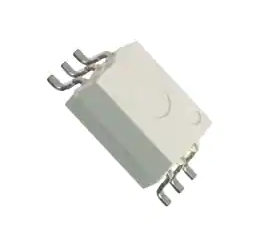
TLP700
TOSHIBA Photocoupler GaAℓAs IRED + Photo IC
Unit: mm
4.58±0.25
Guaranteed performance over temperature: -40 to 100°C
•
Supply current:
2.0 mA (max)
•
Power supply voltage:
15 to 30 V
•
Threshold input current:
IFLH = 5 mA (max)
•
Switching time (tpLH / tpHL):
500 ns (max)
•
Common mode transient immunity:
±15 kV/μs (min)
•
Isolation voltage:
5000 Vrms (min)
•
UL recognized:
UL1577, File No. E67349
•
c-UL approved :
CSA Component Acceptance Service
•
Option (D4) VDE
3
±2.0 A (max)
No. 5A, File No.E67349
approved :
EN60747-5-5 EN60065 EN60950-1(Note 1)
EN62368-1(Pending)
Note 1: When a EN60747-5-5 approved type is needed,
please designate the “Option(D4)”
1.27±0.2
0.4±0.1
9.7±0.3
11-5J1
TOSHIBA
11-5J1
Weight: 0.26 g (t yp .)
Pin Configuration (Top View)
1
6
2
5
3
SHIELD
Truth Table
LED
M1
M2
Output
H
ON
ON
OFF
H
L
OFF
OFF
ON
L
+0.25
1.25±0.25
4
1: ANODE
2: N.C
3: CATHODE
4: GND
5: VO ( OUTPUT )
6: VCC
Schematic
Input
4.0 -0.20
7.62±0.25
-0.05
Peak output current:
•
1 2
0.25 +0.10
•
4
6.8±0.25
TLP700 consists of a GaAℓAs light-emitting diode and an integrated
photodetector. This unit is 6-lead SDIP package. The TLP700 is 50% smaller than
the 8-pin DIP and meets the reinforced insulation class requirements of
international safety standards. Therefore the mounting area can be reduced in
equipment requiring safety standard certification. The TLP700 is suitable for gate
driving circuits for IGBTs or power MOSFETs. In particular, the TLP700 is capable
of “direct” gate driving of low-power IGBTs.
6 5
3.65 +0.15
-0.25
Industrial inverters
Inverter for air conditioners
IGBT/Power MOSFET gate drive
TLP700
1+
ICC
VCC
(M1)
IF
VF
(M2)
3-
6
IO
VO
5
SHIELD
GND
4
Note: A 0.1-μF bypass capacitor must be connected
between pins 6 and 4.
Start of commercial production
2007-08
1
2017-05-24
�TLP700
Absolute Maximum Ratings (Ta = 25 °C)
Characteristics
Symbol
Rating
Unit
IF
20
mA
∆IF/∆Ta
-0.54
mA/°C
IFP
1
A
Forward current
Forward current derating (Ta ≥ 85°C)
LED
Peak transient forward current
(Note 1)
Reverse voltage
VR
5
V
Diode power dissipation
PD
40
mW
∆PD/∆Ta
-1.0
mW/°C
Tj
125
°C
IOPH
-2.0
A
IOPL
2.0
A
Diode power dissipation derating (Ta ≥ 85 °C)
Junction temperature
Detector
“H” peak output current
Ta=-40 to 100 °C
(Note 2)
“L” peak output current
Output voltage
VO
35
V
Supply voltage
VCC
35
V
PC
400
mW
Tj
125
°C
f
50
kHz
Operating temperature range
Topr
-40 to 100
°C
Storage temperature range
Tstg
-55 to 125
°C
Power dissipation
Junction temperature
Operating frequency
(Note 3)
Lead soldering temperature (10 s)
(Note 4)
Tsol
260
°C
Isolation voltage (AC, 60 s, R.H. ≤ 60%)
(Note 5)
BVS
5000
Vrms
Note: Using continuously under heavy loads (e.g. the application of high temperature/current/voltage and the
significant change in temperature, etc.) may cause this product to decrease in the reliability significantly even if
the operating conditions (i.e. operating temperature/current/voltage, etc.) are within the absolute maximum
ratings.
Please design the appropriate reliability upon reviewing the Toshiba Semiconductor Reliability Handbook
(“Handling Precautions”/“Derating Concept and Methods”) and individual reliability data (i.e. reliability test
report and estimated failure rate, etc).
Note:
A ceramic capacitor (0.1 μF) should be connected from pin 6 to pin 4 to stabilize the operation of the high
gain linear amplifier. Failure to provide the bypassing may impair the switching property.
The total lead length between capacitor and coupler should not exceed 1 cm.
Note 1: Pulse width PW ≤ 1 μs, 300 pps
Note 2: Exponential waveform pulse width PW ≤ 0.3 μs, f ≤15 kHz
Note 3: Exponential waveform IOPH ≥ -1.5 A (≤ 0.3 μs), IOPL ≤ +1.5 A (≤ 0.3 μs), Ta=100°C
Note 4: For the effective lead soldering area
Note 5: Device considered a two-terminal device: pins 1, 2 and 3 paired with pins 4, 5 and 6 respectively.
Recommended Operating Conditions
Characteristics
Input current, ON
(Note 1)
Input voltage, OFF
Supply voltage
(Note 2)(Note 3)
Peak output current
Operating temperature
Symbol
Min
Typ.
Max
Unit
IF (ON)
7.5
―
10
mA
VF (OFF)
0
―
0.8
V
VCC
15
―
30
V
IOPH / IOPL
―
―
±1.5
A
Topr
-40
―
100
°C
Note: Recommended operating conditions are given as a design guideline to obtain expected performance of the
device. Additionally, each item is an independent guideline respectively. In developing designs using this
product, please confirm specified characteristics shown in this document.
Note 1: Input signal rise time (fall time) ≤ 0.5 μs.
Note 2: This item denotes operating ranges, not meaning of recommended operating conditions.
Note 3: If the VCC rise slope is sharp, an internal circuit might not operate with stability. Please design the VCC rise
slope under 3.0 V/μs.
2
2017-05-24
�TLP700
Electrical Characteristics (Ta = -40 to 100 °C, unless otherwise specified)
Symbol
Test
Circuit
VF
―
∆VF/∆Ta
Input reverse current
Input capacitance
Characteristics
Forward voltage
Temperature coefficient of forward
voltage
“H” Level
Output current
(Note 1)
“L” Level
“H” Level
Min
Typ.
Max
Unit
IF = 10 mA, Ta = 25 °C
―
1.57
1.75
V
―
IF = 10 mA
―
-1.8
―
mV/°C
IR
―
VR = 5 V, Ta = 25 °C
―
―
10
μA
CT
―
V = 0 V, f = 1 MHz, Ta = 25 °C
―
100
―
pF
1
VCC = 15 V
IF = 5 mA
V6-5 = 3.5 V
―
-1.4
-1.0
V6-5 = 7 V
―
―
-1.5
2
VCC = 15 V
IF = 0 mA
V5-4 = 2.5 V
1.0
1.4
―
V5-4 = 7 V
1.5
―
―
3
VCC1=+15V, VEE1=-15V
RL = 200Ω, IF = 5 mA
11
13.7
―
VCC1=+15V, VEE1=-15V
RL = 200Ω, VF = 0.8 V
―
-14.9
-12.5
IF = 10 mA
―
1.3
2.0
IF = 0 mA
―
1.3
2.0
IOPH1
IOPH2
IOPL1
IOPL2
VOH
Output voltage
Test Condition
A
V
“L” Level
VOL
4
“H” Level
ICCH
5
“L” Level
ICCL
6
VCC = 30 V
VO=Open
Threshold input current
L→H
IFLH
―
VCC = 15 V, VO > 1 V
―
1.8
5
mA
Threshold input voltage
H→L
VFHL
―
VCC = 15 V, VO < 1 V
0.8
―
―
V
VCC
―
15
―
30
V
VUVLO+
―
VO > 2.5V, IF = 5 mA
11.0
12.5
13.5
V
VUVLO-
―
VO < 2.5V, IF = 5 mA
9.5
11.0
12.0
V
UVLOHYS
―
―
1.5
―
V
Supply current
Supply voltage
UVLO thresh hold
UVLO hysteresis
―
―
mA
Note: All typical values are at Ta = 25°C
Note: This product is more sensitive than conventional products to electrostatic discharge (ESD) owing to its low
power consumption design. It is therefore all the more necessary to observe general precautions regarding
ESD when handling this component.
Note 1: Duration of Io time ≤ 50 μs, 1 pulse
Isolation Characteristics (Ta = 25 °C)
Characteristic
Capacitance input to output
Isolation resistance
Symbol
CS
RS
Test Condition
Min
Typ.
Max
Unit
(Note 1)
―
1.0
―
pF
(Note 1)
1×10¹²
1014
―
Ω
5000
―
―
AC, 1 s, in oil
―
10000
―
DC, 60 s, in oil
―
10000
―
Vs = 0 V, f = 1MHz
R.H. ≤ 60 %, VS = 500 V
AC, 60 s
Isolation voltage
Note 1:
BVS
Vrms
Vdc
Device considered a two-terminal device: pins 1, 2 and 3 paired with pins 4, 5 and 6 respectively.
3
2017-05-24
�TLP700
Switching Characteristics (Ta = -40 to 100 °C, unless otherwise specified)
Characteristics
Propagation delay time
Test
Circuit
Symbol
L→H
tpLH
H→L
tpHL
Output rise time (10-90 %)
tr
Output fall time (90-10 %)
tf
Switching time dispersion
between ON and OFF
| tpHL-tpLH |
7
Test Condition
VCC = 30 V
Rg = 20 Ω
Cg = 10 nF
Common mode transient immunity
at HIGH level output
CMH
Common mode transient immunity
at LOW level output
CML
8
Min
Typ.
Max
IF = 0 → 5 mA
50
―
500
IF = 5 → 0 mA
50
―
500
IF = 0 → 5 mA
―
50
―
IF = 5 → 0 mA
―
50
―
IF = 0 ↔ 5 mA
―
―
250
-15
―
―
15
―
―
IF = 5 mA
VCM =1000 Vp-p VO (min) = 26 V
Ta = 25 °C
IF = 0 mA
VCC = 30 V
VO (max) = 1 V
Unit
ns
kV/μs
Note: All typical values are at Ta = 25 °C.
Test Circuit 1: IOPH
1
Test Circuit 2: IOPL
1
6
6
0.1μF
IOPL
A
V6-5
A
IF
IOPH
0.1μF
3
VCC
VCC
3
4
Test Circuit 3: VOH
1
Test Circuit 4: VOL
1
6
0.1μF
IF
RL
V
VOH
3
VCC1
0.1μF
3
VCC1
VEE1
4
Test Circuit 6: ICCL
ICCH
1
A
6
ICCL
A
0.1μF
0.1μF
IF
RL
V
VOL
VEE1
4
6
6
VF
Test Circuit 5: ICCH
1
V5-4
4
VCC
VCC
3
3
4
4
4
2017-05-24
�TLP700
Test Circuit 7: tpLH, tpHL, tr, tf, | tpHL-tpLH |
0.1 μF
(f=25kHz, duty=50%, less than tr=tf=5ns)
6
1
IF
VO
Cg = 10nF
Rg = 20 Ω
3
IF
VCC
tr
VOH
tf
90%
50%
10%
VO
4
tpHL
tpLH
VOL
Test Circuit 8: CMH, CML
IF
1
6
VCM
SW
A
0.1μF
VO
B
tf
• SW A: IF = 5 mA
VO
VCM
+
10%
tr
VCC
4
3
1000 V
90%
-
1V
• SW B: IF = 0 mA
CMH = CML =
CMH
26V
CML
800 V
tf (μs)
800 V
tr (μs)
Note: CML (CMH) is the maximum rate of rise (fall) of the common mode voltage that can be sustained with the output
voltage in the LOW (HIGH) state.
5
2017-05-24
�TLP700
IF - VF
∆VF/∆Ta [mV/°C]
Ta=100°C
10
Coefficient
F o r w a r d C u r r e n t IF [mA]
Ta=-40°C
Ta=25°C
1
0.1
1
1.2
1.4
1.6
1.8
-2.4
-2
-1.6
-1.2
0.1
1
F o r w a r d C u r r e n t IF [mA]
VOL - Ta
VOH - Ta
30
VF=0.8V, RL=200Ω
-20
VCC1=15V, VEE1=-15V
-15
-10
VCC1=7.5V, VEE1=-7.5V
-5
0
-40 -20
0
20
40
60
80
100
25
IF=5mA, RL=200Ω
20
VCC1=15V, VEE1=-15V
15
10
VCC1=7.5V, VEE1=-7.5V
5
0
-40 -20
Ambient Temperature Ta [°C]
0
IF=0mA
VCC=30V
3
2
1
0
-40 -20
0
20
40
40
60
80
100
ICCH - Ta
High level supply current ICCH [mA]
Low level supply current ICCL [mA]
4
20
Ambient Temperature Ta [°C]
ICCL - Ta
5
10
F o r w a r d Vo l t a g e VF [V]
High Level Output Voltage VOH [V]
Low Level Output Voltage VOL [V]
-2.8
2
-30
-25
∆VF/∆Ta - IF
-3.2
100
60
80
100
Ambient Temperature Ta [°C]
5
4
IF=10mA
VCC=30V
3
2
1
0
-40 -20
0
20
40
60
80
100
Ambient Temperature Ta [°C]
6
2017-05-24
�TLP700
Propagation delay time tpHL, tpLH [ns]
500
tpHL, tpLH - VCC
IF=5mA, VCC=30V
Rg=20Ω, Cg=10nF
400
tpHL
300
200
tpLH
100
0
-40 -20
500
0
20
40
60
80
Threshold input current IFLH [mA]
tpHL
100
8
10
12
14
16
18
tpLH
100
0
15
20
25
30
4
VCC=15V, VO>1V
IO=0mA
3
2
1
0
-40 -20
20
0
20
40
60
80
Forward current IF [mA]
Ambient Temperature Ta [°C]
IOPL- Ta
IOPH- Ta
IF=0mA, VCC=15V
4
3
V5-4=7.0V
2
V5-4=2.5V
IOPL
MAX
1
0
-40 -20
200
5
200
5
tpHL
IFLH - Ta
tpLH
6
300
tpHL, tpLH - IF
Rg=20Ω, Cg=10nF
4
Cg=10nF
Supply Voltage VCC [V]
300
0
400
Ambient Temperature Ta [°C]
VCC=30V
400
500 I =5mA
F IF=5mA, Rg=20Ω
100
High Level Peak Output Current IOPH [A]
Low Level Peak Output Current IOPL [A]
Propagation delay time tpHL, tpLH [ns]
Propagation delay time tpHL, tpLH [ns]
tpHL, tpLH - Ta
0
20
40
60
80
100
Ambient Temperature Ta [°C]
0
100
IF=5mA, VCC=15V
V6-5=-3.5V
-1
-2
IOPH
MAX
-3
V6-5=-7.0V
-4
-5
-40 -20
0
20
40
60
80
100
Ambient Temperature Ta [°C]
7
2017-05-24
�TLP700
V5-4 - IOPL
V6-5 - IOPH
6
0
IF=0mA, VCC=15V
Output Voltage V6-5 [V]
Output Voltage V5-4 [V]
7
Ta=100°C
5
Ta=25°C
4
Ta=-40°C
3
2
-2
Ta=-40°C
-3
-4
Ta=100°C
-5
Ta=25°C
-6
1
0
IF=5mA, VCC=15V
-1
0.5
1
1.5
-7
2
Low Level Output Peak Current IOPL [A]
0
-0.5
-1
-1.5
-2
High Level Output Peak Current IOPH [A]
Output Voltage VO(VUVLO)
[V]
VO(VUVLO)** - VCC
14
12
IF=5mA
**Test Circuit : VO(VUVLO) - VCC
UVLOHYS
10
1
8
6
VO
IF
+VUVLO
-VUVLO
6
VCC
4
3
2
0
5
10
15
4
20
Supply Voltage VCC [V]
*: The above graphs show typical characteristics.
8
2017-05-24
�TLP700
Soldering and Storage
(1) Precautions for Soldering
The soldering temperature should be controlled as closely as possible to the conditions shown below, irrespective of
whether a soldering iron or a reflow soldering method is used.
1) When Using Soldering Reflow
The soldering temperature profile is based on the package surface temperature.
(See the figure shown below, which is based on the package surface temperature.)
An example of a temperature profile when Sn-Pb eutectic solder is used:
(°C)
This profile is based on the device’s
maximum heat resistance guaranteed
value.
Set the preheat temperature/heating
temperature to the optimum temperature
corresponding to the solder paste type
used by the customer within the described
profile.
An example of a temperature profile when lead(Pb)-free solder is used:
(°C)
This profile is based on the device’s
maximum heat resistance guaranteed
value.
Set the preheat temperature/heating
temperature to the optimum temperature
corresponding to the solder paste type
used by the customer within the described
profile.
Reflow soldering must be performed once or twice.
The mounting should be completed with the interval from the first to the last mountings being 2 weeks.
2) When using soldering Flow (Applicable to both eutectic solder and Lead(Pb)-Free solder)
Apply preheating of 150 °C (package surface temperature) for 60 to 120 seconds.
Mounting condition of 260 °C or less within 10 seconds is recommended.
Flow soldering must be performed once
3) When using soldering Iron (Applicable to both eutectic solder and Lead(Pb)-Free solder)
Complete soldering within 10 seconds for lead temperature not exceeding 260 °C or within 3 seconds
not exceeding 350 °C.
Heating by soldering iron must be only once per 1 lead
9
2017-05-24
�TLP700
(2) Precautions for General Storage
1) Do not store devices at any place where they will be exposed to moisture or direct sunlight.
2) When transportation or storage of devices, follow the cautions indicated on the carton box.
3) The storage area temperature should be kept within a temperature range of 5 °C to 35 °C,
and relative humidity should be maintained at between 45% and 75%.
4) Do not store devices in the presence of harmful (especially corrosive) gases, or in dusty conditions.
5) Use storage areas where there is minimal temperature fluctuation. Because rapid temperature
changes can cause condensation to occur on stored devices, resulting in lead oxidation or corrosion,
as a result, the solderability of the leads will be degraded.
6) When repacking devices, use anti-static containers.
7) Do not apply any external force or load directly to devices while they are in storage.
8) If devices have been stored for more than two years, even though the above conditions have been
followed, it is recommended that solderability of them should be tested before they are used.
10
2017-05-24
�TLP700
Embossed-Tape Packing (TP) Specifications for SDIP6 Type Photocouplers
1. Applicable Package
Package Name
Product Type
SDIP6
Photocouplers
2. Product Naming System
Type of package used for shipment is denoted by a symbol suffix after a product number. The method of
classification is as below.
(Example)
TLP700 (TP, F)
[[G]]/RoHS COMPATIBLE
(Note 1)
Tape type
Device name
Note 1: Please contact your TOSHIBA sales representative for details as to environmental matters such as the RoHS
compatibility of Product.
RoHS is the Directive 2011/65/EU of the European Parliament and of the Council of 8 June 2011 on the
restriction of the use of certain hazardous substances in electrical and electronic equipment.
3. Tape Dimensions
3.1
Orientation of Devices in Relation to Direction of Tape Movement
Device orientation in the recesses is as shown in Figure 1.
Tape feed
Figure 1
Device Orientation
3.2
Tape Packing Quantity: 1500 devices per reel
3.3
Empty Device Recesses Are as Shown in Table 1.
Table 1
Empty Device Recesses
Standard
Occurrences of 2 or more
successive empty device
recesses
Single empty device
recesses
3.4
0 device
6 devices (max) per reel
Remarks
Within any given 40-mm section of
tape, not including leader and trailer
Not including leader and trailer
Start and End of Tape:
The start of the tape has 30 or more empty holes. The end of the tape has 30 or more empty holes and
two empty turns only for a cover tape.
11
2017-05-24
�TLP700
2.0 ± 0.1
G
F
K0
φ1.6 ± 0.1
16.0 ± 0.3
+0.1
0.4 ± 0.05 φ1.5 -0
E
Tape material: Plastic (protection against electrostatics)
Dimensions: The tape dimensions are as shown in Figure 2 and Table 2.
D
(1)
(2)
Tape Specification
B
3.5
A
4.55 ± 0.2
Figure 2
Tape Forms
Table 2 Tape Dimension
Unit: mm
Unless otherwise specified: ±0.1
Symbol
Dimension
Remark
A
10.4
B
5.1
D
7.5
Center line of indented square hole and sprocket hole
E
1.75
Distance between tape edge and hole center
F
12.0
G
4.0
Cumulative error +0.1 per 10 feed holes
-0.3
+0.1
Cumulative error -0.3 per 10 feed holes
K0
4.1
Internal space
12
2017-05-24
�TLP700
3.6
Reel
(1)
(2)
Material: Plastic
Dimensions: The reel dimensions are as shown in Figure 3 and Table 3.
Table 3
Reel Dimension
A
C
U
B
Unit: mm
E
記 号
寸 法
A
φ380 ± 2
B
φ80 ± 1
C
φ13 ± 0.5
E
2.0 ± 0.5
U
4.0 ± 0.5
W1
17.5 ± 0.5
W2
21.5 ± 1.0
W1
W2
Figure 3
Reel Forms
4. Packing
Either one reel or five reels of photocouplers are packed in a shipping carton.
5. Label Indication
The carton bears a label indicating the product number, the symbol representing classification of standard, the
quantity, the lot number and the Toshiba company name.
6. Ordering Method
When placing an order, please specify the product number, the tape type and the quantity as shown in the
following example.
(Example)
TLP700 (TP, F) 1500 pcs
Quantity (must be a multiple of 1500)
[[G]]/RoHS COMPATIBLE
(Note 1)
Tape type
Device name
Note 1: Please contact your TOSHIBA sales representative for details as to environmental matters such as the RoHS
compatibility of Product.
RoHS is the Directive 2011/65/EU of the European Parliament and of the Council of 8 June 2011 on the
restriction of the use of certain hazardous substances in electrical and electronic equipment.
13
2017-05-24
�TLP700
EN60747-5-5 Option (D4) Specification
Types
: TLP700
Type designations for “option: (D4)”, which are tested under EN60747 requirements.
Ex.: TLP700 (D4-TP,F)
D4 : EN60747 option
TP : Standard tape & reel type
F : [[G]]/RoHS COMPATIBLE (Note 1)
Note: Use TOSHIBA standard type number for safety standard application.
Ex.: TLP700 (D4-TP,F) → TLP700
Note 1: Please contact your TOSHIBA sales representative for details as to environmental matters such as the RoHS
compatibility of Product.
RoHS is the Directive 2011/65/EU of the European Parliament and of the Council of 8 June 2011 on the
restriction of the use of certain hazardous substances in electrical and electronic equipment.
EN60747 Isolation Characteristics
Description
Symbol
Rating
Unit
Application classification
for rated mains voltage ≤ 300Vrms
for rated mains voltage ≤ 600Vrms
Climatic classification
Pollution degree
TLPxxx type
Maximum operating insulation voltage
TLPxxxFtype
VIORM
TLPxxx type
Input to output test voltage, method A
Vpr=1.6 × VIORM, type and sample test
tp=10 s, partial discharge










 工商网监
湘ICP备2023018690号
工商网监
湘ICP备2023018690号