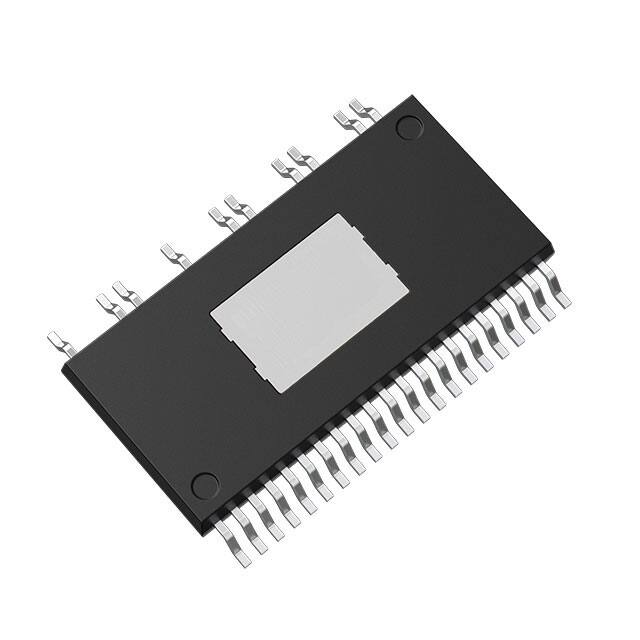
TPD4162F
Intelligent Power Device
TPD4162F
High Voltage Monolithic Silicon Power IC
1. Description
The TPD4162F is a DC brushless motor driver using high-voltage PWM
control. It is fabricated using a high-voltage SOI process. The device
contains PWM circuit, 3-phase decode circuit, level shift high-side
driver, low-side driver, IGBT outputs, FRDs, over-current, and current
limit and under-voltage protection circuits, and a thermal shutdown
circuit. It is easy to control a DC brushless motor by applying a signal
from a motor controller and a Hall element / Hall IC to the TPD4162F.
P-HSSOP31-0918-0.80-002
TPD4162F
2. Applications
DC brushless motor driver IC
3. Features
●
●
●
●
●
●
High voltage power side and low voltage signal side terminal are separated.
Bootstrap circuits give simple high-side supply.
Bootstrap diodes are built in.
PWM and 3-phase decode circuit are built in.
Pulses-per-revolution output:
FGC = High: 3 pulse/electrical angle: 360°
FGC = Low : 1 pulse/electrical angle: 360°
Included over-current and current limit and under-voltage protection, and thermal shutdown.
Start of commercial production
2019-10
© 2020
Toshiba Electronic Devices & Storage Corporation
1
2020-02-20
�TPD4162F
4. Block Diagram
Figure 4.1 Block Diagram
5. Pin Assignments
Figure 5.1 Pin Assignments
© 2020
Toshiba Electronic Devices & Storage Corporation
2
2020-02-20
�TPD4162F
6. Pin Description
Table 6.1
Pin Description
Pin No.
Symbol
Pin Description
1
VBB
High-voltage power supply input pin.
2
BSU
U-phase bootstrap capacitor connecting pin.
3
U
4
IS1
IGBT emitter/FRD anode pin.
5
BSV
V-phase bootstrap capacitor connecting pin.
U-phase output pin.
6
V
7
BSW
V-phase output pin.
8
W
W-phase output pin.
9
NC
Unused pin, which is not connected to the chip internally.
10
IS2
IGBT emitter/FRD anode pin.
11
GND
12
NC
Unused pin, which is not connected to the chip internally.
13
NC
Unused pin, which is not connected to the chip internally.
14
HW-
W-phase Hall element signal input pin. (Hall IC can be used.)
15
HW+
W-phase Hall element signal input pin. (Hall IC can be used.)
16
HV-
V-phase Hall element signal input pin. (Hall IC can be used.)
17
HV+
V-phase Hall element signal input pin. (Hall IC can be used.)
18
HU-
U-phase Hall element signal input pin. (Hall IC can be used.)
19
HU+
U-phase Hall element signal input pin. (Hall IC can be used.)
20
VREG
5 V regulator output pin.
21
CS
W-phase bootstrap capacitor connecting pin.
Ground pin.
Over-current protection detection pin
22
OS
23
RREF
24
NC
PWM triangular wave oscillation frequency setup pin.
(Connect a capacitor to this pin.)
PWM triangular wave oscillation frequency setup pin.
(Connect a resistor to this pin.)
Unused pin, which is not connected to the chip internally.
25
RS
Input for current limit and over-current protection detection pin
26
FGC
27
VS
Speed control signal input pin. (PWM reference voltage input pin.)
28
FG
Revolution pulse output pin.
29
VCC
Control power supply pin.
30
NC
Unused pin, which is not connected to the chip internally.
31
GND
FG pulse count select (High or open = 3 ppr; Low = 1 ppr).
Ground pin.
© 2020
Toshiba Electronic Devices & Storage Corporation
3
2020-02-20
�TPD4162F
7. Functional Description
7.1.1. Timing Chart
HU
HV
Hall amp
input
HW
VU
Output voltage
VV
VW
Revolution pulse
(FGC=H)
FG
Revolution pulse
(FGC=L)
FG
Figure7.1.1 Timing Chart
Note: Hall amp input logic high (H) refers to H*+>H*-. (*: U/V/W)
© 2020
Toshiba Electronic Devices & Storage Corporation
4
2020-02-20
�TPD4162F
7.1.2. Truth Table
Table 7.1.2 Truth Table
FGC
Hall amp Input
U Phase
V Phase
W Phase
FG
HU
HV
HW
High side
Low side
High side
Low side
High side
Low side
H
H
L
H
OFF
ON
ON
OFF
OFF
OFF
H
H
H
L
L
OFF
ON
OFF
OFF
ON
OFF
L
H
H
H
L
OFF
OFF
OFF
ON
ON
OFF
H
H
L
H
L
ON
OFF
OFF
ON
OFF
OFF
L
H
L
H
H
ON
OFF
OFF
OFF
OFF
ON
H
H
L
L
H
OFF
OFF
ON
OFF
OFF
ON
L
H
L
L
L
OFF
OFF
OFF
OFF
OFF
OFF
L
H
H
H
H
OFF
OFF
OFF
OFF
OFF
OFF
L
L
H
L
H
OFF
ON
ON
OFF
OFF
OFF
H
L
H
L
L
OFF
ON
OFF
OFF
ON
OFF
H
L
H
H
L
OFF
OFF
OFF
ON
ON
OFF
H
L
L
H
L
ON
OFF
OFF
ON
OFF
OFF
L
L
L
H
H
ON
OFF
OFF
OFF
OFF
ON
L
L
L
L
H
OFF
OFF
ON
OFF
OFF
ON
L
L
L
L
L
OFF
OFF
OFF
OFF
OFF
OFF
L
L
H
H
H
OFF
OFF
OFF
OFF
OFF
OFF
H
Note: Hall amp input logic high (H) refers to H*+>H*-. (*: U/V/W)
7.2. Handling precautions
(1) When switching the power supply to the circuit on/off, ensure that VS < VVSOFF (all IGBT outputs off). At
that time, either the VCC or the VBB can be turned on/off first. Note that if the power supply is switched off
as described above, the IC may be destroyed if the current regeneration route to the VBB power supply is
blocked when the VBB line is disconnected by a relay or similar while the motor is still running.
(2) The triangular wave oscillator circuit, with externally connected C5 and R3, charges and discharges minute
amounts of current. Therefore, subjecting the IC to noise when mounting it on the board may distort the
triangular wave or cause malfunction. To avoid this, attach external parts to the base of the IC leads or
isolate them from any tracks or wiring which carries large current.
(3) The PWM of this IC is controlled by the on/off state of the high-side IGBT.
(4) If a motor is locked where VBB voltage is low and duty is 100 %, it may not be possible to reboot after the
load is released as a result of the high side being ON immediately prior to the motor being locked. This is
because, over time, the bootstrap voltage falls, the high-side voltage decrease protection operates and the
high-side output becomes OFF. In this case, since the level shift pulse necessary to turn the high side ON
cannot be generated, reboot is not possible. A level shift pulse is generated by either the edge of a Hall
sensor output or the edge of an internal PWM signal, but neither edge is available due to the motor lock
and duty 100 % command. In order to reboot after a lock, the high-side power voltage must return to a
level 0.5 V (typ.) higher than the voltage decrease protection level, and a high-side input signal must be
introduced. As a high-side input signal is created by the aforementioned level shift pulse, it is possible to
reboot by reducing PWM duty to less than 100 % or by forcing the motor to turn externally and creating an
edge at a Hall sensor output. In order to ensure reboot after a system lock, the maximum duty of motor
operation must be less than 100 %.
© 2020
Toshiba Electronic Devices & Storage Corporation
5
2020-02-20
�TPD4162F
7.3. Description of Protection Function
(1)
Current limit protection
The IC incorporates a current limit protection circuit to protect itself against over current at startup or
when a motor is locked. This protection function detects voltage generated in the current-detection
resistor connected to the RS pin. When this voltage exceeds VR = 0.5 V (typ.), the high-side IGBT output,
which is on, temporarily shuts down after a delay time, preventing any additional current from flowing to
the IC. The next PWM ON signal releases the shutdown state.
Duty ON
PWM reference voltage
Duty OFF
Triangle wave
Delay time
toff
ton
ton
Current limit setting value
Output current
Retry
Over-current shutdown
Figure7.3.1 Description of Current limit protection
(2) Over-current protection
This protection function detects voltage generated in the current-detection resistor connected to the RS
pin. When this voltage exceeds VR = 0.7 V (typ.), the all high-side and low-side IGBT outputs are shut down.
Over-current protection recovery time can be adjusted with the capacitor and resistance connected to CS
terminal. The CS terminal voltage is carried out by the damping time constant decided by this capacitor
and resistance. The low side IGBT of the phase which a high side turns on by a timing chart will be made
to turn on, a bootstrap capacitor will be charged, if the threshold value 1(VRON) is exceeded (refreshment
operation), and the threshold value 2(VROFF) is exceeded after that, IGBT turns on according to an input
signal.
CS terminal Voltage
Threshold value 2(VROFF)
Threshold value 1(VRON)
Refreshment operation
tcs
tcsr
Over-current setting value
Output current
Retry
Over-current shutdown
Figure7.3.2 Description of Over-current protection
© 2020
Toshiba Electronic Devices & Storage Corporation
6
2020-02-20
�TPD4162F
(3) Under-voltage protection
The IC incorporates under-voltage protection circuits to prevent the IGBT from operating in unsaturated
mode when the VCC voltage or the VBS voltage drops.
When the VCC power supply falls to the IC internal setting VCCUVD = 11 V (typ.), all IGBT outputs are shut
down regardless of the input. This protection function has hysteresis. When the VCC power supply reaches
0.5 V higher than the shutdown voltage VCCUVR = 11.5 V (typ.), the IC is automatically restored and the
IGBT is turned on/off again by the input.
When the VBS supply voltage drops VBSUVD = 3.0 V (typ.), the high-side IGBT output shuts down. When
he VBS supply voltage reaches 0.5 V higher than the shutdown voltage VBSUVR = 3.5 V (typ.) VBS supply
voltage reaches 0.5 V higher than the shutdown voltage VBSUVR = 3.5 V (typ.), the IGBT is turned on/off
again by the input signal.
(4) Thermal shutdown
The IC incorporates a thermal shutdown circuit to protect itself against excessive rise in temperature.
When the temperature of this chip rises to the internal setting TSD due to external causes or internal heat
generation, all IGBT outputs are shut down regardless of the input. This protection function has hysteresis
∆TSD = 50 °C (typ.). When the chip temperature falls to TSD − ∆TSD, the chip is automatically restored
and the IGBT is turned on/off again by the input.
Because the chip contains just one temperature-detection location, when the chip heats up due to the IGBT
for example, the distance between the detection location and the IGBT (the source of the heat) can cause
differences in the time taken for shutdown to occur. Therefore, the temperature of the chip may rise higher
than the thermal shutdown temperature.
7.4. Description of Bootstrap Capacitor Charging and Its Capacitance
The IC uses bootstrapping for the power supply for high-side drivers.
The bootstrap capacitor is charged by turning on the low-side IGBT of the same arm (approximately 1/5 of
PWM cycle) while the high-side IGBT controlled by PWM is off. For example, to drive at 20 kHz, it takes
approximately 10 μs per cycle to charge the capacitor. When the VS voltage exceeds 3.8 V (55 % duty),
the low-side IGBT is continuously in the off state. This is because when the PWM on-duty becomes larger,
the arm is short-circuited while the low-side IGBT is on. Even in this state, because PWM control is being
performed on the high-side IGBT, the regenerative current of the diode flows to the low-side FRD of the
same arm, and the bootstrap capacitor is charged. Note that when the on-duty is 100 %, diode regenerative
current does not flow; thus, the bootstrap capacitor is not charged.
When driving a motor at 100 % duty cycle, take the voltage drop at 100 % duty (see the figure below) into
consideration to determine the capacitance of the bootstrap capacitor.
Capacitance of the bootstrap capacitor = Current dissipation (max) of the high-side driver × Maximum drive
time /(VCC − VF (BSD) + VF (FRD) − 13.5) [F]
VF (BSD) : Bootstrap diode forward voltage
VF (FRD) : Fast recovery diode forward voltage
Consideration must be made for aging and temperature change of the capacitor.
Duty cycle 100 % (VS: 5.4 V)
Duty cycle 80 %
C
Triangular wave
Duty cycle 55 % (VS: 3.8 V)
PWM reference voltage
B
Duty cycle 0 % (VS: 2.1 V)
VVsOFF (VS: 1.3 V)
Low-side ON
High-side duty ON
A
GND
VS Range
IGBT Operation
A
Both high and low-side OFF.
B
Charging range. Low-side IGBT refreshing on the phase the high-side IGBT in PWM.
C
No charging range. High-side at PWM according to the timing chart. Low-side no refreshing.
© 2020
Toshiba Electronic Devices & Storage Corporation
7
2020-02-20
�TPD4162F
8. Absolute Maximum Ratings
Table 8.1
Absolute Maximum Ratings
(Ta = 25°C unless otherwise specified)
Characteristics
Symbol
Rating
Unit
VBB
600
V
VCC
20
V
Output current (DC)
Iout
0.7
A
Output current (pulse)
Ioutp
1.2
A
Input voltage (except VS)
VIN
-0.5 to VREG + 0.5
V
Input voltage (only VS)
VVS
8.2
V
VREG current
IREG
50
mA
FG voltage
VFG
6
V
FG current
IFG
20
mA
Power dissipation (Tc = 25°C)
PC
20
W
Operating junction temperature
Power supply voltage
Tjopr
-40 to 135
°C
Junction temperature
Tj
150
°C
Storage temperature
Tstg
-55 to 150
°C
Note: Using continuously under heavy loads (e.g. the application of high temperature/current/voltage and the significant
change in temperature, etc.) may cause this product to decrease in the reliability significantly even if the operating
conditions (i.e. operating temperature/current/voltage, etc.) are within the absolute maximum ratings and the
operating ranges.
Please design the appropriate reliability upon reviewing the Toshiba Semiconductor Reliability Handbook
(“Handling Precautions”/“Derating Concept and Methods“) and individual reliability data (i.e. reliability test report
and estimated failure rate, etc).
8.1. Safe Operating Area
Peak winding current
(A)
0.7
0
0
450
Power supply voltage VBB (V)
Figure8.1 SOA at Tj = 135 °C
© 2020
Toshiba Electronic Devices & Storage Corporation
8
2020-02-20
�TPD4162F
9. Operating Ranges
Table 9.1 Operating Ranges(Ta=25 ℃)
Characteristics
Operating power supply voltage
Symbol
Test Condition
Min
Typ.
Max
VBB
50
280
450
VCC
13.5
15
17.5
Unit
V
10. Electrical Characteristics
Electrical Characteristics(Ta=25 ℃)
Table 10.1
Characteristics
Current dissipation
Symbol
Test Condition
Min
Typ.
Max
IBB
VBB = 450 V, Duty cycle = 0 %
0.5
ICC
VCC = 15 V, Duty cycle = 0 %
0.9
1.5
IBS (ON)
VBS = 15 V, high side ON
85
150
IBS (OFF)
VBS = 15 V, high side OFF
75
130
Unit
mA
µA
VHSENS(HA)
―
50
―
―
mVp-p
IHB(HA)
―
-2
0
2
µA
CMVIN(HA)
―
0.7
VREG-1.3
V
Hall amp hysteresis width
∆VIN(HA)
―
8
30
62
Hall amp input voltage L→H
VLH(HA)
―
4
15
31
Hall amp input voltage H→L
VHL(HA)
―
-31
-15
-4
Hall amp input sensitivity
Hall amp input current
Hall amp common input voltage
Output saturation voltage
VCEsat
FRD forward voltage
PWM ON-duty cycle
PWM ON-duty cycle, 0 %
VF
2.0
3.0
V
IF = 0.5 A
1.5
3.0
V
―
0
PWMMAX
―
100
PWM = 0 %
1.7
2.1
2.5
V
PWM = 100 %
4.9
5.4
6.1
V
VVS100 % − VVS0 %
2.8
3.3
3.8
V
Output all OFF
1.1
1.3
1.5
V
VCC = 15 V, IREG = 30 mA
4.5
5.0
5.5
V
VVS0 %
VVS100 %
PWM ON-duty voltage range
VVSW
Regulator voltage
VCC = 15 V, Ioutp = 0.5 A
PWMMIN
PWM ON-duty cycle, 100 %
Output all-OFF voltage
mV
VVSOFF
VREG
Speed control voltage range
VS
FG output saturation voltage
VFGsat
―
VCC = 15 V, IFG = 5 mA
%
0
6.5
V
0.5
V
Current limit voltage
VR
―
0.46
0.5
0.54
V
Current limit delay time
DtR
3
4.5
µs
Over-current protection voltage
VCS
0.64
0.7
0.76
V
Over-current protection delay time
tCS
2.2
3.5
µs
Over-current protection recovery time
tcsr
1.0
2.0
ms
Thermal shutdown temperature
TSD
135
185
°C
C4=470 pF , R2=2 MΩ
Thermal shutdown hysteresis
∆TSD
―
50
°C
VCC under-voltage protection
VCCUVD
―
10
11
12
V
VCC under-voltage protection
recovery
VCCUVR
―
10.5
11.5
12.5
V
© 2020
Toshiba Electronic Devices & Storage Corporation
9
2020-02-20
�TPD4162F
VBS under-voltage protection
VBSUVD
―
2.0
3.0
4.0
V
VBS under-voltage protection
recovery
VBSUVR
―
2.5
3.5
4.5
V
Refresh operating ON voltage
VRFON
Refresh operation ON
1.1
1.3
1.5
V
Refresh operating OFF voltage
VRFOFF
Refresh operation OFF
3.1
3.8
4.6
V
16.5
20
25
kHz
Triangular wave frequency
fc
R3 = 27 kΩ, C5 = 1000 pF
Output-on delay time
ton
VBB = 280 V, VCC = 15 V, Ioutp = 0.5 A
2.5
3.5
µs
Output-off delay time
toff
VBB = 280 V, VCC = 15 V, Ioutp = 0.5 A
2.0
3.0
µs
FRD reverse recovery time
trr
VBB = 280 V, VCC = 15 V, Ioutp = 0.5 A
200
ns
11. Application Circuit Example
Figure 11.1
© 2020
Toshiba Electronic Devices & Storage Corporation
Application Circuit Example
10
2020-02-20
�TPD4162F
Typical external parts are shown in the following table.
Table 11.1 Typical external parts
Part
Typical
C1, C2, C3
25 V/2.2 μF
R1
1 Ω ± 1 % (1 W)
R2
Purpose
Remarks
Bootstrap capacitor
(Note 1)
Current detection
(Note 2)
2 MΩ± 5 %
Over-current
protection recovery setup
(Note 3)
C4
25 V / 470 pF
Over-current
protection recovery setup
(Note 3)
C5
25 V/1000 pF ± 5 %
PWM frequency setup
(Note 4)
R3
27 kΩ ± 5 %
PWM frequency setup
(Note 4)
C6
25 V/10 μF
C7
25 V/0.1 μF
Control power supply stability
(Note 5)
C8
25 V/10 μF
C9
25 V/0.1 μF
VREG power supply stability
(Note 5)
R4
5.1 kΩ± 5 %
FG pin pull-up resistor
(Note 6)
Note 1: The required bootstrap capacitance value varies according to the motor drive conditions.
Although the IC can operate at above the VBS undervoltage level, it is however recommended that
the capacitor voltage be greater than or equal to 3.5 V to keep the power dissipation small.
Note 2: The following formula shows the detection current: IO = VR ÷ R1 (at VR = 0.5 V (typ.))
Do not exceed a detection current of 0.7 A when using the IC.
Note 3: A setup of over-current protection recovery and the refreshment operating time at the time of a
return are set up in the combination of C4 and R2 which were shown in the formula.
And recommends a setup of C4 and R2 from which refreshment operating time is set to 190 μs or
more. If the CS pin is not used, connect to the VREG pin.
Over-current protection recovery time =1.06×C4×R2 [s]
Refreshment operating time =0.21×C4×R2 [s]
Note 4: With the combination of C5 and R3 shown in the table, the PWM frequency is around 20 kHz. The
IC intrinsic error factor is around 10 %.
The PWM frequency is broadly expressed by the following formula. (In this case, the stray
capacitance of the printed circuit board needs to be considered.)
fc = 0.65 ÷ { C5 × (R3 + 4.25 kΩ)} [Hz]
R3 creates the reference current of the PWM triangular wave charge/discharge circuit. If R3 is set
too small it exceeds the current capacity of the IC internal circuits and the triangular wave distorts.
Set R3 to at least 9 kΩ.
Note 5: When using the IC, adjustment is required in accordance with the use environment. When
mounting, place as close to the base of the IC leads as possible to improve noise elimination.
Note 6: The FG pin is open drain. If the FG pin is not used, connect to the GND.
Note 7: If noise is detected on the Input signal pin, add a capacitor between inputs.
Note 8: A Hall device should be an indium antimony system. It is recommend that the peak Hall device
voltage be set more than 300 mV
© 2020
Toshiba Electronic Devices & Storage Corporation
11
2020-02-20
�TPD4162F
12. Internal circuit diagrams
Internal circuit diagram of HU+, HU-, HV+, HV-, HW+, HW- input pins
Internal circuit diagram of VS pin
Internal circuit diagram of FG pin
Internal circuit diagram of FGC pin
Internal circuit diagram of RS pin
© 2020
Toshiba Electronic Devices & Storage Corporation
12
2020-02-20
�TPD4162F
13. Package Information
13.1. Package Dimensions
P-HSSOP31-0918-0.80-002
Unit:mm
Detailed illustration of Part F.
Note)
1. *1, *2: Does not include leftover resin.
2. *3: Does not include leftover tiebar.
Weight: 0.7 g (typ.)
Figure 13.1 Package Dimensions
© 2020
Toshiba Electronic Devices & Storage Corporation
13
2020-02-20
�TPD4162F
13.2. Marking
Figure 13.2 Marking
© 2020
Toshiba Electronic Devices & Storage Corporation
14
2020-02-20
�TPD4162F
RESTRICTIONS ON PRODUCT USE
Toshiba Corporation and its subsidiaries and affiliates are collectively referred to as “TOSHIBA”.
Hardware, software and systems described in this document are collectively referred to as “Product”.
• TOSHIBA reserves the right to make changes to the information in this document and related Product without notice.
• This document and any information herein may not be reproduced without prior written permission from TOSHIBA. Even with TOSHIBA's
written permission, reproduction is permissible only if reproduction is without alteration/omission.
• Though TOSHIBA works continually to improve Product's quality and reliability, Product can malfunction or fail. Customers are responsible for
complying with safety standards and for providing adequate designs and safeguards for their hardware, software and systems which
minimize risk and avoid situations in which a malfunction or failure of Product could cause loss of human life, bodily injury or damage to
property, including data loss or corruption. Before customers use the Product, create designs including the Product, or incorporate the
Product into their own applications, customers must also refer to and comply with (a) the latest versions of all relevant TOSHIBA information,
including without limitation, this document, the specifications, the data sheets and application notes for Product and the precautions and
conditions set forth in the "TOSHIBA Semiconductor Reliability Handbook" and (b) the instructions for the application with which the Product
will be used with or for. Customers are solely responsible for all aspects of their own product design or applications, including but not limited
to (a) determining the appropriateness of the use of this Product in such design or applications; (b) evaluating and determining the
applicability of any information contained in this document, or in charts, diagrams, programs, algorithms, sample application circuits, or any
other referenced documents; and (c) validating all operating parameters for such designs and applications. TOSHIBA ASSUMES NO
LIABILITY FOR CUSTOMERS' PRODUCT DESIGN OR APPLICATIONS.
• PRODUCT IS NEITHER INTENDED NOR WARRANTED FOR USE IN EQUIPMENTS OR SYSTEMS THAT REQUIRE
EXTRAORDINARILY HIGH LEVELS OF QUALITY AND/OR RELIABILITY, AND/OR A MALFUNCTION OR FAILURE OF WHICH MAY
CAUSE LOSS OF HUMAN LIFE, BODILY INJURY, SERIOUS PROPERTY DAMAGE AND/OR SERIOUS PUBLIC IMPACT
("UNINTENDED USE"). Except for specific applications as expressly stated in this document, Unintended Use includes, without limitation,
equipment used in nuclear facilities, equipment used in the aerospace industry, and lifesaving and/or life supporting medical equipment. IF
YOU USE PRODUCT FOR UNINTENDED USE, TOSHIBA ASSUMES NO LIABILITY FOR PRODUCT. For details, please contact your
TOSHIBA sales representative or contact us via our website.
• Do not disassemble, analyze, reverse-engineer, alter, modify, translate or copy Product, whether in whole or in part.
• Product shall not be used for or incorporated into any products or systems whose manufacture, use, or sale is prohibited under any
applicable laws or regulations.
• The information contained herein is presented only as guidance for Product use. No responsibility is assumed by TOSHIBA for any
infringement of patents or any other intellectual property rights of third parties that may result from the use of Product. No license to any
intellectual property right is granted by this document, whether express or implied, by estoppel or otherwise.
• ABSENT A WRITTEN SIGNED AGREEMENT, EXCEPT AS PROVIDED IN THE RELEVANT TERMS AND CONDITIONS OF SALE FOR
PRODUCT, AND TO THE MAXIMUM EXTENT ALLOWABLE BY LAW, TOSHIBA (1) ASSUMES NO LIABILITY WHATSOEVER,
INCLUDING WITHOUT LIMITATION, INDIRECT, CONSEQUENTIAL, SPECIAL, OR INCIDENTAL DAMAGES OR LOSS, INCLUDING
WITHOUT LIMITATION, LOSS OF PROFITS, LOSS OF OPPORTUNITIES, BUSINESS INTERRUPTION AND LOSS OF DATA, AND (2)
DISCLAIMS ANY AND ALL EXPRESS OR IMPLIED WARRANTIES AND CONDITIONS RELATED TO SALE, USE OF PRODUCT, OR
INFORMATION, INCLUDING WARRANTIES OR CONDITIONS OF MERCHANTABILITY, FITNESS FOR A PARTICULAR PURPOSE,
ACCURACY OF INFORMATION, OR NONINFRINGEMENT.
• Do not use or otherwise make available Product or related software or technology for any military purposes, including without limitation, for
the design, development, use, stockpiling or manufacturing of nuclear, chemical, or biological weapons or missile technology products (mass
destruction weapons). Product and related software and technology may be controlled under the applicable export laws and regulations
including, without limitation, the Japanese Foreign Exchange and Foreign Trade Law and the U.S. Export Administration Regulations. Export
and re-export of Product or related software or technology are strictly prohibited except in compliance with all applicable export laws and
regulations.
• Please contact your TOSHIBA sales representative for details as to environmental matters such as the RoHS compatibility of Product. Please
use Product in compliance with all applicable laws and regulations that regulate the inclusion or use of controlled substances, including
without limitation, the EU RoHS Directive. TOSHIBA ASSUMES NO LIABILITY FOR DAMAGES OR LOSSES OCCURRING AS A RESULT
OF NONCOMPLIANCE WITH APPLICABLE LAWS AND REGULATIONS.
https://toshiba.semicon-storage.com/
© 2020
Toshiba Electronic Devices & Storage Corporation
15
2020-02-20
�