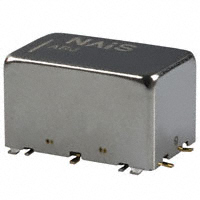
Microwave Devices
RJ RELAYS
Product Catalog
2022.4
�Microwave Devices
RJ
RELAYS
8 GHz max. capable, 1 W carrying power ( at 5 GHz ), 50 Ω impedance and 2 Form C relays
FEATURES
Protective construction:Sealed type
Excellent high frequency characteristics (50 Ω, up to
5 GHz)
Surface-mount type also available
Small size:
9(W) × 14(L) × 8.2 (H) mm
9
14
8.2
9
14
TYPICAL APPLICATIONS
8.2
Communication and measurement equipment
Medical instrument equipment
Note: �If you consider using applications with low level loads or with high frequency
switching, please consult us.
(Unit:mm)
HIGH FREQUENCY CHARACTERISTICS
50 Ω (Initial)
Frequency
Up to 5 GHz
V.S.W.R. (Max.)
1.25
Insertion loss (dB, Max.)
0.5*
Isolation (dB, Min.)
Between open contacts
35
Between contact sets
30
*Not included PC board loss
ORDERING INFORMATION (PART NO.)
ARJ 2
Operating function
0:Single side stable
2:2 coil latching
Contact arrangement
2:2 Form C
Rated coil voltage(DC)
03:3V, 4H:4.5V,
12:12V, 24:24V
(H=0.5)
Terminal shape
Nil :Standard PC board terminal
A :Surface-mount terminal
Packing style
Nil:Carton packing
X :Tape and reel packing
(picked from 1/2/3-pin side)
Z :Tape and reel packing
(picked from 6/7/8-pin side)
Note:Packing style symbol“X”,“Z”is not marked on the relay.
Panasonic Industry Co., Ltd. Electromechanical Control Business Division
industrial.panasonic.com/ac/e/
ー1ー
Panasonic Industry Co., Ltd. 2022
ASCTB105E 202204
�Microwave Devices RJ RELAYS
TYPES
PC board terminal
Carton packing
Contact arrangement
2 Form C
Rated coil voltage
Part No.
Standard packing
Single side stable
2 coil latching
3 V DC
ARJ2003
ARJ2203
4.5 V DC
ARJ204H
ARJ224H
12 V DC
ARJ2012
ARJ2212
24 V DC
ARJ2024
ARJ2224
Inner carton
Outer carton
50 pcs.
500 pcs.
Surface mount terminal
Carton packing
Contact arrangement
2 Form C
Rated coil voltage
Part No.
Standard packing
2 coil latching
Single side stable
3 V DC
ARJ20A03
ARJ22A03
4.5 V DC
ARJ20A4H
ARJ22A4H
12 V DC
ARJ20A12
ARJ22A12
24 V DC
ARJ20A24
ARJ22A24
Inner carton
Outer carton
50 pcs.
500 pcs.
Tape and reel packing Z
Part No.
Contact arrangement
2 Form C
Rated coil voltage
Standard packing
Single side stable
2 coil latching
3 V DC
ARJ20A03Z
ARJ22A03Z
4.5 V DC
ARJ20A4HZ
ARJ22A4HZ
12 V DC
ARJ20A12Z
ARJ22A12Z
24 V DC
ARJ20A24Z
ARJ22A24Z
Inner carton
(1-reel)
Outer carton
500 pcs.
1,000 pcs.
RATING
Coil data
• �Operating characteristics such as ‘Operate voltage’ and ‘Release voltage’ are influenced by mounting conditions, ambient
temperature, etc.
Therefore, please use the relay within ±5% of rated coil voltage.
• �‘Initial’ means the condition of products at the time of delivery.
Single side stable
Rated coil
voltage
3 V DC
4.5 V DC
12 V DC
24 V DC
Operate voltage*
(at 20 °C)
Release voltage*
(at 20 °C)
Max. 75% V of
rated coil voltage
(Initial)
Min. 10% V of
rated coil voltage
(Initial)
Set voltage*
(at 20 °C)
Reset voltage*
(at 20 °C)
Max. 75% V of
rated coil voltage
(Initial)
Max. 75% V of
rated coil voltage
(Initial)
Rated operating
current
(±10%, at 20 °C)
Coil resistance
(±10%, at 20 °C)
66.7 mA
45 Ω
44.4 mA
101.2 Ω
16.7 mA
720 Ω
8.3 mA
2,880 Ω
Rated operating
current
(±10%, at 20 °C)
Coil resistance
(±10%, at 20 °C)
Rated operating power
Max. allowable
voltage
(at 70 °C)
200 mW
110% V of rated
coil voltage
Rated operating power
Max. allowable
voltage
(at 70 °C)
150 mW
110% V of rated
coil voltage
*square, pulse drive
2 coil latching
Rated coil
voltage
3 V DC
4.5 V DC
12 V DC
24 V DC
50 mA
60 Ω
33.3 mA
135 Ω
12.5 mA
960 Ω
6.3 mA
3,840 Ω
*square, pulse drive
Panasonic Industry Co., Ltd. Electromechanical Control Business Division
industrial.panasonic.com/ac/e/
ー2ー
Panasonic Industry Co., Ltd. 2022
ASCTB105E 202204
�Microwave Devices RJ RELAYS
Specifications
Item
Contact data
Specifications
Contact arrangement
2 Form C
Contact resistance
(initial)
Max. 150 mΩ (by voltage drop 10 V C 10 mA)
Contact material
Au plating
Contact rating
1 W (5 GHz, 50 Ω, V.S.W.R.: Max. 1.25), 10 mA 10 V DC (resistive)
Contact input power
(CW)
Max. 1 W (1 GHz, 50 Ω, V.S.W.R.: Max. 1.25)
Max. switching voltage
30 V DC
Max. switching current
0.3 A (DC)
500 MΩ (at 500 V DC, Measured portion is the same as the case of dielectric strength.)
Insulation resistance (initial)
Between open contacts 500 Vrms for 1 min (detection current:10 mA)
Dielectric
strength (initial)
Time
characteristics
(initial)
Between contact and
coil
500 Vrms for 1 min (detection current:10 mA)
Between contact sets
500 Vrms for 1 min (detection current:10 mA)
Between contact and
ground
500 Vrms for 1 min (detection current:10 mA)
Operate (Set) time
Max. 5 ms at rated coil voltage (at 20 °C, without bounce)
[Max. 5 ms (at 20 °C, without bounce)]
Release (Reset) time
Max. 5 ms at rated coil voltage (at 20 °C, without bounce, without diode)
[Max. 5 ms (at 20 °C, without bounce)]
Shock
resistance
Functional
500 m/s2 (half-sine shock pulse:6 ms, detection time:10 μs)
Destructive
1,000 m/s2 (half-sine shock pulse:11 ms)
Vibration
resistance
Functional
10 to 55 Hz (at double amplitude of 3 mm, detection time:10 μs)
Destructive
10 to 55 Hz (at double amplitude of 5 mm)
Expected life
Mechanical life (Cold
switch)
Min. 10 x 106 (Switching frequency: 180 times/min)
Conditions
Conditions for usage,
transport and storage*
Ambient temperature: -30 to +70 °C (Allowable temperature is from -30 to +60 °C at our standard packing
condition.)
Humidity:5 to 85% RH (Avoid icing and condensation)
Approx. 3 g
Unit weight
*For ambient temperature, please read “GUIDELINES FOR RELAY USAGE”.
Electrical life (Hot switch)
Conditions: Resistive load, switching frequency 20 times/min
Type
2 Form C
Load
Switching capacity
Number of operations
High frequency load
1 W (5 GHz, 50 Ω, V.S.W.R.: Max. 1.25)
Min. 106
Resistive load
10 mA 10 V DC
Min. 106
REFERENCE DATA
1.High frequency characteristics (50 Ω, Surface mount terminal)
Sample:ARJ20A12
Measuring method:See“Measuring method”under“NOTES”.
V.S.W.R. characteristics
Insertion loss characteristics
Isolation characteristics
(without D.U.T. board’s loss)
0
0
2
1.9
0.5
1.7
1.6
1.5
1.4
20
Isolation, dB
Insertion loss, dB
1.8
V.S.W.R.
10
1
1.5
Between open contact
60
1.2
2.5
70
1.1
1
Between contact sets
40
50
2
1.3
30
45MHz
5GHz
Frequency
8GHz
3
45MHz
5GHz
Frequency
8GHz
80
45MHz
Panasonic Industry Co., Ltd. Electromechanical Control Business Division
industrial.panasonic.com/ac/e/
ー3ー
Panasonic Industry Co., Ltd. 2022
5GHz
Frequency
8GHz
ASCTB105E 202204
�Microwave Devices RJ RELAYS
MEASURING METHOD OF HIGH FREQUENCY CHARACTERISTICS
Unit: mm
50 Ω
Measuring method
①
Network B
analyzer A
R
B S parameter
A test set
R
HP 8710C
PORT2
①
HP 85015A
No.
Product name
Contents
1
HP85131-60013
3.5 mm Test port, Extension cable
2
HP83059
3.5 mm Coaxial adapter
1) �Connect connectors 1 and 2 respectively to PORT1 and
PORT2. Perform calibration using the 3.5 mm calibration kit
(HP 85052B).
2) �After calibration, connect the D.U.T board and measure.
However, connectors other than those for measurement
should be connected with 50 Ω termination resistor.
②
PORT1
RF
IN
RF
OUT
②
Notes: 1. �All bottom surface of the base should be touched closely or soldered with
PC board ground.
2. �4 ribs should be soldered with PC board ground.
D.U.T board
Material
Glass PTFE double-sided through hole PC board
R-4737 (manufactured by our company)
Board thickness
t = 0.8 mm
Copper planting
thickness
18 μm
PC board terminal
Surface mount terminal
8.35
6-1.76
0.8
14.5
0.4
0.4
7.22
3.81
7.62
1
10
4-0.6 dia.
Calibration board
45°
6-1.7 dia.
6-0.7 dia.
12.7
0.4
0.4
8.89
12.04
17
6-1.86
0.9
0.4 or 0.5
1.76 or 1.86
78-0.4 dia.
4-1.6 dia.
17
0.4
0.4
Through hole
86-0.4 dia.
1
20
6.72
20
6.62
8.35
0.5
45°
0.5
8.89
11.7
30
30
Connector (SMA type Connector)
Product name
Correction of insertion loss
The insertion loss of relay itself is given by subtracting the
insertion loss of short-circuit the COM and the N.C. or N.O.
R125 510 (RADIALL)
Panasonic Industry Co., Ltd. Electromechanical Control Business Division
industrial.panasonic.com/ac/e/
ー4ー
Panasonic Industry Co., Ltd. 2022
ASCTB105E 202204
�Microwave Devices RJ RELAYS
DIMENSIONS
Unit: mm
CAD The CAD data of the products with a “CAD” mark can be downloaded from our Website.
PC board terminal
10.6
Recommended PC board pattern
(BOTTOM VIEW)
②4 ribs should be soldered
with PC board ground.
+
12.7
0 to 0.2
14
9
Tolerance : ±0.1
(Typical:0.1)
0.2
11.4
4
5
+
①All bottom surface of the base
0.5
-
7
6
Direction indication
should be touched closely or
soldered with PC board ground.
0.15
6.36
3
2 coil latching
(Reset)
7.62
0.2
8.89
12.7
2
9
8
characteristics may
be obtained when
A this portion is
soldered with
0.5
3.81 PC board ground.
0.4
1
10
③Better HF
8.2
3.5
0.5
Schematic
(BOTTOM VIEW)
Single side stable
(De-energize)
Direction indication
6-0.7 dia.
12.2
4-0.6 dia.
7.62
Expansion of A
10.4
8.89
3.81
External dimensions
CAD
1
2
3
-
10
4
9
5
General tolerance : ±0.3
+
8
7
6
-
Surface mount terminal
1.5
14
(Typical:0.1)
0.2
8.2
③Better HF
10
11.4
A
characteristics may
be obtained when
this portion is
soldered with
PC board ground.
①All bottom surface of the base
should be touched closely or
soldered with PC board ground.
0.5
6.36
13.5
11.4
10.4
8.89
1.1
General tolerance : ±0.3
2
3.81
8.2
7.02
6.4
9
15
0.9
1.5
Expansion of A:
Coplanarity of terminals
& ribs & base
1.7
with PC board ground.
0 to 0.2
0.4
8.89
12.2
②4 ribs should be soldered
3.81
10.4
0.5
10.6
0.5
Recommended PC board pattern
(TOP VIEW)
0.8
0.9
9
12.1
Schematic
(TOP VIEW)
Single side stable
(De-energize)
Direction indication
1.3
External dimensions
CAD
8
9
5
4
+
1
2
3
-
1.7
2 coil latching
(Reset)
Tolerance : ±0.1
Relay terminals.
Ground. Note that soldering is required.
Ground. Note that you must determine
the necessity of solder based on effect
of heat when soldering.
Ground. Note that some extra work is
required due to the effect of lifting
when soldering.
Panasonic Industry Co., Ltd. Electromechanical Control Business Division
ー5ー
6
10
Direction indication
+
Panasonic Industry Co., Ltd. 2022
8
7
6
-
9
5
10
4
+
industrial.panasonic.com/ac/e/
7
1
2
3
-
ASCTB105E 202204
�Microwave Devices RJ RELAYS
PACKING SPECIFICATION
Unit: mm
Tape and reel packing
1) �Tape dimensions
2) �Dimensions of plastic reel
Z type
9.4
RJ relay
21±0.8 dia.
0.4
2±0.5
16
380±2 dia.
X type
8.8
80±1 dia.
4
2
1.5+0.1
0 dia.
14.4
11.5 1.75
24±0.3
Relay polarity bar
24.4+ 20
2±0.2
8.5
Tape coming out direction
Relay polarity bar
General tolerance : ±0.1
13±0.2 dia.
3) �Ambient temperature when transporting and during storage
with the product in its our standard packaging: -30 to +60 °C
EXAMPLE FOR RECOMMENDED SOLDERING CONDITION
For cautions for use, please read “Relay Soldering and Cleaning Guidelines” and “SMT Soldering Guidelines”.
PC board terminal
In case of hand soldering, the following conditions should be observed.
The effect on the relay depends on the PC board used. Please verify the actual PC board to be used.
Automatic soldering (Flow)
Manual soldering
Recommended
condition
Time
Measurement
area
Recommended
condition
Temperature
Temperature
Time
Measurement
area
Preheating
Max. 120 °C
Within 120
seconds
Solder surface
terminal
Soldering
Max. 350 °C
Within 3
seconds
Tip temperature
Soldering
260 ± 5 °C
Within 6
seconds
Solder
temperature
Surface mount terminal
In case of automatic soldering (reflow), the following conditions should be observed.
IRS (infrared reflow soldering method) heating conditions
Recommended condition
The number of reflow
operation
1 time
Measurement area
Surface of PC board where relay is mounted.
t4
T3
T2
T1
t1
t2
t3
t 1=60s to 120s
t 2=within 20s
t 3=within 30s
C)
t 4=within 10s(245 to 250°
T1=150 to 180°
C
C and higher
T2=230°
C max
T3=250°
Mounting cautions
Cautions to observe when mounting temperature increases
in the relay are greatly dependent on the way different parts
are located a PC board and the heating method of the reflow
device. Therefore, please conduct testing on the actual
device beforehand after making sure the parts soldered on
the relay terminals and the top of the relay case are within the
temperature conditions.
Measuring position of temperature profile
Note
Note:The soldering temperature profile
indicates the pad temperature. In
some cases, the ambient
temperature may be greatly
increased. Check for the specific
mounting condition.
Other things to observe
• �Exceeding the stipulated conditions when soldering may
affect coaxial switch performance. Be sure to consult us
beforehand.
• �Since thermal stress on a relay will depend on the PC board
and process conditions, please be sure to test using the
actual PC board.
• �Creep-up, wettability and solder strength will differ depending
on changes in the mounting conditions and type of solder.
Please evaluate based on actual production conditions.
• �Only apply coating after the relay has returned to room
temperature.
Panasonic Industry Co., Ltd. Electromechanical Control Business Division
industrial.panasonic.com/ac/e/
ー6ー
Panasonic Industry Co., Ltd. 2022
ASCTB105E 202204
�Microwave Devices RJ RELAYS
GUIDELINES FOR USAGE
� or cautions for use, please read “GUIDELINES FOR MICROWAVE DEVICES USAGE” and “GUIDELINES FOR
F
RELAY USAGE”
Cautions for usage of RJ relays
Latching
• �We recommend latching type when using in applications
which involve lengthy duty cycles.
• �Regarding the set and reset pulse time, for the purpose of
reliable operation under ambient temperature fluctuations
and different operating conditions, we recommend setting the
coil applied set and reset pulse time to 20 ms or more at the
rated coil voltage.
• �The latching type relay is shipped in the reset position.
But jolts during transport or impacts during installation can
change the reset position. It is, therefore, advisable to build a
circuit in which the relay can be initialized (set and reset) just
after turning on the power.
External magnetic field
• �Since RJ relays are highly sensitive polarized relays, their
characteristics will be affected by a strong external magnetic
field. Avoid using the relay under that condition.
CONDITIONS FOR USE
Conditions for use, transport and storage conditions
During usage, storage, or transportation, avoid locations subject to direct sunlight and maintain normal temperature, humidity, and
pressure conditions.
Temperature and humidity
When transporting or storing relays while they are tube
packaged, there are cases when the temperature may differ
from the allowable range. In this situation, be sure to consult
the individual specifications.
The humidity range varies with the temperature. Use within
the range indicated in the graph. (The allowable temperature
depends on the relays.)
Humidity(%RH)
85
Allowable range
Avoid icing
when used at
temperatures
lower than 0℃
Avoid condensation when
used at temperatures
higher than 0℃
5
0
70
Ambient temperature(℃)
ー30
Panasonic Industry Co., Ltd. Electromechanical Control Business Division
industrial.panasonic.com/ac/e/
ー7ー
Panasonic Industry Co., Ltd. 2022
ASCTB105E 202204
�GUIDELINES FOR MICROWAVE DEVICES USAGE
For cautions for use, please read “GUIDELINES FOR RELAY USAGE”.
https://industrial.panasonic.com/ac/e/control/relay/cautions_use/index.jsp
Precautions for Coil Input
Long term current carrying
A circuit that will be carrying a current continuously for long periods
without relay or microwave device switching operation. (circuits for
emergency lamps, alarm devices and error inspection that, for
example, revert only during malfunction and output warnings with form
B contacts) Continuous, long-term current to the coil will facilitate
deterioration of coil insulation and characteristics due to heating of the
coil itself.
For circuits such as these, please use a magnetic-hold type latching
relay. If you need to use a single stable relay, use a sealed type relay
that is not easily affected by ambient conditions and make a failsafe
circuit design that considers the possibility of contact failure or
disconnection.
DC Coil operating power
Maximum allowable voltage and temperature rise
Proper usage requires that the rated coil voltage be impressed on the
coil. Note, however, that if a voltage greater than or equal to the
maximum continuous voltage is impressed on the coil, the coil may
burn or its layers short due to the temperature rise. Furthermore, do
not exceed the usable ambient temperature range listed in the catalog.
Maximum allowable voltage for coil
In addition to being a requirement for relay operation stability, the
maximum continuous impressed coil voltage is an important constraint
for the prevention of such problems as thermal deterioration or
deformity of the insulation material, or the occurrence of fire hazards.
Operate voltage change due to coil temperature rise
(Hot start)
In DC relays, after continuous passage of current in the coil, if the
current is turned OFF, then immediately turned ON again, due to the
temperature rise in the coil, the operate voltage will become somewhat
higher. Also, it will be the same as using it in a higher temperature
atmosphere. The resistance/temperature relationship for copper wire
is about 0.4% for 1 °C, and with this ratio the coil resistance increases.
That is, in order to operate of the relay, it is necessary that the voltage
be higher than the operate voltage and the operate voltage rises in
accordance with the increase in the resistance value. However, for
some polarized relays, this rate of change is considerably smaller.
Steady state DC current should be applied to the coil. The wave form
should be rectangular. If it includes ripple, the ripple factor should be
less than 5%.
However, please check with the actual circuit since the electrical
characteristics may vary. The rated coil voltage should be applied to
the coil and the set/reset pulse time of latching type relay differs for
each relays, please refer to the relay's individual specifications.
Coil connection
When connecting coils of polarized relays, please check coil polarity
(+,-) at the internal connection diagram (Schematic). If any wrong
connection is made, it may cause unexpected malfunction, like
abnormal heat, fire and so on, and circuit do not work. Avoid
impressing voltages to the set coil and reset coil at the same time.
Ambient Environment
Dew condensation
Condensation occurs when the ambient temperature drops suddenly
from a high temperature and humidity, or the relay and microwave
device is suddenly transferred from a low ambient temperature to a
high temperature and humidity. Condensation causes the failures like
insulation deterioration, wire disconnection and rust etc.
Panasonic Industry Co., Ltd. does not guarantee the failures caused
by condensation.
The heat conduction by the equipment may accelerate the cooling of
device itself, and the condensation may occur.
Please conduct product evaluations in the worst condition of the actual
usage. (Special attention should be paid when high temperature
heating parts are close to the device. Also please consider the
condensation may occur inside of the device.)
Icing
Condensation or other moisture may freeze on relays when the
temperature become lower than 0 °C.This icing causes the sticking of
movable portion, the operation delay and the contact conduction failure
etc. Panasonic Industry Co., Ltd. does not guarantee the failures
caused by the icing.
The heat conduction by the equipment may accelerate the cooling of
relay itself and the icing may occur. Please conduct product
evaluations in the worst condition of the actual usage.
Low temperature and low humidity
The plastic becomes brittle if the switch is exposed to a low
temperature, low humidity environment for long periods of time.
High temperature and high humidity
Storage for extended periods of time (including transportation periods)
at high temperature or high humidity levels or in atmospheres with
organic gases or sulfide gases may cause a sulfide film or oxide film to
form on the surfaces of the contacts and/or it may interfere with the
functions. Check out the atmosphere in which the units are to be
stored and transported.
Package
In terms of the packing format used, make every effort to keep the
effects of moisture, organic gases and sulfide gases to the absolute
minimum.
Panasonic Industry Co., Ltd. Electromechanical Control Business Division
industrial.panasonic.com/ac/e/
ー8ー
Panasonic Industry Co., Ltd. 2022
ASCTB403E 202204
�GUIDELINES FOR MICROWAVE DEVICES USAGE
Storage requirements
Since the surface-mount terminal type is sensitive to humidity it is
packaged with tightly sealed anti-humidity packaging. However, when
storing, please be careful of the following.
1) �Please use promptly once the anti-humidity pack is opened.(within
72 hours, Max. 30 °C/70% RH). If left with the pack open, the relay
will absorb moisture which will cause thermal stress when reflow
mounting and thus cause the case to expand. As a result, the seal
may break.
*�For RE relays, after this bag is opened, the product must be used
within 24 hours.
2) �If relays will not be used within 72 hours, please store relays in a
humidity controlled desiccator or in an anti-humidity bag to which
silica gel has been added.
*�If the relay is to be soldered after it has been exposed to excessive
humidity atmosphere, cracks and leaks can occur. Be sure to mount
the relay under the required mounting conditions
*�For RE relays, after this bag is opened, the product must be used
within 24 hours.
3) �The following cautionary label is affixed to the anti-humidity pack.
Silicon
When a source of silicone substances (silicone rubber, silicone oil,
silicone coating materials and silicone filling materials etc.) is used
around the relay, the silicone gas (low molecular siloxane etc.) may be
produced.
This silicone gas may penetrate into the inside of the relay. When the
relay is kept and used in this condition, silicone compound may adhere
to the relay contacts which may cause the contact failure. Do not use
any sources of silicone gas around the relay (Including plastic seal
types).
NOx Generation
When relay is used in an atmosphere high in humidity to switch a load
which easily produces an arc, the NOx created by the arc and the
water absorbed from outside the relay combine to produce nitric acid.
This corrodes the internal metal parts and adversely affects operation.
Avoid use at an ambient humidity of 85%RH or higher (at 20 °C). If use
at high humidity is unavoidable, please contact our sales
representative.
*RE Relays only
Others
Cleaning
1) �Although the environmentally sealed type relay (plastic sealed type,
etc.) can be cleaned, avoid immersing the relay into cold liquid (such
as cleaning solvent) immediately after soldering. Doing so may
deteriorate the sealing performance.
2) �Surface-mount terminal type relay is sealed type and it can be
cleaned by immersion. Use pure water or alcohol-based cleaning
solvent.
3) �Cleaning with the boiling method is recommended (The temperature
of cleaning liquid should be 40°C or lower).
Avoid ultrasonic cleaning on relays. Use of ultrasonic cleaning may
cause breaks in the coil or slight sticking of the contacts due to the
ultrasonic energy.
Please refer to "the latest product specifications"
when designing your product.
•Requests to customers:
https://industrial.panasonic.com/ac/e/salespolicies/
Panasonic Industry Co., Ltd. Electromechanical Control Business Division
industrial.panasonic.com/ac/e/
ー9ー
Panasonic Industry Co., Ltd. 2022
ASCTB403E 202204
�Electromechanical Control Business Division
1006, Oaza Kadoma, Kadoma-shi, Osaka 571-8506, Japan
industral.panasonic.com/ac/e/
©Panasonic Industry Co., Ltd. 2022
Specifications are subject to change without notice.
ASCTB105E 202204
2022.4
�