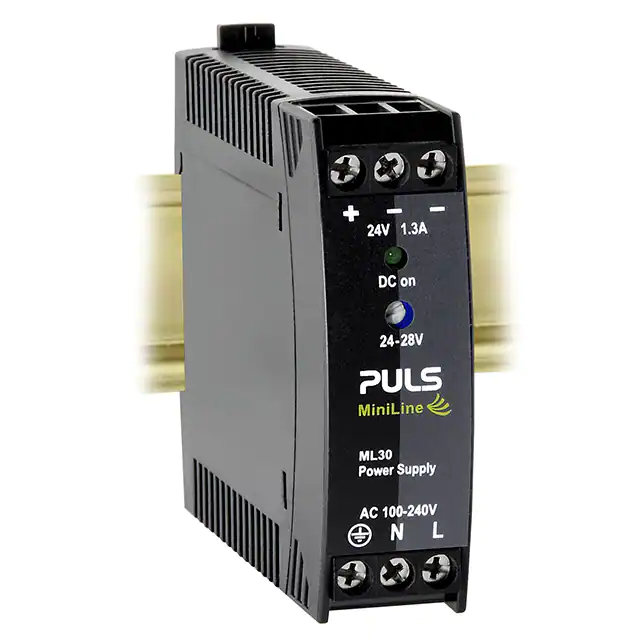
ML30.241
24V, 1.3A, SINGLE PHASE INPUT
MiniLine-2
POWER SUPPLY
100-240V Wide Range Input
NEC Class 2 Compliant
Adjustable Output Voltage
Efficiency up to 89.4%
Compact Design, Width only 22.5mm
Full Power between -10°C and +60°C
Large International Approval Package
3 Year Warranty
GENERAL DESCRIPTION
SHORT-FORM DATA
A compact size, light weight, simple mounting onto the
DIN-rail and the utilization of only quality components
are what makes the MiniLine power supplies so easy to
use and install within seconds.
Output voltage
Adjustment range
Output current
The rugged electrical and mechanical design as well as a
high immunity against electrical disturbances on the
mains provides reliable output power. This offers
superior protection for equipment which is connected
to the public mains network or is exposed to a harsh
industrial environment.
Output power
Output ripple
Input voltage
Mains frequency
AC Input current
Power factor
AC Inrush current
DC 24V
24 - 28V
1.3A at 24V
1.1A at 28V
30W
< 50mVpp
AC 100-240V
50-60Hz
0.54 / 0.3A
0.52 / 0.49
typ. 18 / 35A
DC Input
88-375Vdc
Efficiency
Losses
Temperature range
Derating
Hold-up time
Dimensions
Weight
88.5 / 89.4%
4.1 / 3.7W
-10°C to +70°C
0.8W/°C
typ. 31 / 141ms
22.5x75x91mm
140g / 0.31lb
The MiniLine series offers output voltages from 5 to
56Vdc and a power rating from 15W to 120W.
The supplementary MiniLine redundancy module
MLY10.241 allows building of redundant systems or to
protect against back-feeding voltages.
ORDER NUMBERS
20Hz to 20MHz
-15% / +10%
±6%
at 120 / 230Vac
at 120 / 230Vac
peak value at
120 / 230Vac 40°C
and cold start
below 110Vdc
derating required
at 120 / 230Vac
at 120 / 230Vac
operational
+60 to +70°C
at 120 / 230Vac
WxHxD
MARKINGS
Power Supply
ML30.241
24-28V Standard unit
Accessory
MLY10.241
Redundancy module
UL 508
UL 60950-1
Class I Div 2
IEC 60950-1
Apr. 2021 / Rev. 1.4 DS-ML30.241-EN
All parameters are specified at 24V, 1.3A, 230Vac input, 25°C ambient and after a 5 minutes run-in time unless otherwise noted.
www.pulspower.com Phone +49 89 9278 0
Germany
1/25
�ML30.241
24V, 1.3A, SINGLE PHASE INPUT
MiniLine-2
INDEX
Page
1.
2.
3.
4.
5.
6.
7.
8.
9.
10.
11.
12.
13.
14.
15.
16.
17.
18.
Intended Use .......................................................3
Installation Instructions ......................................3
AC-Input...............................................................5
Input Inrush Current ...........................................6
Output .................................................................7
Hold-up Time .......................................................8
DC-Input...............................................................8
Efficiency and Power Losses................................9
Functional Diagram ...........................................10
Front Side and User Elements ...........................10
Terminals and Wiring ........................................11
Lifetime Expectancy and MTBF.........................11
EMC ....................................................................12
Environment ......................................................13
Protection Features ...........................................14
Safety Features ..................................................14
Dielectric Strength ............................................15
Approvals and Fulfilled Standard .....................16
Page
19. Regulatory Compliance .................................... 17
20. Physical Dimensions and Weight ..................... 18
21. Accessory ........................................................... 19
21.1. MLY10.241 - Redundancy Module ........... 19
22. Application Notes ............................................. 20
22.1. Peak Current Capability ........................... 20
22.2. Back-feeding Loads .................................. 20
22.3. Charging of Batteries ............................... 21
22.4. External Input Protection ......................... 21
22.5. Parallel Use to Increase Output Power .... 21
22.6. Parallel Use for Redundancy .................... 22
22.7. Inductive and Capacitive Loads................ 22
22.8. Series Operation ....................................... 22
22.9. Operation on Two Phases ........................ 23
22.10. Use Without PE on the Input ................... 23
22.11. Use in a Tightly Sealed Enclosure ............ 24
22.12. Mounting Orientations ............................ 25
The information presented in this document is believed to be accurate and reliable and may change without notice.
The housing is patent by PULS (US patent No US D442,923S).
No part of this document may be reproduced or utilized in any form without permission in writing from the publisher.
TERMINOLOGY AND ABREVIATIONS
PE and
symbol
PE is the abbreviation for Protective Earth and has the same meaning as the symbol
.
Earth, Ground
This document uses the term “earth” which is the same as the U.S. term “ground”.
T.B.D.
To be defined, value or description will follow later.
AC 230V
A figure displayed with the AC or DC before the value represents a nominal voltage with
standard tolerances (usually ±15%) included.
E.g.: DC 12V describes a 12V battery disregarding whether it is full (13.7V) or flat (10V)
230Vac
A figure with the unit (Vac) at the end is a momentary figure without any additional
tolerances included.
50Hz vs. 60Hz
As long as not otherwise stated, AC 100V and AC 230V parameters are valid at 50Hz and AC
120V parameters are valid at 60Hz mains frequency.
may
A key word indicating flexibility of choice with no implied preference.
shall
A key word indicating a mandatory requirement.
should
A key word indicating flexibility of choice with a strongly preferred implementation.
Apr. 2021 / Rev. 1.4 DS-ML30.241-EN
All parameters are specified at 24V, 1.3A, 230Vac input, 25°C ambient and after a 5 minutes run-in time unless otherwise noted.
www.pulspower.com Phone +49 89 9278 0
Germany
2/25
�ML30.241
24V, 1.3A, SINGLE PHASE INPUT
MiniLine-2
1. INTENDED USE
This device is designed for installation in an enclosure and is intended for the general use such as in industrial control,
office, communication, and instrumentation equipment.
Do not use this power supply in equipment, where malfunction may cause severe personal injury or threaten human
life.
2. INSTALLATION INSTRUCTIONS
WARNING
-
Risk of electrical shock, fire, personal injury or death.
Turn power off before working on the device and protect against inadvertent re-powering.
Do not open, modify or repair the device.
Use caution to prevent any foreign objects from entering into the housing.
Do not use in wet locations or in areas where moisture or condensation can be expected.
Do not touch during power-on, and immediately after power-off. Hot surface may cause burns.
Obey the following installation instructions:
This device may only be installed and put into operation by qualified personnel.
This device does not contain serviceable parts. The tripping of an internal fuse is caused by an internal defect.
If damage or malfunction should occur during installation or operation, immediately turn power off and send unit to
the factory for inspection.
Install device in an enclosure providing protection against electrical, mechanical and fire hazards.
Install the device onto a DIN-rail according to EN 60715 with the input terminals on the bottom of the device. Other
mounting orientations require a reduction in output current.
Make sure that the wiring is correct by following all local and national codes. Use appropriate copper cables that are
designed for a minimum operating temperature of 60°C for ambient temperatures up to +45°C, 75°C for ambient
temperatures up to +60°C and 90°C for ambient temperatures up to +70°C. Ensure that all strands of a stranded wire
enter the terminal connection. Unused screw terminals should be securely tightened.
The device is designed for pollution degree 2 areas in controlled environments. No condensation or frost is allowed.
The housing of the device provides a degree of protection of IP20. The housing does not provide protection against
spilled liquids.
The isolation of the device is designed to withstand impulse voltages of overvoltage category III according to IEC
60664-1.
The device is designed as “Class of Protection” I equipment according to IEC 61140. Do not use without a proper PE
(Protective Earth) connection.
The device is suitable to be supplied from TN, TT or IT mains networks. The continuous voltage between the input
terminal and the PE potential must not exceed 300Vac.
The input can also be powered from batteries or similar DC sources. The continuous voltage between the supply
voltage and the PE/ground potential must not exceed 375Vdc. Connect the +pole to L and the -pole to the N terminal.
A disconnecting means shall be provided for the input of the device.
The device is designed for convection cooling and does not require an external fan. Do not obstruct airflow and do not
cover ventilation grid!
The device is designed for altitudes up to 5000m (16400ft). Above 2000m (6560ft) a reduction in output current and
over voltage category is required.
Keep the following minimum installation clearances: 40mm on top, 20mm on the bottom, 0mm left and right side.
Increase the 0mm to 15mm in case the adjacent device is a heat source.
Apr. 2021 / Rev. 1.4 DS-ML30.241-EN
All parameters are specified at 24V, 1.3A, 230Vac input, 25°C ambient and after a 5 minutes run-in time unless otherwise noted.
www.pulspower.com Phone +49 89 9278 0
Germany
3/25
�ML30.241
24V, 1.3A, SINGLE PHASE INPUT
MiniLine-2
The device is designed, tested and approved for branch circuits up to 20A without additional protection device. If an
external fuse is utilized, do not use circuit breakers smaller than 6A B- or 3A C-Characteristic to avoid a nuisance
tripping of the circuit breaker.
The maximum surrounding air temperature is +70°C (+158°F). The operational temperature is the same as the ambient
or surrounding air temperature and is defined 2cm below the device.
The device is designed to operate in areas between 5% and 95% relative humidity.
Installation Instructions for Hazardous Location Areas
The device is suitable for use in Class I Division 2 Groups A, B, C, D locations.
Substitution of components may impair suitability for this environment.
Do not disconnect the device or operate the voltage adjustment unless power has been switched off or the area is
known to be non-hazardous.
Apr. 2021 / Rev. 1.4 DS-ML30.241-EN
All parameters are specified at 24V, 1.3A, 230Vac input, 25°C ambient and after a 5 minutes run-in time unless otherwise noted.
www.pulspower.com Phone +49 89 9278 0
Germany
4/25
�ML30.241
24V, 1.3A, SINGLE PHASE INPUT
MiniLine-2
3. AC-INPUT
AC input
AC input range
nom.
Allowed voltage L or N to earth
Input frequency
Turn-on voltage
Shut-down voltage
max.
nom.
typ.
typ.
Input current (rms)
Power factor *)
Crest factor **)
Start-up delay
Rise time
typ.
typ.
typ.
typ.
typ.
typ.
max.
Turn-on overshoot
AC 100-240V
85-264Vac
264–300Vac
264Vac or 375Vdc
50–60Hz
46Vac
44Vac
AC 100V
0.63A
0.55
3.1
90ms***)
40ms
90ms
250mV
-15% / +10%, TN/TT/IT-mains
continuous operation
< 0.5s
±6%
see Fig. 3-1
see Fig. 3-1
AC 120V
0.54A
0.52
3.3
90ms***)
40ms
90ms
250mV
AC 230V
0.3A
0.49
3.9
90ms***)
40ms
100ms
250mV
at 24V, 1.3A see Fig. 3-3
at 24V, 1.3A see Fig. 3-4
at 24V, 1.3A
see Fig. 3-2
at 24V, 1.3A, 0mF, see Fig. 3-2
at 24V, 1.3A, 1.3mF
see Fig. 3-2
*) The power factor is the ratio of the true (or real) power to the apparent power in an AC circuit.
**) The crest factor is the mathematical ratio of the peak value to RMS value of the input current waveform.
***) At low temperatures, start-up attempts may occur which extends the start-up delay
Fig. 3-1 Input voltage range
Turn-on
Shut-down
Input
Voltage
max.
500ms
- 5%
Output
Voltage
VIN
45V
85V
Input Current, typ.
Fig. 3-4 Power factor vs. output load at 24V
Power Factor, typ.
a
a) 100Vac
b) 120Vac
c) 230Vac
b
0.4
0.3
0.2
0.65
0.60
0.55
c
a) 100Vac
b) 120Vac
c) 230Vac
Output Current
0 0.1
0.3
0.5
0.7
0.9
1.1 1.3A
a
b
0.50
c
0.45
0.1
0
Rise
Time
264V 300Vac
Fig. 3-3 Input current vs. output load at 24V
0.7A
0.6
0.5
Start-up
delay
Overshoot
Rated
input range
2V
POUT
Fig. 3-2 Turn-on behavior, definitions
Output Current
0.40
0.3
0.5
0.7
0.9
1.1
1.3A
Apr. 2021 / Rev. 1.4 DS-ML30.241-EN
All parameters are specified at 24V, 1.3A, 230Vac input, 25°C ambient and after a 5 minutes run-in time unless otherwise noted.
www.pulspower.com Phone +49 89 9278 0
Germany
5/25
�ML30.241
24V, 1.3A, SINGLE PHASE INPUT
MiniLine-2
4. INPUT INRUSH CURRENT
A NTC limits the input inrush current after turn-on of the input voltage. The inrush current is input voltage and
ambient temperature dependent.
The charging current into EMI suppression capacitors is disregarded in the first microseconds after switch-on.
Inrush current
Inrush energy
max.
typ.
typ.
AC 100V
19Apeak
15Apeak
0.15A2s
AC 120V
22Apeak
18Apeak
0.2A2s
AC 230V
44Apeak
35Apeak
1.0A2s
40°C ambient, cold start
40°C ambient, cold start
40°C ambient, cold start
Fig. 4-1 Input inrush current, typical behavior
Fig. 4-2 Input inrush current, zoom into first peak
Input:
Output:
Ambient:
Upper curve:
Lower curve:
Time basis:
Input:
Output:
Ambient:
Input current
Time basis:
230Vac
24V, 1.3A
25°C
Input current 5A/DIV
Input voltage 500V/DIV
10ms / DIV
230Vac
24V, 1.3A
25°C
5A/DIV
400µs / DIV
Apr. 2021 / Rev. 1.4 DS-ML30.241-EN
All parameters are specified at 24V, 1.3A, 230Vac input, 25°C ambient and after a 5 minutes run-in time unless otherwise noted.
www.pulspower.com Phone +49 89 9278 0
Germany
6/25
�ML30.241
24V, 1.3A, SINGLE PHASE INPUT
MiniLine-2
5. OUTPUT
Output voltage
Adjustment range
nom.
max.
Factory setting
Line regulation
Load regulation
Ripple and noise voltage
Output capacitance
Output current
max.
max.
max.
typ.
nom.
nom.
nom.
min.
max.
Output power
Short-circuit current
*)
24V
24-28V
30V *)
24.5V
10mV
100mV
50mVpp
900µF
1.3A
1.1A
30W
1.9A
2.9A
guaranteed
at clockwise end position of potentiometer
±0.2%, at full load, cold unit
85-264Vac
static value, 0A 1.3A
20Hz to 20MHz, 50Ohm
at 24V, see Fig. 5-1
at 28V, see Fig. 5-1
load impedance 800mOhm, see Fig. 5-1
load impedance 800mOhm, see Fig. 5-1
This is the maximum output voltage which can occur at the clockwise end position of the potentiometer due to tolerances. It is not a
guaranteed value which can be achieved. The typical value which can be achieved by turning the potentiometer to the clock-wise end
position is 28.6V.
Fig. 5-1 Output voltage vs. output current,
typ.
Adjustment
Range
Output Voltage
28V
24
20
16
12
8
4
0
Output Current
0
0.4
0.8
1.2
1.6
2.0
2.4 2.8A
Peak current capability (up to several milliseconds)
The power supply can deliver a peak current which is higher than the specified short term current. This helps to start
current demanding loads or to safely operate subsequent circuit breakers.
The extra current is supplied by the output capacitors inside the power supply. During this event, the capacitors will be
discharged and causes a voltage dip on the output. Detailed curves can be found in chapter 22.1.
Peak current voltage dips
typ.
typ.
typ.
from 24V to 16V
from 24V to 15V
from 24V to 10V
at 2.6A for 50ms, resistive load
at 6.5A for 2ms, resistive load
at 6.5A for 5ms, resistive load
Apr. 2021 / Rev. 1.4 DS-ML30.241-EN
All parameters are specified at 24V, 1.3A, 230Vac input, 25°C ambient and after a 5 minutes run-in time unless otherwise noted.
www.pulspower.com Phone +49 89 9278 0
Germany
7/25
�ML30.241
24V, 1.3A, SINGLE PHASE INPUT
MiniLine-2
6. HOLD-UP TIME
Hold-up Time
AC 100V
41ms
18ms
typ.
typ.
AC 120V
66ms
31ms
AC 230V
285ms
141ms
at 24V, 0.65A, see Fig. 6-1
at 24V, 1.3A, see Fig. 6-1
Note: At no load, the hold-up time can be up to several seconds. The green DC-on lamp is also on during this time
Fig. 6-1 Hold-up time vs. input voltage
Hold-up Time
120ms
a
b
c
Fig. 6-2 Shut-down behavior, definitions
d
Zero Transition
Input
Voltage
100
80
60
a) 24V 0.65A typ.
b) 24V 0.65Amin.
c) 24V 1.3A typ.
d) 24V 1.3A min.
Input Voltage
40
20
0
85
120
155
190
- 5%
Output
Voltage
Hold-up Time
230Vac
7. DC-INPUT
The power supply can also be supplied from a DC source. Use a battery or similar DC source. For other sources contact
PULS. Connect the + pole to L and the – pole to N. Connect the PE terminal to an earth wire or to the machine ground.
DC input
DC input range
nom.
DC 110-300V
88-375Vdc
Allowed Voltage L/N to Earth
DC input current
Turn-on voltage
Shut-down voltage
max.
typ.
typ.
typ.
375Vdc
0.31A / 0.12A
60Vdc
35Vdc
Fig. 7-1 Wiring for DC Input
Battery
Fig. 7-2 Allowable output current below
110Vdc input voltage
Output Power
Power Supply
+
AC
L
internal
fused
-
PE
DC
30W
(b)
25
(a)
(a) Ambient 2000m (6500ft), see Fig. 14-2
IEC 62103, EN 50178, altitudes up to 2000m
altitudes from 2000m to 6000m
IEC 62103, EN 50178, not conductive
4W/1000m or 5°C/1000m
III
II
2
Degree of pollution
*) Operational temperature is the same as the ambient temperature and is defined as the air temperature 2cm below the unit.
**) Do not energize while condensation is present
Fig. 14-1 Output power vs. ambient temp.
Fig. 14-2 Output power vs. altitude
Allowable
Output Power
Allowable
Output Power
30W
30W
25
25
20
20
15
15
10
10
5
5
Ambient Temperature
0
-10
0
20
40
A
A... Tamb < 60°C
B... Tamb < 50°C
C... Tamb < 40°C
0
2000
C
Altitude
0
60 70°C
B
4000
6000m
Apr. 2021 / Rev. 1.4 DS-ML30.241-EN
All parameters are specified at 24V, 1.3A, 230Vac input, 25°C ambient and after a 5 minutes run-in time unless otherwise noted.
www.pulspower.com Phone +49 89 9278 0
Germany
13/25
�ML30.241
24V, 1.3A, SINGLE PHASE INPUT
MiniLine-2
15. PROTECTION FEATURES
Output protection
Output over-voltage protection
Output over-current protection
Degree of protection
Penetration protection
Over-temperature protection
Input transient protection
Internal input fuse
*)
Electronically protected against overload, no-load and short-circuits *)
typ. 36Vdc
In case of an internal power supply fault, a redundant
max. 38Vdc
circuit limits the maximum output voltage. In such a
case, the output shuts down and stays down until the
input voltage is turned off and on again.
electronically limited
see Fig. 5-1
IP 20
EN/IEC 60529
> 2.5mm in diameter
e.g. screws, small parts
not included
MOV
Metal Oxide Varistor
T3.15A H.B.C.
not user replaceable
In case of a protection event, audible noise may occur.
16. SAFETY FEATURES
Input / output separation *)
Class of protection
Isolation resistance
Touch current (leakage current)
*)
SELV
PELV
I
> 5MOhm
typ. 0.17mA / 0.38mA
typ. 0.24mA / 0.55mA
typ. 0.40mA / 0.86mA
< 0.21mA / 0.44mA
< 0.30mA / 0.66mA
< 0.54mA / 1.08mA
IEC/EN 60950-1
IEC/EN 60204-1, EN 50178, IEC 62103, IEC 60364-4-41
PE (Protective Earth) connection required
Input to output, 500Vdc
100Vac, 50Hz, TN-,TT-mains / IT-mains
120Vac, 60Hz, TN-,TT-mains / IT-mains
230Vac, 50Hz, TN-,TT-mains / IT-mains
110Vac, 50Hz, TN-,TT-mains / IT-mains
132Vac, 60Hz, TN-,TT-mains / IT-mains
264Vac, 50Hz, TN-,TT-mains / IT-mains
Double or reinforced insulation
Apr. 2021 / Rev. 1.4 DS-ML30.241-EN
All parameters are specified at 24V, 1.3A, 230Vac input, 25°C ambient and after a 5 minutes run-in time unless otherwise noted.
www.pulspower.com Phone +49 89 9278 0
Germany
14/25
�ML30.241
24V, 1.3A, SINGLE PHASE INPUT
MiniLine-2
17. DIELECTRIC STRENGTH
The output voltage is floating and has no ohmic connection to the ground. Type and factory tests are conducted by
the manufacturer. Field tests may be conducted in the field using the appropriate test equipment which applies the
voltage with a slow ramp (2s up and 2s down). Connect all phase-terminals together as well as all output poles before
conducting the test. When testing, set the cut-off current settings to the value in the table below.
Type test
60s
A
2500Vac
B
3000Vac
C
500Vac
Factory test
5s
2500Vac
2500Vac
500Vac
Field test
5s
2000Vac
2000Vac
500Vac
> 6mA
> 6mA
> 1mA
Fig. 17-1 Dielectric strength
Input
L
N
B
Output
A
Earth, PE
+
C
-
Cut-off current setting
To fulfill the PELV requirements according to EN 60204-1 § 6.4.1,
we recommend that either the + pole, the – pole or any other part
of the output circuit shall be connected to the protective earth
system. This helps to avoid situations in which a load starts
unexpectedly or can not be switched off when unnoticed earth
faults occur.
Apr. 2021 / Rev. 1.4 DS-ML30.241-EN
All parameters are specified at 24V, 1.3A, 230Vac input, 25°C ambient and after a 5 minutes run-in time unless otherwise noted.
www.pulspower.com Phone +49 89 9278 0
Germany
15/25
�ML30.241
24V, 1.3A, SINGLE PHASE INPUT
MiniLine-2
18. APPROVALS AND FULFILLED STANDARD
UL 508
IEC 60950-1
UL 60950-1
Class I Div 2
NEC Class 2
Marine (DNV)
Marine (ABS)
ISA-71.04-1985
ISA-71.04-1985
VDMA 24364
UL Certificate
Listed equipment for category NMTR - Industrial Control
Equipment and Fulfilled Standard
Applicable for US and Canada
E-File: E198865
CB Scheme Certificate
General safety requirements for Information Technology
Equipment (ITE)
UL Certificate
Recognized component for category QQGQ - Information
Technology Equipment (ITE)
Applicable for US and Canada
E-File: E137006
CSA Certificate
Power Supplies for Hazardous Location
Applicable for Canada and US
CSA Class: 5318-01 (Canada), 5318-81 (USA)
Temperature Code: T4
Groups: A, B, C and D
Manufacturer's Declaration
NEC CLASS 2 – Limited Power Source
Listed device according to NEC Handbook chapter 725-121
DNV Certificate
DNV Type approved product
Certificate: TAA00001ST
Temperature: Class B
Humidity: Class B
Vibration: Class C
EMC: Class B
Enclosure: Class A
ABS Design Assessment Certificate
ABS (American Bureau of Shipment) assessed product
Certificate: 17-HG1599236-PDA
Manufacturer's Declaration (Online Document)
Airborne Contaminants Corrosion Test
Severity Level: G3 Harsh
H2S: 100ppb
NOx: 1250ppb
Cl2: 20ppb
SO2: 300ppb
Test Duration: 3 weeks, which simulates a service life of at least
10 years.
Manufacturer's Declaration (Online Document)
Airborne Contaminants Corrosion Test
Severity Level: G3 Harsh
H2S: 100ppb
NOx: 1250ppb
Cl2: 20ppb
SO2: 300ppb
Test Duration: 3 weeks, which simulates a service life of at least
10 years.
Paint Wetting Impairment Substances Test (or LABS-Test)
Tested for Zone 2 and test class C1 according to VDMA 24364C1-L/W for solvents and water-based paints
Apr. 2021 / Rev. 1.4 DS-ML30.241-EN
All parameters are specified at 24V, 1.3A, 230Vac input, 25°C ambient and after a 5 minutes run-in time unless otherwise noted.
www.pulspower.com Phone +49 89 9278 0
Germany
16/25
�ML30.241
24V, 1.3A, SINGLE PHASE INPUT
MiniLine-2
19. REGULATORY COMPLIANCE
EU Declaration of
Conformity
REACH Directive
EAC TR Registration
The CE mark indicates conformance with the
- EMC directive
- Low-voltage directive (LVD)
- RoHS directive
Manufacturer's Statement
EU-Directive regarding the Registration, Evaluation,
Authorisation and Restriction of Chemicals
EAC Certificate
EAC EurAsian Conformity - Registration Russia, Kazakhstan
and Belarus
8504408200, 8504409000
Apr. 2021 / Rev. 1.4 DS-ML30.241-EN
All parameters are specified at 24V, 1.3A, 230Vac input, 25°C ambient and after a 5 minutes run-in time unless otherwise noted.
www.pulspower.com Phone +49 89 9278 0
Germany
17/25
�ML30.241
24V, 1.3A, SINGLE PHASE INPUT
MiniLine-2
20. PHYSICAL DIMENSIONS AND WEIGHT
Weight
DIN-Rail
Installation Clearances
140g / 0.31lb
Use 35mm DIN-rails according to EN 60715 or EN 50022 with a height of 7.5 or 15mm.
The DIN-rail height must be added to the unit depth (91mm) to calculate the total required
installation depth.
See chapter 2
Fig. 20-1 Front view
Fig. 20-2 Side view
Apr. 2021 / Rev. 1.4 DS-ML30.241-EN
All parameters are specified at 24V, 1.3A, 230Vac input, 25°C ambient and after a 5 minutes run-in time unless otherwise noted.
www.pulspower.com Phone +49 89 9278 0
Germany
18/25
�ML30.241
24V, 1.3A, SINGLE PHASE INPUT
MiniLine-2
21. ACCESSORY
21.1. MLY10.241 - REDUNDANCY MODULE
Voltage
Monitor
+ + Output
+ + Output
ML30.241
ML30.241
Input
Input
L
L
N
I
I
The MLY10.241 is a dual redundancy module, which has two diodes with
a common cathode included. It can be
used for various purposes. The most
popular application is to configure
highly reliable and true redundant
power supply systems. Another
interesting application is the
separation of sensitive loads from nonsensitive loads. This avoids the
distortion of the power quality for the
sensitive loads which can cause
controller failures.
N
+ - + IN 1 IN 2
MLY10
Load
Output
+ - -
+ -
L
N
Apr. 2021 / Rev. 1.4 DS-ML30.241-EN
All parameters are specified at 24V, 1.3A, 230Vac input, 25°C ambient and after a 5 minutes run-in time unless otherwise noted.
www.pulspower.com Phone +49 89 9278 0
Germany
19/25
�ML30.241
24V, 1.3A, SINGLE PHASE INPUT
MiniLine-2
22. APPLICATION NOTES
22.1. PEAK CURRENT CAPABILITY
Solenoids, contactors and pneumatic modules often have a steady state coil and a pick-up coil. The inrush current
demand of the pick-up coil is several times higher than the steady-state current and usually exceeds the nominal
output current. The same situation applies when starting a motor or switching-on a capacitive load.
In many cases, the peak current capability also ensures a safe operation of subsequent circuit breakers. Branch circuits
are often protected with circuit breakers or fuses. In case of a short or an overload in a branch circuit, the fuse needs a
certain amount of over-current to trip or to blow.
Assuming the input voltage is turned on before such an event, the built-in large sized output capacitors inside the
power supply can deliver extra current. Discharging this capacitor causes a voltage dip on the output. The following
two examples show typical voltage dips:
Fig. 22-1 Peak loading with 2x the nominal
current for 50ms, typ.
Peak load 2.6A (resistive load) for 50ms
Output voltage dips from 24V to 16V.
Fig. 22-2 Peak loading with 5x the nominal
current for 5ms, typ.
Peak load 6.5A (resistive load) for 5ms
Output voltage dips from 24V to 10V.
22.2. BACK-FEEDING LOADS
Loads such as decelerating motors and inductors can feed voltage back to the power supply. This feature is also called
return voltage immunity or resistance against Back- E.M.F. (Electro Magnetic Force).
This power supply is resistant and does not show malfunctioning when a load feeds back voltage to the power supply.
It does not matter whether the power supply is on or off.
The maximum allowed feed-back-voltage is 35Vdc. The absorbing energy can be calculated according to the built-in
large sized output capacitor which is specified in chapter 5.
Apr. 2021 / Rev. 1.4 DS-ML30.241-EN
All parameters are specified at 24V, 1.3A, 230Vac input, 25°C ambient and after a 5 minutes run-in time unless otherwise noted.
www.pulspower.com Phone +49 89 9278 0
Germany
20/25
�ML30.241
24V, 1.3A, SINGLE PHASE INPUT
MiniLine-2
22.3. CHARGING OF BATTERIES
The power supply can be used to charge lead-acid or maintenance free batteries. (Two 12V batteries in series)
Instructions for charging batteries (float charging):
a)
Ensure that the ambient temperature of the power supply is below 45°C
b)
Set output voltage (measured at no load and at the battery end of the cable) very precisely to the end-of-charge
voltage.
End-of-charge voltage
27.8V
27.5V
27.15V
26.8V
Battery temperature
10°C
20°C
30°C
40°C
c)
Use a 2A circuit breaker (or blocking diode) between the power supply and the battery.
d)
Ensure that the output current of the power supply is below the allowed charging current of the battery.
e)
Use only matched batteries when putting 12V types in series.
f)
The return current to the power supply (battery discharge current) is typical 9mA when the power supply is
switched off (except in case a blocking diode is utilized).
22.4. EXTERNAL INPUT PROTECTION
The unit is tested and approved for branch circuits up to 20A. An external protection is only required, if the supplying
branch has an ampacity greater than this. Check also local codes and local requirements. In some countries local
regulations might apply.
If an external fuse is necessary or utilized, minimum requirements need to be considered to avoid nuisance tripping of
the circuit breaker. A minimum value of 6A B- or 3A C-Characteristic breaker should be used.
Unit A
22.5. PARALLEL USE TO INCREASE OUTPUT POWER
AC
+
ML30.241 power supplies can be paralleled to increase the output power. This
power supply has no feature included which balances the load current
DC
+
between the power supplies. Usually the power supply with the higher
Unit B
adjusted output voltage draws current until it goes into current limitation. This
Load
AC
means no harm to this power supply as long as the ambient temperature stays
+
below 45°C. The ML30.241 can also be paralleled with other power supplies
from MiniLine series with 24V output voltage. The output voltages of all
DC
power supplies shall be adjusted to the same value (±100mV). A fuse or diode
on the output of each unit is only required if more than three units are connected in parallel. If a fuse (or circuit
breaker) is used, choose one with approximately 150% of the rated output current of one power supply. Keep an
installation clearance of 15mm (left / right) between two power supplies and avoid installing the power supplies on
top of each other. Do not use power supplies in parallel in mounting orientations other than the standard mounting
orientation (input terminals on the bottom and output terminals on top of the unit). Be aware that leakage current,
EMI, inrush current and harmonics will increase when using multiple power supplies in parallel.
Apr. 2021 / Rev. 1.4 DS-ML30.241-EN
All parameters are specified at 24V, 1.3A, 230Vac input, 25°C ambient and after a 5 minutes run-in time unless otherwise noted.
www.pulspower.com Phone +49 89 9278 0
Germany
21/25
�ML30.241
24V, 1.3A, SINGLE PHASE INPUT
MiniLine-2
22.6. PARALLEL USE FOR REDUNDANCY
Power supplies can be paralleled for redundancy to gain higher system
availability. Redundant systems require a certain amount of extra power
to support the load in case one power supply unit fails. The simplest way
is to put two power supplies in parallel. This is called a 1+1 redundancy.
In case one power supply unit fails, the other one is automatically able
to support the load current without any interruption. Redundant
systems for a higher power demand are usually built in an N+1 method.
E.g. five power supplies, each rated for 1.3A are paralleled to build a 5A
redundant system.
Voltage
Monitor
+ + Output
+ + Output
ML30.241
ML30.241
Input
Input
L
N
N
I
L
+ - + IN 1 IN 2
MLY10
Load
Output
+ - -
+ -
I
Please note: This simple way to build a redundant system does not
L
cover failures such as an internal short circuit in the secondary side of
N
the power supply. In such a case, the defect unit becomes a load for the
other power supplies and the output voltage can not be maintained any
more. This can only be avoided by utilizing decoupling diodes which are included in the redundancy module
MLY10.241.
Recommendations for building redundant power systems:
a)
Use separate input fuses for each power supply.
b)
Use separate mains systems for each power supply whenever it is possible.
c)
Monitor the individual power supply units.
d)
1+1 Redundancy is allowed up to an ambient temperature of 60°C.
N+1 Redundancy is allowed up to an ambient temperature of 45°C.
e)
It is desirable to set the output voltages of all units to the same value (± 100mV) or leave it at the factory setting.
22.7. INDUCTIVE AND CAPACITIVE LOADS
The unit is designed to supply any type of load, including unlimited capacitive and inductive loads.
22.8. SERIES OPERATION
Unit A
Power supplies of the exact same type can be connected in series for higher
AC
+
output voltages. It is possible to connect as many units in series as needed,
providing the sum of the output voltage does not exceed 150Vdc. Voltages
DC
with a potential above 60Vdc are not SELV any more and can be dangerous.
+
Such voltages must be installed with a protection against touching. Earthing of
Unit B
Load
the output is required when the sum of the output voltage is above 60Vdc.
AC
Avoid return voltage (e.g. from a decelerating motor or battery) which is
+
applied to the output terminals. Keep an installation clearance of 15mm (left /
Earth
right) between two power supplies and avoid installing the power supplies on
DC
top of each other. Do not use power supplies in series in mounting
orientations other than the standard mounting orientation (input terminals on the bottom and output terminals on
top of the unit). Be ware that leakage current, EMI, inrush current and harmonics will increase when using multiple
power supplies series.
Apr. 2021 / Rev. 1.4 DS-ML30.241-EN
All parameters are specified at 24V, 1.3A, 230Vac input, 25°C ambient and after a 5 minutes run-in time unless otherwise noted.
www.pulspower.com Phone +49 89 9278 0
Germany
22/25
�ML30.241
24V, 1.3A, SINGLE PHASE INPUT
MiniLine-2
Power Supply
L1
The power supply can also be used on two-phases of a three-phase-system. A
phase-to-phase connection is allowed as long as the supplying voltage is
below 240V+10%. Use a fuse or a circuit breaker to protect the N input. The N
input is not internally protected and is in this case connected to a hot wire.
Appropriate fuses or circuit breakers are specified in section 22.4.
240V +10% max.
22.9. OPERATION ON TWO PHASES
L3
AC
L
Fuse
internal
fuse
N
PE
DC
L2
22.10. USE WITHOUT PE ON THE INPUT
From a safety standpoint, the unit is internally designed according to the requirements for Protection Class 1 and 2.
Please contact PULS if you do not plan to use the PE terminal. A different marking of the front foil is then required.
Grounding of the input is beneficial for a high EMI immunity: Symmetrical spikes or fast transients on the input side
can be conducted directly to earth by the built-in filter capacitors. The magnitude of such spikes or fast transients on
the output side caused by the input is much smaller compared to not connecting this terminal to ground.
Fig. 22-3 Earthed input
Fig. 22-4 Not earthed input
Surge
Spike
Surge
24V
L
Power Supply
+
L
-
N
X
N
Power Supply
+
X
-
Y
Ground
Apr. 2021 / Rev. 1.4 DS-ML30.241-EN
All parameters are specified at 24V, 1.3A, 230Vac input, 25°C ambient and after a 5 minutes run-in time unless otherwise noted.
www.pulspower.com Phone +49 89 9278 0
Germany
23/25
�ML30.241
24V, 1.3A, SINGLE PHASE INPUT
MiniLine-2
22.11. USE IN A TIGHTLY SEALED ENCLOSURE
When the power supply is installed in a tightly sealed enclosure, the temperature inside the enclosure will be higher
than outside. In such situations, the inside temperature defines the ambient temperature for the power supply.
The following measurement results can be used as a reference to estimate the temperature rise inside the enclosure.
The power supply is placed in the middle of the box; no other heat producing items are inside the box.
Enclosure:
Input:
Rittal Type IP66 Box PK 9510 100, plastic, 130x130x75mm
230Vac
Case A:
Load:
Temperature inside the box:
Temperature outside the box:
Temperature rise:
24V, 1.3A; load is placed outside the box
35.2°C (in the middle of the right side of the power supply with a distance of 1cm)
23.9°C
11.3K
Case B:
Load:
Temperature inside the box:
Temperature outside the box:
Temperature rise:
24V, 1.04A; (=80%) load is placed outside the box
32.0°C (in the middle of the right side of the power supply with a distance of 1cm)
23.1°C
8.9K
Apr. 2021 / Rev. 1.4 DS-ML30.241-EN
All parameters are specified at 24V, 1.3A, 230Vac input, 25°C ambient and after a 5 minutes run-in time unless otherwise noted.
www.pulspower.com Phone +49 89 9278 0
Germany
24/25
�ML30.241
24V, 1.3A, SINGLE PHASE INPUT
MiniLine-2
22.12. MOUNTING ORIENTATIONS
Mounting orientations other than input terminals on the bottom and output on the top require a reduction in
continuous output power or a limitation in the maximum allowed ambient temperature. The amount of reduction
influences the lifetime expectancy of the power supply. Therefore, two different derating curves for continuous
operation can be found below:
Curve A1
Curve A2
Recommended output current.
Max allowed output current (results in approximately half the lifetime expectancy of A1).
Fig. 22-5
Mounting
Orientation A
(Standard
orientation)
Output Power
OUTPUT
30W
24
18
12
6
0
10
Power
Supply
INPUT
Fig. 22-6
Mounting
Orientation B
(Upside down)
20
30
40
50
60°C
INPUT
30W
24
18
12
6
0
10
A2
A1
Ambient Temperature
20
30
40
50
60°C
Power
Supply
OUTPUT
Output Power
30W
24
18
12
6
0
10
A2
A1
Ambient Temperature
20
30
40
50
60°C
Output Power
OUTPUT
Power
Supply
INPUT
30W
24
18
12
6
0
10
A2
A1
Ambient Temperature
20
30
40
60°C
50
INPUT
Power
Supply
Output Power
OUTPUT
Fig. 22-9
Mounting
Orientation E
(Horizontal ccw)
Ambient Temperature
Output Power
Fig. 22-7
Mounting
Orientation C
(Table-top
mounting)
Fig. 22-8
Mounting
Orientation D
(Horizontal cw)
A1
30W
24
18
12
6
0
10
A2
A1
Ambient Temperature
20
30
40
50
60°C
Apr. 2021 / Rev. 1.4 DS-ML30.241-EN
All parameters are specified at 24V, 1.3A, 230Vac input, 25°C ambient and after a 5 minutes run-in time unless otherwise noted.
www.pulspower.com Phone +49 89 9278 0
Germany
25/25
�