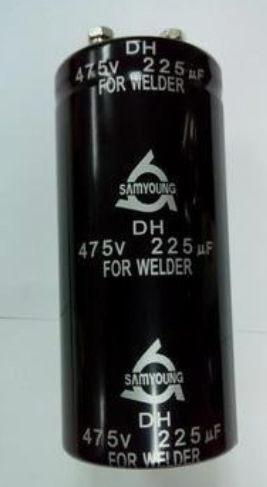
DH475LG225M50*110_LG 数据手册
Messrs.
Date
2019.05.09
Approval No.
843 - 2155
SYQD(SHENZHEN YAZE)
APPROVAL SHEET
Al
Aluminum
i
electrolytic
l t l ti capacitors
it
Catalog Type
DH 475 LG2G 225 T (Ø50 × 110L)
User Part No
No.
Applied To
Reference
RoHS
Samyoung Electronics Co.,Ltd.
General manager of product engineering group
CHOI
SEONG
ROK
User Approval
Approval No. :
Address
KOREA
47, Sagimakgol-ro, Jungwon-gu,Seongnamsi, Gyeonggi-do
CHINA
No 5 Changjiang Road Pingdu-city
No.5
Pingdu-city, Shandong-province
SamYoung Electronics Co., Ltd.
�PAGE 1 OF 5
APPROVAL NO.
ALUMINUM ELECTROLYTIC CAPACITORS
DH 475 LG2G 225 (T)
843 - 2155
SERIES
DH
RATING
475 V 225 ㎌
CASE SIZE
Ø 50 × 110 L
[ UNIT : ㎜ ]
A. DIAGRAM OF DIMENSION
Sleeve
Bottom plate
M5
Safety vent
H
F±1
L+4max.
°
B ±1
øD+1.8 max.
3 0 ±0 .5
6
W±1
A±1
8max.
ØD
L
F
50
110
22.4
A
B
W
H
78
64
68
4.5
B. MARKING: BLACK SLEEVE & SILVER INK
< LOT No. : Sleeve or bottom plate marking. >
< VIEW OF CAPACITOR >
①②③④
DATE CODE
or
LOT No.
DH
475v 225㎌
FOR WELDER
< FRONT >
or
①②
③④
①:The ending figure of manufactured year in A
A.D.
D
②:Manufactured month(1,2,3,…,9,O,N,D)
③:Manufactured day (A,B,C,…,Z,a,b,c,d,e)
④:SAMYOUNG's
Korea : 1, China :
< DATE CODE : Sleeve marking. >
< BACK >
①②③④
①②:YEAR : The ending of A.D.
③④:WEEKS : 01 ~ 52
C. ELECTRICAL CHARACTERISTICS
A. OPERATING TEMPERATURE RANGE
: - 25 ∼ +70℃
B. RATED VOLTAGE
: 475 VDC
C. SURGE VOLTAGE
: 500 VDC
D. CAPACITANCE TOLERANCE
: -10 ~ +50% at 20℃, 120㎐
E. LEAKAGE CURRENT
: Lower 3000 ㎂, after 5 minutes at 20℃
F. DISSIPATION FACTOR (TANδ)
: Lower 0.15 at 20℃, 120㎐
G.TEMPERATURE CHARACTERISTICS
: C(-10℃) / C(20℃) ≥ 0.8
(capacitance change)
(at 120㎐)
H. LOAD LIFE : The following specifications shall be satisfied when the capacitors are restored to 40℃,
after the rated working voltage applied. And than charge and discharge (charge
0.8sec. Discharge 0.2sec) are repeated 1,000,000 times. And than the capactors are
restored to 20℃ after the measurements.
# Capacitance change
: ≤ ±20 % of the initial value
# Tanδ
: ≤ 200 % of the initial value
# Leakage current
: ≤ 200 % of the initial specified value
I. CLEANING CONDITIONS : Non-solvent proof → Refer to Cleaning conditions (Page 5)
J. OTHERS
: Satisfied charateristics KS C IEC 60384-4
SamYoung Electronics Co., Ltd.
�PAGE 2 OF 5
APPROVAL NO.
ALUMINUM ELECTROLYTIC CAPACITOR
843 - 2155
▶PACKING SPEC
[ UNIT: ㎜ ]
1) BOX FORM
H
W
D
2) PACKING QUANTITY AND BOX DIMENSION
CASE SIZE
INNER BOX
QUANTITY (PCS)
ØD
L
SIZE (W × D × H)
50
110
415 × 425 × 110
SamYoung Electronics Co., Ltd.
32
�PAGE 3 OF 5
APPROVAL NO.
ALUMINUM ELECTROLYTIC CAPACITORS
843 - 2155
▶ STRUCTURE AND MATERIALS
VENT RUBBER
AL TAB
TERMINAL
CATHODE FOIL
BAKE
ANODE FOIL
AL TAB
AL CASE
ADHESIVE TAPE
SLEEVE
ELEMENT
VISTAC
BOTTOM PLATE
SEPARATOR
※LARGE SIZED TYPE CAPACITORS COMPONENT
MATERIALS
PART NAME
TERMINAL
ALUMINUM 99.7 %
BAKE
PHENOL
VENDER
NOK
MECTRON
(JAPAN)
(KOREA/CHINA)
NAN TONG TOP
(CHINA)
KISTRON
AL TAB
SLEEVE
ALUMINUM 99.9 % OVER
PVC (POLY VINYL CHLORIDE)
(KOREA)
SAMYOUNG
DONG YANG
(JAPAN)
MOODEUNG
(KOREA/CHINA)
YUN LIN PLASTIC
SHUN PENG PLASTIC
(CHINA)
SUZHOU QILIAN
BOTTOM PLATE
AL CASE
P.P (Polypropylene)
ALUMINUM 99.5 %
SUNG NAM
(KOREA)
SPEEFOX / DONG NAM
(KOREA)
SUNLIT
(JAPAN)
LINAN AOXING
NANTONG XINLIAN / HAI BANG
PONTIGGIA
(ITALIA)
SAM YOUNG
(KOREA)
K.D.K / JCC / MATSUSHITA
(JAPAN)
BECROMAL
ANODE FOIL
FORMED ALUMINUM 99.9 % OVER
(CHINA)
SATMA
(ITALY)
(FRANCE)
HUAFENG / NANTONG / RAOIO / HAIYUAN
YINGKELAI / HUARONG / HEC
(CHINA)
XINJIANG JOINWORLD
LUXON / LITON
CATHODE FOIL
ETCHED ALUMINUM 99.8 % OVER
(JAPAN)
K-JCC
(KOREA)
AFT / INCULCU / SHENGHONG
ELECON / WU JIANG FEILO
N.K.K
SEPARATOR
ADHESIVE TAPE
INSULATION PAPER
POLY PROPYLENE OR POLY IMIDE FILM
(TAIWAN)
K.D.K
(CHINA)
(JAPAN)
GLT
(GERMANY)
KAN
(CHINA)
DAI IL / SWECO
(KOREA)
NITTO / NICHIBAN
(JAPAN)
SamYoung Electronics Co., Ltd.
�PAGE 4 OF 5
PRECAUTIONS AND GUIDELINES TO USERS
When using aluminum elelctrolytic capacitors, pay strict attention to the following:
1. Electrolytic capacitors for DC application require polarization.
Confirm the polarity. If uesd in reversed polarity, the circuit life may be shortened or the capacitor may be damaged. For
use on circuits whose polarity is occasionally reversed, or whose polarity is unknown, use bi-polarized capacitors(BP-series).
Also, note that the electrolytic capacitor cannot be used for AC application.
2. Do not apply a voltage exceeding the capacitor's voltage rating.
If a voltage exceeding the capacitor's voltage rating is applied, the capacitor may be damaged as leakage current increases.
When using the capacitor with AC voltage superimposed on DC voltage, care must be exercised that the peak value of AC
voltage does not exceed the rated voltage.
3. Do not allow excessive ripple current to pass.
Use the electrolytic capacitor at current values within the permissible ripple range. If the ripple current exceeds the specified
value, request capacitors for high ripple current applications.
4. Ascertain the operating temperature range.
Use the electrolytic capacitors according to the specified operating temperature range. Usage at room temperature will ensure
longer life.
5. The electrolytic capacitor is not suitable for circuits in which charge and discharge are frequently repeated.
If used in circuits in which charge and discharge are frequently repeated, the capacitance value may drop, or the capacitor
may be damaged. Please consult our engineering department for assistance in these applications.
6. Apply voltage treatment to the electrolytic capacitor which has been allowed to stand for a long time.
If the electrolytic capacitor is allowed to stand for a long time, its withstand voltage is liable to drop, resulting in increased
leakage current. If the rated voltage is applied to such a product, a large leakage current occurs and this generates internal
heat, which damaged the capacitor. If the electrolytic capacitor is allowed to stand for a long time, therefore, use it after
giving voltage treatment .
7. Be careful of temperature and time when soldering.
When soldering a printed circuit board with various components, care must be taken that the soldering temperature is not
too high and that the dipping time is not too long. Other wise, there will be adverse effects on the electrical characteristics
and insulation sleeve of electrolytic capacitors in the case of small-sized electrolytic capacitors, nothing abnormal will occur
if dipping is performed at less than 260℃ for less than 10 seconds.
8. Do not place a soldering iron body of the capacitor.
The electrolytic capacitor is covered with a vinyl sleeve. If the soldering iron comes in contact with the electrolytic capacitor
body during wiring, damage to the vinyl sleeve and/or case may result in defective insulation, or improper protection of the
capacitor element.
9. Cleaning circuit boards after soldering.
Some solvents have adverse effects on capacitors.
Please refer to the next page.
10. Do not apply excessive force to the lead wires or terminals.
If excessive force is applied to the lead wires and terminals, they may be broken or their connections with the internal elements may be affected. (For strength of terminals, refer to KS C IEC 60384-4 (JIS C5101-1, JIS C5101-4) )
11. Care should be used in selecting a storage area.
If electrolytic capacitors are exposed to high temperatures caused by such things as direct sunlight, the life of the capacitor
may be adversely affected. Storage in a high humidity atmosphere may affect the solderability of lead wires and terminals.
12. Surge voltage
The surge voltage rating is the maximum DC over-voltage to which the capacitor may be subjected for short periods not
exceeding approximately 30 seconds at infrequent intervals of not more than six minutes. According to KS C IEC 60384-4, the test
operating temperature for the capacitors of characteristics KS C IEC 60384-4 with voltage applied through a series resistance
of 1000 ohms without discharge. The electrical characteristics of the capacitor after the test are specified in KS C IEC 60384-4.
Unless otherwise specified, the rated surge voltages are as follows:
Rated Voltage(WV)
4
6.3
10
16
25
35
50
63
Surge Voltage(SV)
5
8
13
20
32
44
63
79 100 125 200 250 300 365 400 450 470 500 550 600 650
80 100 160 200 250 315 350 400 420 450 500 550 600
Note 1 Voltage treatment ... Treat them with appropriate voltage before using. As treating method, it is used current density less
than specified leakage current in room temperature.
1) 80% of rated voltage applied and keep 1 hour after reaching 80% of rated voltage.
2) 90% of rated voltage applied and keep 1 hour after reaching 90% of rated voltage.
3) 100% off rated
applied
hour after
t d voltage
lt
li d and
d kkeep 1 h
ft reaching
hi 100% off rated
t d voltage.
lt
Note 2 For methods of testing, refer to KS C IEC 60384-4. (JIS C 5101-1, JIS C 5101-4)
SamYoung Electronics Co., Ltd.
�PAGE 5 OF 5
CLEANING CONDITIONS
Aluminum electrolytic capacitors that have been exposed to halogenate'd hydrocarbon cleaning and defluxing
solvents are susceptible to attack by these solvents. This exposure can result in solvent penetration
into the capacitors, leading to internal corrosion and potential failure.
Common type of halogenated cleaning agents are listed below.
Chemical Name
Structural
Formula
Representatice
Brand Name
Trichlorotrifluoroethane
C2Cl3F3
Freon TF , Daiflon S-3
Fluorotrichloromethane
CCl3F
Freon -11 , Daiflon S-1
1,1,1-Trichloroethane
F2H3Cl3
Chloroethane
Trichloroethylene
C2HCl3
Trichlene
Methyl Chloride
CH3Cl
MC
We would like to recommend you the below cleaning materials for your stable cleaning condition taking the place of
previous materials.
◎ lsopropyl Alcohol(IPA) or water
Cleaning method : One of immersion, ultrasonic or vapor cleaning
Maximum cleaning time : 5 minutes (Chip type : 2 minutes)
※ Do not use AK225AES
Aluminum electrolytic capacitors are easily affected by halogen ions, particularly by chloride and bromine ions.
Excessive amounts of halogen ions, if happened to enter the inside of the capacitors, will give corrosion accidents-rapid
capacitance drop and vent open. The extent of corrosion accidents varies with kinds of electrolytes and seal-materials.
Therefore, the prevention of halogen ion contamination is the most important check point for quality lines, At present,
halogenated hydrocarbon-contained organic solvents such as Trichloroethylene, 1,1,1-Trichloroethane, and Freon are
used to remove flux from circuit boards.
If electroytic capacitors are cleaned with such solvents, they may gradually penetrate the seal portion and cause the erosion.
When using latex-based adhesive on the capacitor's rubber end seal for adhesion to a PCB, corrosion may occur depending
on the kind of solvent in the adhesive. Select an adhesive as an organic solvent with dissolved polymer that is not halogenated
hydrocarbon. Hot air drying is required for eliminating the solvent between the product and the PCB at 50℃~80℃ after
coating.
Followings are the penetration path of the halogenated solvent.
① Penetration between the rubber and the aluminum case
② Penetration between the rubber and the lead wire
③ Penetration through the rubber
The inside of the capacitors, the mechanism of corrosion of aluminum electrolytic capacitors by halogen ions can be
explained as follows:
Halides (RX) are absorbed and diffused into the seal portion. The halides then enter the inside of the capacitors and contact
with the electrolyte of the capacitors, whereby halogen ions are made free by a hydrolysis
with water in the electrolyte:
+
RX + H2O → ROH + H + X
The halogen ions (X ) react with the dielectric substance (Al2 O3) of aluminum electrolytic capacitors:
+
Al2O3 + 6H + 6X → 2AlX3 + 3H2O
AlX3 is dissociated with water:
+
AlX3 + 3H2O → Al (OH)3 + 3H + 3X
※ MANUFACTURING SITE
- SamYoung Electronics Co., Ltd. ( Korea / China )
SamYoung Electronics Co., Ltd.
�