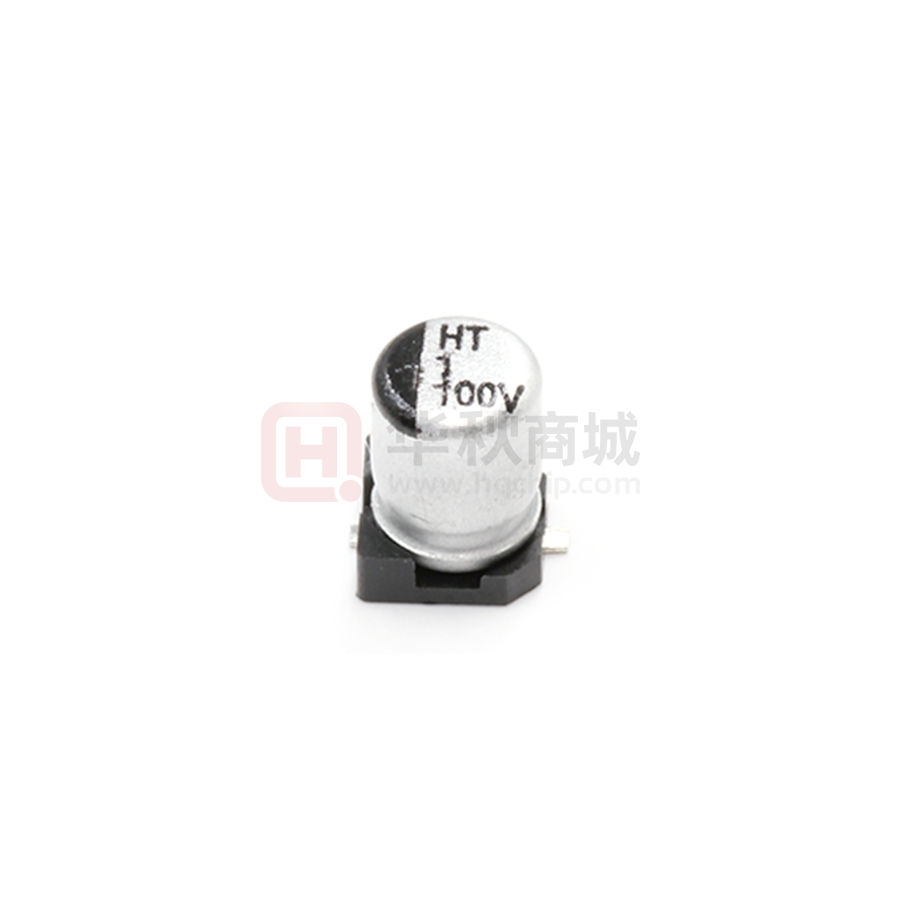
STANDARD OF HT SERIES CAPACITORS
1. Scope
This Specification covers "HT Series" V-chip aluminum electrolytic capacitors.
2. Reference Standard
Japanese industrial Standard JIS C-5141 characteristics W and JIS C-5101 except as specified in this
specification.
3. Environmental Protection Standard
Comply with the EU directive 2011/65/EC
4. Operating Temperature Range
-40C ~ +105C
5. Voltage Range
4 ~ 450V
6. Capacitance Range
0.1 ~ 6800F
7. Capacitance Tolerance
20% at 120Hz, 20C
8. Leakage Current
Leakage current (4~10) ≦0.01CV or 3μA, whichever is greater (after 2 minutes application of rated voltage)
Leakage current ( 12.5~ 16) ≦0.03CV or 4μA, whichever is greater (after 1 minute application of rated
voltage)
Leakage current ( 6.3~ 16) ≦ 0.04CV or 100μA, whichever is greater (after 5 minutes application of rated
voltage)
9. Tan
Measurement frequency: 120Hz, Temperature: 20C
4
6.3
10
16
25
35
50
63
Rated Voltage (V)
0.35 0.30 0.24 0.20 0.16 0.14 0.14 0.12
4~10
Tan (max.)
12.5~16 0.42 0.38 0.34 0.30 0.26 0.22 0.18 0.14
160~250
0.20
0.20
100
0.12
0.12
350~450
0.25
0.25
10. Stability at Low Temperature
Measurement frequency: 120Hz
Rated Voltage (V)
Impedance
Ratio
ZT/Z20 (max.)
4~10
12.5~16
Z(-25°C) / Z(20°C)
Z(-40°C) / Z(20°C)
Z(-25°C) / Z(20°C)
Z(-40°C) / Z(20°C)
4
7
15
7
17
6.3
4
8
5
12
10
3
6
4
10
16
2
4
3
8
25
2
4
2
5
35
2
3
2
4
50~63
2
3
2
3
100
160~250
3
4
2
3
2
3
2
6
350~450
3
6
4
10
11. Load Life
After 2000 hrs. (1000 hrs. for 4~ 6.3 5.4) application of the rated voltage at 105°C, they meet the
characteristics listed below.
Within 20% of initial value for capacitors of 10V or more
Capacitance Change
(Within 30% of initial value for capacitors of 4V or less)
200% or less of initial specified value
Tan
Leakage Current
Initial specified value or less
12. Self Life
After leaving capacitors under no load at 105 C for 1000 hours, they meet the specified value for load life
characteristics listed above
第 1 页
1
�HT SERIES
Aluminum Electrolytic Capacitors
13. Resistance to Soldering Heat
After reflow soldering and restored at room temperature, they meet the characteristics listed below.
Capacitance Change
Within 10% of initial value
Initial specified value or less
Tan
Leakage Current
Initial specified value or less
14. Surge Voltage
The surge voltage rating is the maximum DC over-voltage to which the capacitors may be subject of short periods not
exceeding approximately 30 seconds at infrequent intervals of not less than 5 minutes. The rated surges of the
electrolytic capacitors are as follows:
Rated voltage (V)
6.3
10
16
25
35
50
63
100
Surge voltage (V)
8
13
20
32
44
63
79
125
15. Marking and drawing (Unit: mm)
*1. Voltage mark for 6.3V is [6V]
*2. Applicable to 6.3x7.7
*3. Applicable to 810.5~10
*4. Applicable to 12.5~16
第 2 页
�HT SERIES
Aluminum Electrolytic Capacitors
16. Dimensions (Unit: mm)
D x L
4 x 5.4
5 x 5.4
6.3 x 5.4
6.3 x 7.7
8 x 6.2
8 x 10.5/12.5
10 x 10.5
10 x 12.5
12.5 x 13.5
12.5 x 16
16 x 16.5
A
1.9
2.2
2.6
2.6
3.3
3.2
3.2
3.2
4.7
4.7
5.5
B
4.3
5.3
6.6
6.6
8.3
8.3
10.3
10.3
13.0
13.0
17.0
C
4.3
5.3
6.6
6.6
8.3
8.3
10.3
10.3
13.0
13.0
17.0
E±0.2
1.0
1.3
2.2
2.2
2.2
3.1
4.4
4.4
4.4
4.4
6.7
φ4~φ8x6.2
L+0.4/L-0.1
φ6.3x7.7
L±0.3
φ8x10.5~φ16
L±0.5
5.4
5.4
5.4
7.7
6.2
10.5
10.5
13.5
13.5
16.0
16.5
17.
Taping Specifications
Carrier Tape
Drawing 1 (for 4 ~ 10)
Unreel direction
Feeding hole
Chip pocket
2.00.1
W0.3
4.00.1
1.5
D0.2
17.50.1
+0.1
-0
–
–
–
–
–
+
+
+
+
+
P0.1
Polarity
0.4
F0.1
B0.2
A0.2
Dimension
(Unit: mm)
DL
45.4
55.4/5.8
6.35.4/5.8
6.37.7/10.5
86.2
810.5/12.5
1010.5/12.5/13.5
W
12.0
12.0
16.0
16.0
16.0
24.0
24.0
P
8.0
12.0
12.0
12.0
12.0
16.0
16.0
F
5.5
5.5
7.5
7.5
7.5
11.5
11.5
A
5.0
6.0
7.0
7.0
8.7
8.7
10.7
B
5.0
6.0
7.0
7.0
8.7
8.7
10.7
D
6.2
6.2
6.2
8.4/11.0
6.8
11.0/13.2
11.0/14.0
Drawing 2 (for 12.5~16 )
Feeding hole
Unreel direction
Dimension
0.20.05
0.75 +0.1
-0
20.1
4.00.1
W0.3
Chip pocket
P0.1
D0.2
+0.1
1.5 -0
1.750.1
0.6 max.
F0.1
S0.1
B0.5
A0.5
第 3 页
(Unit: mm)
DL
12.513.5
12.516
1616.5/21.5
W
32.0
32.0
44.0
P
24.0
24.0
28.0
F
14.2
14.2
20.2
A
14.0
14.0
17.5
B
14.0
14.0
17.5
D
14.0
16.5
17.5/22.5
S
28.4
28.4
40.4
�HT SERIES
Aluminum Electrolytic Capacitors
Reel
13.00.5
80 min.
23
A
B max.
3.0
(Unit: mm)
D L
45.4/5.8
55.4/5.8
A
B
14
382
14
382
6.35.4
/7.7/10.5/11.5
18
382
86.2
810.5/12.5
1010.5/12.5
12.513.5/16
1616.5
18
382
26
382
26
382
34
382/332*
34
332
*For a small package
box
Package Quantity
Size
DL (mm)
Reel (pcs)
In-box (reels)
Quantity/In-box (pcs)
4 5.4/5.8
2,000
10
20,000
5 5.4/5.8
1,000
10
10,000
6.3 5.4/5.8
1,000
10
10,000
6.3 7.7
1,000
10
10,000
8 6.2
1,000
10
10,000
8 10.5
500
10
5,000
8 12.5
400
10
4,000
10 10.5
500
10
5,000
10 12.5
400
10
4,000
12.5 13.5
200
8
1,600
12.516
200
8
1,600
1616.5
125
2
250
*For a small package
●Please order by minimum package quantity
第 4 页
�HT SERIES
Aluminum Electrolytic Capacitors
18. Lead-free Reflow Soldering Condition
A. Recommended Conditions for Reflow Soldering
(1) A thermal condition system such as infrared radiation (IR) or hot blast should be adopted, and vapor heat
transfer systems (VPS) are not recommended.
(2) Reflow soldering should be within 2 cycles. Please make sure that the parts have enough cooling time.
(3) For lead-free type reflow soldering, please observe proper conditions below:
a) The time of preheating from 150°C to 200°C shall be within maximum 180 seconds;
b) The time of soldering temperature at 217°C measured on capacitors' top shall not exceed tL (second);
c) The peak temperature on capacitors' top shall not exceed Tp(°C), and the time within 5°C of actual
peak temperature shall not exceed tp (second).
B. Classification Reflow Profile
tp
Tp
Critical Zone
217°C to Tp
Ramp-up *1
Temperature
217
tL
200
(C)
Ramp-down *2
150
Preheat 180 sec Max.
25
25°C to Peak *3
Time (sec.)
*1. Average ramp-up rate is 3C/second max.
*2. Ramp-down rate is 6C /second max.
*3 .Time from 25C to peak temperature is 8 minutes max.
Classified at Temperature and Time Only for Standard Size without ( )
Size
Thickness (mm)
Volume (mm3)
Tp (°C)
tL (second)
Tp (second)
4~6.3, 86.2L
2.5
2000
240±0
40
5
19. Recommended Land Size (Unit: mm)
Y
a
Y
X
Size
4
5
6.3
8×10.5L
10×10.5L
12.5×13.5/16
16×16.5
X
1.6
1.6
1.6
2.5
2.5
3.0
3.5
第 5 页
Y
2.6
3.0
3.5
3.5
4.0
5.7
6.5
a
1.0
1.4
2.1
3.0
4.0
4.0
6.0
�HT SERIES
Aluminum Electrolytic Capacitors
20. Explanation of Part Number
1
2
4
5
Voltage (WV)
Series
Example:
3
HT 2A 1R0
6
7
Capacitance (F)
M
8
9
Cap. Tol. (%)
10
11
12
T y p e (mm)
0405
Type (Chip)
Capacitance Tolerance (20%)
Capacitance (1F)
Voltage (100V)
Series (HT)
21. Construction
22. Frequency Coefficient of Allowable Ripple Current
Frequency
4 ~ 10
Coefficien
t
12.5 ~
16
50Hz
120Hz
300Hz
1KHz
10KHz~
0.1 ~ 68F
0.70
1.00
1.17
1.36
1.50
100 ~ 3300F
0.85
1.00
1.08
1.20
1.30
~ 68F
0.75
1.00
1.35
1.57
2.00
100 ~ 680F
0.80
1.00
1.23
1.34
1.50
1000 ~ 6800F
0.85
1.00
1.10
1.13
1.15
23. Dimensions & Maximum Permissible Ripple Current
第 6 页
�HT SERIES
Aluminum Electrolytic Capacitors
Part Number
HT2A010M0405
Customer P/N
Capacitance
(F)
Working
Voltage
(V)
Case Size
DL
(mm)
Ripple current
(Ma rms) at
105℃, 120Hz
/
1
100
4X5.4
7
24. General Information for Application
The following precautions must be observed when using electrolytic capacitors.
A) Circuit Design
1) Please make sure that the environmental and mounting conditions to which the capacitor to be exposed are
within the conditions specified in this catalogue.
2) Operating temperature and applied ripple must be within the specifications.
The capacitor shall not be used in an ambient temperature which exceeds the operating temperature
specified in the specification.
Do not apply excessive current which exceeds the allowable ripple current.
3) Appropriate capacitors which comply with the life requirement of the products, should be selected when
designing the circuit.
4) Aluminum electrolytic capacitors are polarized. Make sure that no reserve voltage or AC voltage is applied
to the capacitors. Please use non-polarized capacitors for a circuit that can possibly see reserved polarity.
Note: Even non-polarizes capacitors cannot be used for AC voltage application.
5) For a circuit that repeats rapid charging/discharging of electricity, an appropriate capacitor that is capable of
enduring such a condition must be used. Welding machines and photo flash are a few examples of products
that contain such a circuit.
For appropriate choice of capacitors for circuit that repeat rapid charging/discharging, please consult us.
6) Make sure that no excess voltage (that is higher than the rated voltage) is applied to the capacitor.
Pleased pay attention so that the peak voltage, which is DC voltage overlapped by ripple current, should
not exceed the rated voltage.
In the case where more than two aluminum electrolytic capacitors are used in series, please make sure
that applied voltage should be lower than rated voltage should be applied to each capacitor equally
using a balancing resistor in parallel with the capacitor.
7) Outer sleeved of the capacitor is not guarantee as an electrical insulator. Do not use standard sleeve on a
capacitor in applications that require electrical insulation. When the application requires special insulation,
please contact our sales office for details.
8) Capacitors may fail if they are used under the following conditions:
Environmental (climatic) conditions
(a) Being exposed to water, high temperature & high humidity atmosphere, or condensation of moisture.
(b) Being exposed to oil or an atmosphere that is filled with particles of oil.
(c) Being exposed to salty water or an atmosphere that is filled with particles of salt.
(d) In an atmosphere filled with toxic gasses (such as hydrogen sulfide, sulfurous acid, nitrous acid,
chlorine, bromine, methyl bromide, ammonia, etc.).
(e) Being exposed to direct sunlight, ozone, ultraviolet ray, or radication.
(f) Being exposed to acidic or alkaline solutions.
Severe vibration and physical shock conditions that exceed our specification.
Vibration test condition:
Vibration frequency range: 10~55~10Hz
Sweet rate
: 10~55~10Hz per minute
Spacing
Sweet method
: logarithmic
Circuit
Amplitude or acceleration : 1.5mm (maximum acceleration is 10G)
board
Direction of vibration
: X, Y, Z direction
Testing time
: 2 hours per each direction
Shock is not applicable normally.
Pressure
If a particular condition is required, please contact our sales office.
relief vent
Circuit
9) When designing a circuit board, please pay attention to the following:
board
Have the hole spacing on the P.C. board match the lead spacing of
Gas hole
the capacitor.
There should not be any circuit pattern or circuit wire above the
capacitor safety vent.
Unless otherwise specified, following clearance should be made above
the pressure relief vent.
Case Diameter
Clearance Required
第 7 页
�Aluminum Electrolytic Capacitors
HT SERIES
6.3 to 16
2mm or more
18 to 35
3mm or more
40 or more
5mm or more
In case the vent side is placed toward P.C. board (such as end seal vented parts),
make a corresponding hole on the P.C. board to release the gas when vent is
operated. The hole should be made to match the capacitor vent position.
10) The main chemical solution of the electrolyte and the separator paper in the capacitor are combustible. The
electrolyte is conductive. When it comes in contact with the P.C. board, there is a possibility of pattern or
short circuit between the circuit pattern, which could result in smoking or fire. Do not locate any circuit
pattern beneath the capacitor end seal.
11) Do not design a circuit board so that heat generating components are placed near an aluminum electrolytic
capacitor or reserve side of P.C. board (under the capacitor).
12) Please refer to the recommended land size in this catalogue when you design in surface mount capacitors.
13) Electrical characteristics may vary depending on changes in temperature and frequency. Please consider the
variation when you design circuits.
14) When you install more than 2 capacitors in parallel, consider the balance of current following in to the
capacitor.
15) While mounting capacitors on double side P.C. board, the capacitors should be away from those
unnecessary base plate holes and connection holes.
B) Mounting
1) Once a capacitor has been assembled in the set and power applied, do not attempt to re-use the capacitor in
other circuits or application.
2) Electric potential between positive and negative terminal may exist as a result of returned electromotive
force, so please discharge the capacitor using 1K resistor.
3) Leakage current of the parts that have stored for more than 2 years may increase. When leakage current has
increased, please perform a voltage treatment using a 1K resistor.
4) Please confirm rating and polarity before installing capacitor on the P.C. board.
Push
5) Do not drop the capacitors on the floor, nor use a capacitors that was dropped.
6) Be careful not to deform the capacitor during installation.
7) Please confirm that the lead spacing of the capacitor matches the pad spacing
of the P.C.board prior to installation.
Circuit
8) Please pay attention that the clinch force is not too strong when capacitors are
board
placed and fixed by an automatic insertion machine.
9) Please pay attention to the mechanical shock to the capacitor by suction nozzle
of the automatic insertion machine or automatic mounted, or by product
checker, or by centering mechanism.
10) Hand soldering:
Soldering condition shall be confirmed to be within the specification.
If it is necessary that the leads must be formed due to a mismatch of the lead space to hole space on the
board, bend the lead prior to soldering without applying too much stress to the capacitor.
If you need to remove parts which were soldered, please melt the solder enough so that stress is not
applied to lead.
Please pay attention so that solder iron does not touch any portion of capacitor body.
11) Flow soldering (wave solder):
Aluminum capacitor body must not be submerged into the solder bath.
Soldering condition must be confirmed to be within specification.
Please avoid having flux adhere to any portion except the terminal.
Please avoid contact between other components and the aluminum capacitor.
12) Reflow soldering (SMD only):
Please follow "Reflow Soldering Conditions" in this catalogue.
When an infrared heater is used, please pay attention to the extent of heating since the absorption rate of
infrared, will vary due to difference in the color and size of the capacitor.
13) Do not tilt lay down or twist the capacitor body after the capacitor are soldered to the P.C. board.
14) Do not carry the P.C. board by grasping the soldered capacitor.
15) Please do not allow anytime to touch the capacitor after soldering. If P.C. board are stored in stack, please
make sure P.C. board or the other components do not touch the capacitor. The capacitors shall not be
effected by any radiated heat from the soldered P.C. board or other components after soldering.
16) Cleaning
Do not clean capacitors with halogenated cleaning agent. However, if it is necessary to clean with
halogenated cleaning agent, please contact our sales office.
第 8 页
�Aluminum Electrolytic Capacitors
HT SERIES
Recommended cleaning method:
Applicable: Any type, any ratings.
Cleaning agents:
Based alcohol solvent cleaning agent: Isopropyl Alcohol
Based water solvent cleaning agent:
Premium alcohol solvent type: Pine Alpha ST-100S, Techno Care FRW14~17, Sanelek B-12
Surfactant type: cleaning through 750H/750L/710M
Alkaline saponification agent: Aqua Cleaner 210SEP
Cleaning conditions:
Total cleaning time shall be within 5 minutes by immersion, ultrasonic or other method. Temperature
of the cleaning agent shall
be 60C or lower. After cleaning, capacitors should be dried using hot air for minimum of 10 minutes
along with the P.C. board. Hot air temperature should be below the maximum operating temperature of
the capacitor. Insufficient dry after water rinse may cause appearance problems, sleeve shirk, bottomplate bulge and such.
Avoid using ozone destructive substance for cleaning agents to concern about global environment.
17) Fixing Material and Coating Material
Do not use any affixing or coating materials, which contain halide substance.
Remove flux and any contamination, which remains in the gap between the end seal and P.C. board.
Please dry the cleaning agent on the P.C. board before using affixing or coating materials.
Please do not apply any material all around the end seal when using affixing or coating materials.
There are variations of cleaning agents, fixing and coating materials, so please contact those manufacture
or our sales office to make sure that the material would not cause any problems.
18) Other
Wooden package material may be subjected to fumigation by a halogen (e.g. methyl bromide) before they
are exported in order to protect them against pests. If devices with aluminum electrolytic capacitors or
capacitors themselves are directly fumigated or packed with the pallet that is fumigated, the capacitors may
internaIly corrode due to the halogen contents of fumigation agents.
C) In The Equipment
1) Do not directly touch terminal by hand.
2) Do not short between terminal by conductor, nor spill conductible liquid such as alkaline or acidic solution
on or near the capacitor.
3) Please make sure that the ambient conditions where the set is installed not have any of the following
conditions:
Where capacitors are exposed to water, high temperature & high humidity atmosphere, or condensation
of moisture.
Where capacitors are exposed to oil or an atmosphere that is filled with particles of oil.
Where capacitors are exposed to salty water, high temperature & high humidity atmosphere, or
condensation of moisture.
The atmosphere is filled with toxic acid gasses (e.g. hydrogen sulfide, sulfurous acid, nitrous acid,
chlorine, bromine, methy bromide, etc.).
The atmosphere is filled with toxic alkaline gasses (e.g. ammonia).
Where capacitors are exposed to acidic or alkaline solutions.
Since shrinkage, bulging and/or crack could be seen on outer sleeve of capacitor when capacitors are
used in atmosphere where condensation of moisture occures, please confirm their adaptation before the
use. The condensation of moisture could occure when temperature cycling test/rapid change of
temperature test is performed, in this case, aforementioned sleeve problem could be seen.
D) Maintenance and Inspection
Please periodically inspect the aluminum capacitors that are installed in industrial equipment. The following
Items should be checked:
1) Appearance: Remarkable abnormality such as vent operation, leaking electrolyte etc.
2) Electrical characteristic: Capacitance, dielectric loss tangent, leakage current etc., which are specified in this
catalogue.
E) In an Emergency
1) If you see smoke due to operation of safety vent, turn off the main switch or pull out the plug from the
outlet.
2) Do not draw your face to the safety vent since gas over 100C will be emitted when the safety vent operates.
If the gas has entered your eyes, please flush your eyes immediately in pure water. If you breathed the gas
第 9 页
�Aluminum Electrolytic Capacitors
HT SERIES
immediately wash out your mouth and throat with water.
3) Do not ingest electrolyte. If your skin is exposed to electrolyte, please wash it away using soap and water.
F) Storage
1) Do not keep capacitor in high temperature and high humidity.
Storage conditions should be:
Temperature : +5C ~ +35C
Humidity
: Lower than 75%
Place
: Indoor
2) Avoid ambient conditions where capacitors can be covered with water, brine or oil.
3) Avoid ambient conditions where capacitors are exposed to poisonous gases such as hydrogen sulfide,
sulfurous acid, nitrous acid, chlorine, ammonium etc.
4) Do not keep capacitor in conditions that expose the capacitor to ozone, ultraviolet ray or radiation.
5) Store capacitors in a packed condition as much as possible.
G) Disposal
1) Please dispose capacitors in either of the following ways:
Incinerate (at a temperature of 800C or higher) capacitors after crushing parts or making a hole on the
capacitor body.
If incineration is not applicable, hand them over to a waste disposal agent and have them buried in a
landfilI.
2) When removing a capacitor from the circuit board or when disposing of capacitor please ensure that the
capacitor is properly discharged.
25. Other
All design and specifications are for reference only and is subject to change without prior notice. If any doubt
about safety for your application, please contact us immediately for technical assistance before purchase.
NO.
Prohibited Substances
1
Cd
content
N.D
2
Pb