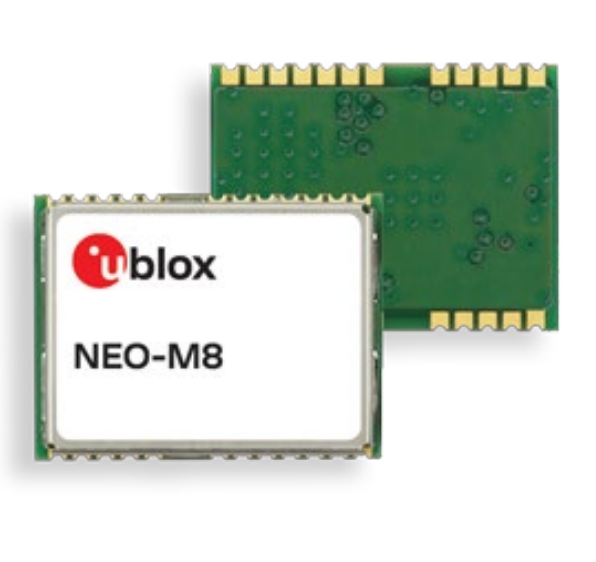
NEO-M8
u-blox M8 concurrent GNSS modules
Data sheet
Abstract
This data sheet describes the NEO-M8 module family which provides concurrent reception of up to 3 GNSS
(GPS, Galileo, GLONASS, BeiDou). NEO-M8 is backward compatible with NEO-7, NEO-6 and NEO-5
families.
www.u-blox.com
UBX-15031086 - R11
C1-Public
�NEO-M8 - Data sheet
Document information
Title
NEO-M8
Subtitle
u-blox M8 concurrent GNSS modules
Document type
Data sheet
Document number
UBX-15031086
Revision and date
R11
Document status
Production information
22-Oct-2021
Disclosure restriction C1-Public
Product status
Corresponding content status
In Development /
Prototype
Objective Specification
Target values. Revised and supplementary data will be published later.
Engineering Sample
Advance Information
Data based on early testing. Revised and supplementary data will be published later.
Initial Production
Early Production Information
Data from product verification. Revised and supplementary data may be published later.
Mass Production /
End of Life
Production Information
Document contains the final product specification.
This document applies to the following products:
Product name
Type number
Firmware version
PCN reference
NEO-M8N
NEO-M8N-0-12
Flash FW SPG 3.01
UBX-21015025
NEO-M8Q
NEO-M8Q-0-12
ROM SPG 3.01
UBX-21015025
NEO-M8M
NEO-M8M-0-11
ROM SPG 3.01
UBX-21015022
NEO-M8J
NEO-M8J-0-11
Flash FW SPG 3.05
UBX-21015025
u-blox or third parties may hold intellectual property rights in the products, names, logos and designs included in this
document. Copying, reproduction, modification or disclosure to third parties of this document or any part thereof is only
permitted with the express written permission of u-blox.
The information contained herein is provided “as is” and u-blox assumes no liability for its use. No warranty, either express or
implied, is given, including but not limited to, with respect to the accuracy, correctness, reliability and fitness for a particular
purpose of the information. This document may be revised by u-blox at any time without notice. For the most recent
documents, visit www.u-blox.com.
Copyright © u-blox AG.
UBX-15031086 - R11
C1-Public
Document information
Page 2 of 29
�NEO-M8 - Data sheet
Contents
Document information ................................................................................................................................ 2
Contents .......................................................................................................................................................... 3
1
Functional description ......................................................................................................................... 5
1.1 Overview ........................................................................................................................................................ 5
1.2 Product features ......................................................................................................................................... 5
1.3 Performance ................................................................................................................................................. 6
1.4 Block diagram .............................................................................................................................................. 7
1.5 Supported GNSS constellations .............................................................................................................. 7
1.5.1
GPS ........................................................................................................................................................ 7
1.5.2
GLONASS ............................................................................................................................................. 8
1.5.3
BeiDou ................................................................................................................................................... 8
1.5.4
Galileo .................................................................................................................................................... 8
1.6 Assisted GNSS (A-GNSS) .......................................................................................................................... 8
1.6.1
AssistNowTM Online ............................................................................................................................ 8
1.6.2
AssistNowTM Offline ........................................................................................................................... 8
1.6.3
AssistNowTM Autonomous ............................................................................................................... 9
1.7 Augmentation systems ............................................................................................................................. 9
1.7.1
Satellite-based augmentation system (SBAS) ............................................................................ 9
1.7.2
QZSS ..................................................................................................................................................... 9
1.7.3
IMES ...................................................................................................................................................... 9
1.7.4
Differential GPS (D-GPS) .................................................................................................................10
1.8 Broadcast navigation data and satellite signal measurements .....................................................10
1.9 Odometer ....................................................................................................................................................10
1.10 Data logging (NEO-M8N/J) .....................................................................................................................10
1.11 Geofencing..................................................................................................................................................10
1.12 Message integrity protection .................................................................................................................11
1.13 Spoofing detection ...................................................................................................................................11
1.14 EXTINT: External interrupt......................................................................................................................11
1.14.1 Pin control ..........................................................................................................................................11
1.14.2 Aiding ..................................................................................................................................................11
1.15 TIMEPULSE ................................................................................................................................................12
1.16 Protocols and interfaces .........................................................................................................................12
1.17 Interfaces ....................................................................................................................................................12
1.17.1 UART ...................................................................................................................................................12
1.17.2 USB ......................................................................................................................................................12
1.17.3 SPI ........................................................................................................................................................12
1.17.4 Display data channel (DDC) ............................................................................................................13
1.18 Clock generation........................................................................................................................................13
1.18.1 Oscillators ..........................................................................................................................................13
1.18.2 Real-time clock (RTC) ......................................................................................................................13
UBX-15031086 - Production information
C1-Public
Contents
Page 3 of 29
�NEO-M8 - Data sheet
1.19 Power management .................................................................................................................................13
1.19.1 DC-DC converter ...............................................................................................................................13
1.19.2 Power mode setup ............................................................................................................................13
1.19.3 Continuous mode ..............................................................................................................................14
1.19.4 Power save mode ..............................................................................................................................14
1.20 Antenna .......................................................................................................................................................14
1.21 LNA_EN .......................................................................................................................................................14
2
Pin definition ........................................................................................................................................ 15
2.1 Pin assignment ..........................................................................................................................................15
2.2 Pin name changes .....................................................................................................................................16
3
Configuration management ............................................................................................................ 17
3.1 Interface selection (D_SEL) ....................................................................................................................17
4
Electrical specification ..................................................................................................................... 18
4.1 Absolute maximum rating.......................................................................................................................18
4.2 Operating conditions ................................................................................................................................18
4.3 Indicative current requirements ............................................................................................................19
4.4 SPI timing diagrams .................................................................................................................................20
4.4.1
Timing recommendations ...............................................................................................................20
4.5 DDC timing diagrams ...............................................................................................................................20
5
Mechanical specifications ............................................................................................................... 21
6
Reliability tests and approvals....................................................................................................... 22
6.1 Reliability tests ..........................................................................................................................................22
6.2 Approvals ....................................................................................................................................................22
7
Product handling and soldering ..................................................................................................... 23
7.1 Packaging ...................................................................................................................................................23
7.1.1
Reels ....................................................................................................................................................23
7.1.2
Tapes ...................................................................................................................................................23
7.2 Shipment, storage and handling ...........................................................................................................24
7.2.1
Moisture sensitivity levels ..............................................................................................................24
7.2.2
Reflow soldering ................................................................................................................................24
7.2.3
ESD handling precautions ..............................................................................................................24
8
Default messages ............................................................................................................................... 25
9
Labeling and ordering information ............................................................................................... 26
9.1 Product labeling.........................................................................................................................................26
9.2 Explanation of codes ................................................................................................................................26
9.3 Ordering codes ...........................................................................................................................................26
Appendix ....................................................................................................................................................... 27
A
Glossary ................................................................................................................................................. 27
Related documents ................................................................................................................................... 28
Revision history .......................................................................................................................................... 28
Contact .......................................................................................................................................................... 29
UBX-15031086 - Production information
C1-Public
Contents
Page 4 of 29
�NEO-M8 - Data sheet
1
Functional description
1.1 Overview
The NEO-M8 series of concurrent GNSS modules is built on the high-performing u-blox M8 GNSS
engine in the industry-proven NEO form factor.
The NEO-M8 modules utilize concurrent reception of up to three GNSS systems (GPS/Galileo together
with BeiDou or GLONASS), recognize multiple constellations simultaneously and provide outstanding
positioning accuracy in scenarios where urban canyon or weak signals are involved. For even better
and faster positioning improvement, the NEO-M8 series supports augmentation of QZSS, GAGAN
and IMES together with WAAS, EGNOS, and MSAS. The NEO-M8 series also supports message
integrity protection, geofencing, and spoofing detection with configurable interface settings to easily
fit to customer applications.
The NEO‑M8M is optimized for cost-sensitive applications, while NEO-M8N and NEO-M8Q provide
the best performance. The future-proof NEO-M8N and NEO-M8J include an internal flash that allows
future firmware updates. This makes NEO-M8N and NEO-M8J perfectly suited to industrial and
automotive applications.
The I2C-compliant DDC interface provides connectivity and enables synergies with most u‑blox
cellular modules. For RF optimization, NEO-M8J, NEO-M8N, and NEO-M8Q feature an additional
front-end LNA for easier antenna integration and a front-end SAW filter for increased jamming
immunity.
u-blox M8 modules use GNSS chips qualified according to AEC‑Q100, are manufactured in ISO/TS
16949 certified sites, and are fully tested on a system level. Qualification tests are performed as
stipulated in the ISO16750 standard: “Road vehicles – Environmental conditions and testing for
electrical and electronic equipment”.
The u-blox NEO-M8 modules can also benefit from the u-blox AssistNow assistance service. The
Online service provides GNNS broadcast parameters, for example, ephemeris, almanac plus time or
rough position to reduce the receiver’s time to first fix significantly and to improve acquisition
sensitivity. The extended validity of AssistNow Offline data (up to 35 days) and AssistNow
Autonomous data (up to 6 days) provide faster acquisition after a long off time.
☞
See section 1.6 for more information concerning the NEO-M8 related AssistNow Assistance.
1.2 Product features
●
NEO-M8Q
●
●
●
●
●
3
●
●
●
●
●
NEO-M8M
●
●
●
●
●
3
●
●
●
●
NEO-M8J
●
●
●
●
●
3
●
●
●
●
●
●
●
●
●
●
●
T
1
●
●
●
●
T
1
●
●
C
1
●
●
C
1
●
●
●
●
Automotive
●
Professional
●
Standard
Programmable (flash)
●
Built-in antenna supply
and supervisor
Timepulse
DDC (I2C compliant)
●
Built-in antenna
SPI
●
Oscillator
USB
3
RTC crystal
UART
●
Additional LNA
2.7 V – 3.6 V
●
Grade
Additional SAW
BeiDou
●
Timing
●
Dead Reckoning
●
High Precision GNSS
NEO-M8N
Standard Precision
Galileo
Features
Data logging
Supply Interfaces
Number of concurrent
GNSS
1.65 V – 3.6 V
GNSS
GLONASS
Category
GPS / QZSS
Model
C = Crystal / T = TCXO
UBX-15031086 - Production information
C1-Public
Functional description
Page 5 of 29
�NEO-M8 - Data sheet
1.3 Performance
Parameter
Specification
Receiver type
72-channel u-blox M8 engine
GPS L1C/A, SBAS L1C/A, QZSS L1C/A, QZSS L1 SAIF, GLONASS L1OF, BeiDou B1I, Galileo E1B/C
Accuracy of time
pulse signal
RMS
99%
30 ns
60 ns
Frequency of time
pulse signal
0.25 Hz…10 MHz
(configurable)
Operational limits 1
Dynamics
≤4g
Altitude
50,000 m
Velocity
500 m/s
Velocity accuracy 2
Heading accuracy
0.05 m/s
2
0.3 degrees
GNSS
Horizontal position
accuracy 3
GPS & GLONASS
GPS
GLONASS
BeiDou
Galileo
With SBAS
2.5 m
2.0 m
2.5 m
2.0 m
4m
-
3m
-
3m
-
NEO-M8N
5 Hz
10 Hz
10 Hz
10 Hz
10 Hz
NEO-M8Q
10 Hz
18 Hz
18 Hz
18 Hz
18 Hz
Cold start
26 s
29 s
30 s
34 s
45 s
1s
1s
1s
1s
1s
NEO-M8N/Q
Max navigation
update rate
Time-To-First-Fix 4
Hot start
Aided starts
Sensitivity 6
5
2s
2s
2s
3s
7s
Tracking &
Navigation
–167 dBm
–166 dBm
-166 dBm
-160 dBm
-159 dBm
Reacquisition
–160 dBm
–160 dBm
-156 dBm
-157 dBm
-153 dBm
Cold start
–148 dBm
–148 dBm
-145 dBm
-143 dBm
-138 dBm
Hot start
–157 dBm
–157 dBm
-156 dBm
-155 dBm
-151 dBm
NEO-M8J
5 Hz
10 Hz
10 Hz
10 Hz
10 Hz
NEO-M8M
10 Hz
18 Hz
18 Hz
18 Hz
18 Hz
Cold start
26 s
30 s
33 s
39 s
57 s
Hot start
1s
1s
1s
1s
1s
Aided starts 6
3s
3s
3s
7s
7s
Tracking &
Navigation
-164 dBm
-164 dBm
-163 dBm
-160 dBm
-154 dBm
Reacquisition
-160 dBm
-159 dBm
-156 dBm
-155 dBm
-152dBm
Cold start
-148 dBm
-147 dBm
-145 dBm
-143 dBm
-133 dBm
Hot start
-157 dBm
-156 dBm
-155 dBm
-155 dBm
-151 dBm
NEO-M8J/M
Max navigation
update rate
Time-To-First-Fix 4
Sensitivity
6
Table 1: NEO-M8 performance in different GNSS modes (default: concurrent reception of GPS and GLONASS including
QZSS, SBAS)
1
2
3
4
5
6
Assuming Airborne < 4 g platform
50% at 30 m/s
CEP, 50%, 24 hours static, -130 dBm, > 6 SVs
All satellites at -130 dBm, except Galileo at -127 dBm
Dependent on aiding data connection speed and latency
Demonstrated with a good external LNA
UBX-15031086 - Production information
C1-Public
Functional description
Page 6 of 29
�NEO-M8 - Data sheet
1.4 Block diagram
Figure 1: NEO-M8 block diagram
1.5
Supported GNSS constellations
The NEO-M8 GNSS modules are concurrent GNSS receivers which can receive and track multiple
GNSS systems: GPS, Galileo, GLONASS and BeiDou. Owing to the dual-frequency RF front-end
architecture, either GLONASS or BeiDou can be processed concurrently with GPS and Galileo signals
providing reception of three GNSS systems. By default the M8 receivers are configured for concurrent
GPS and GLONASS, including SBAS and QZSS reception. If power consumption is a key factor, the
receiver should be configured for a single GNSS operation using GPS, Galileo, GLONASS or BeiDou and
disabling QZSS and SBAS. The module can be configured to receive any single GNSS constellation or
within the set of permissible combinations shown below.
GPS
Galileo
GLONASS
BeiDou
•
•
–
–
•
•
•
–
•
•
–
•
•
–
•
–
•
–
–
•
–
•
•
–
–
•
–
•
–
–
•
•
Table 2 Permissible GNSS combinations (• = enabled)
☞
The SBAS and QZSS augmentation systems can be enabled only if GPS operation is configured.
☞
Galileo is not enabled as the default configuration.
1.5.1
GPS
The NEO-M8 positioning modules are designed to receive and track the L1C/A signals provided at
1575.42 MHz by the global positioning system (GPS).
UBX-15031086 - Production information
C1-Public
Functional description
Page 7 of 29
�NEO-M8 - Data sheet
1.5.2
GLONASS
The NEO-M8 modules can receive and process the GLONASS satellite system as an alternative to the
US-based global positioning system (GPS). u-blox NEO-M8 positioning modules are designed to
receive and track the L1OF signals GLONASS provides at 1602 MHz + k*562.5 kHz, where k is the
satellite’s frequency channel number (k = –7,..., 5, 6). The ability to receive and track GLONASS L1OF
satellite signals allows design of GLONASS receivers where required by regulations.
To take advantage of GPS and GLONASS, dedicated hardware preparation must be made during the
design-in phase. See the NEO-8Q / NEO-M8 Hardware integration manual [1] for u-blox design
recommendations.
1.5.3
BeiDou
The NEO-M8 modules can receive and process the B1I signals broadcast at 1561.098 MHz from the
BeiDou Navigation Satellite System. The ability to receive and track BeiDou signals in conjunction with
another constellation results in higher coverage, improved reliability and better accuracy.
1.5.4
Galileo
The NEO-M8 positioning modules can receive and track the E1-B/C signals centered on the GPS L1
frequency band. GPS and Galileo signals can be processed concurrently together with either BeiDou
or GLONASS signals, enhancing coverage, reliability and accuracy. The SAR return link message
(RLM) parameters for both short and long versions are decoded by the receiver and made available to
users via UBX proprietary messages.
☞
Galileo has been implemented according to ICD release 1.2 (November 2015) and verified with live
signals from the Galileo in-orbit validation campaign.
☞
Galileo reception is by default disabled, but can be enabled by sending a configuration message
(UBX-CFG-GNSS) to the receiver. See the u-blox 8 / u-blox M8 Receiver Description including
Protocol Specification [2] for more information.
1.6 Assisted GNSS (A-GNSS)
Supply of GNSS receiver assistance information, such as ephemeris, almanac, rough user position
and time, will reduce the time to first fix significantly and improve acquisition sensitivity. The NEOM8J, NEO-M8N, NEO-M8Q, and NEO-M8M modules support the u-blox AssistNow Online and
AssistNow Offline A-GNSS services, support AssistNow Autonomous, and are OMA SUPL compliant.
1.6.1
AssistNowTM Online
With AssistNow Online, an internet-connected host downloads assistance data from the u-blox
AssistNow Online service to the receiver at system start-up. The Multi-GNSS Assistance (MGA)
service is an HTTP protocol-based network operator-independent service.
Supplying assistance information, such as ephemeris, almanac, a rough last position and time, can
reduce the time to first fix significantly and improve acquisition sensitivity.
☞
The AssistNow Online service provides data for GPS, GLONASS, BeiDou, Galileo and QZSS
1.6.2
AssistNowTM Offline
With the AssistNow Offline service, users can download long-term orbit data over the internet at their
convenience. The orbit data can be stored in the GNSS receiver’s SQI flash memory or, alternatively,
within the memory of the application processor. The function requires no connectivity at system
UBX-15031086 - Production information
C1-Public
Functional description
Page 8 of 29
�NEO-M8 - Data sheet
start-up, enabling a position fix within seconds, even when no network is available. AssistNow Offline
offers augmentation for up to 35 days.
☞
AssistNow Offline service provides data for GPS and GLONASS only, BeiDou and Galileo are not
currently supported.
1.6.3
AssistNowTM Autonomous
AssistNow Autonomous provides aiding information without the need for a host or external network
connection. Based on previous broadcast satellite ephemeris data downloaded to and stored by the
GNSS receiver, AssistNow Autonomous automatically generates accurate predictions of satellite
orbital data (“AssistNow Autonomous data”) that is usable for future GNSS position fixes. The
concept capitalizes on the periodic nature of GNSS satellites; by capturing strategic ephemeris data
at specific times of the day. The flash memory-based NEO-M8N/J modules can predict accurate
satellite ephemeris for up to six days after initial reception. The ROM-based NEO-M8M/Q modules
can use only GPS satellites with a prediction time of up to three days.
u-blox AssistNow Autonomous benefits are:
•
•
•
•
☞
Faster fix in situations where satellite signals are weak
No connectivity required
Compatible with AssistNow Online (can work stand-alone, or in tandem with AssistNow Online
service)
No integration effort; calculations are done in the background, transparent to the user
For more details on A-GNSS, see the u-blox 8 / u-blox M8 Receiver Description including Protocol
Specification [2].
1.7 Augmentation systems
1.7.1
Satellite-based augmentation system (SBAS)
The u-blox NEO-M8 modules support reception of SBAS broadcast signals. These systems
supplement GNSS data with additional regional or wide area GPS augmentation data. The system
broadcasts range correction and integrity information via satellite which can be used by GNSS
receivers to improve resulting precision. SBAS satellites can be used as additional satellites for
ranging (navigation), further enhancing availability. The following SBAS types are supported: GAGAN,
WAAS, EGNOS and MSAS.
☞
For more details, see the u-blox 8 / u-blox M8 Receiver Description including Protocol Specification
[2].
1.7.2
QZSS
The Quasi-Zenith Satellite System (QZSS) is a regional navigation satellite system that transmits
additional GPS L1 C/A signals for the Pacific region covering Japan and Australia. NEO-M8 positioning
modules are able to receive and track these signals concurrently with GPS signals, resulting in better
availability especially under challenging signal conditions, e.g. in urban canyons. The L1- SAIF signal
provided by QZSS can be enabled for reception via a GNSS configuration message.
1.7.3
IMES
The Japanese Indoor Messaging System (IMES) system is used for indoor position reporting using
low-power transmitters which broadcast a GPS–like signal. NEO-M8 modules can be configured to
receive and demodulate the signal to provide an in-door location estimate.
☞
This service is authorized and available only in Japan.
UBX-15031086 - Production information
C1-Public
Functional description
Page 9 of 29
�NEO-M8 - Data sheet
☞
IMES reception is disabled by default.
1.7.4
Differential GPS (D-GPS)
u-blox receivers support Differential GPS (D-GPS) data according to RTCM specification 10402.3 [4]:
The use of D-GPS improves GPS position accuracy. The RTCM implementation supports the following
RTCM 2.3 messages.
Message type
Description
1
Differential GPS corrections
2
Delta differential GPS corrections
3
GPS reference station parameters
9
GPS partial correction set
Table 3: Supported RTCM 2.3 messages
☞
RTCM corrections cannot be used together with SBAS.
☞
For more details, see the u-blox 8 / u-blox M8 Receiver Description including Protocol Specification
[2].
1.8 Broadcast navigation data and satellite signal
measurements
The NEO-M8 modules can output all the GNSS broadcast data upon reception from tracked satellites.
This includes all the supported GNSS signals plus the augmentation services SBAS, QZSS and IMES.
The receiver also makes available the tracked satellite signal information, that is, raw code phase and
Doppler measurements in a form aligned to the ETSI mobile cellular location services protocol (RRLP)
[6]. For more details, see the u-blox 8 / u-blox M8 Receiver Description including Protocol Specification
[2].
1.9 Odometer
The odometer function provides information on travelled ground distance (in meters) based on the
position and Doppler-based velocity output from the navigation solution. For each computed distance
since the last odometer reset, the odometer estimates a 1-sigma accuracy value. The total
cumulative ground distance is maintained and saved in the BBR memory.
☞
The odometer feature is disabled by default. For more details, see the u-blox 8 / u-blox M8 Receiver
Description including Protocol Specification [2].
1.10 Data logging (NEO-M8N/J)
The NEO-M8N and NEO-M8J modules can be used in data logging applications. The data logging
feature enables continuous storage of position, velocity and time information to an onboard SQI flash
memory (at least 16 Mbit). It can also log the distance from the odometer. The information can be
downloaded from the receiver later for further analysis or for conversion to a mapping tool. For more
information see the u-blox 8 / u-blox M8 Receiver Description including Protocol Specification [2].
1.11 Geofencing
The u-blox NEO-M8 modules support up to four circular Geofencing areas defined on the Earth’s
surface using a 2D model. Geofencing is active when at least one Geofence is defined, the current
status can be found by polling the receiver. A GPIO pin can be nominated to indicate status to, for
example, wake up a host on activation.
UBX-15031086 - Production information
C1-Public
Functional description
Page 10 of 29
�NEO-M8 - Data sheet
1.12 Message integrity protection
The NEO-M8 modules provide a function to detect third party interference with the UBX message
steam sent from receiver to host. The security mechanism “signs” nominated messages via a
subsequent UBX message. This message signature is then compared with one generated by the host
to determine if the message data has been altered. The signature algorithm seed can use one fixed
secret ID key set by eFuse in production and a dynamic ID key set by the host, enabling users to detect
“man-in-the-middle” style attacks.
1.13 Spoofing detection
Spoofing is a process whereby a malicious third party tries to control the reported position via a “fake”
GNSS broadcast signal. This may result in the form of reporting incorrect position, velocity or time.
To combat against this, NEO-M8 modules include spoofing detection measures to alert the host when
signals appear to be suspicious. The receiver combines a number of checks on the received signals
looking for inconsistencies across several parameters.
☞
This feature does not guarantee detecting all spoofing attacks.
1.14 EXTINT: External interrupt
EXTINT is an external interrupt pin with fixed input voltage thresholds with respect to VCC. It can be
used for control of the receiver or for aiding.
For more information about how to implement and configure these features, see the u-blox 8 / u-blox
M8 Receiver Description including Protocol Specification [2] and the NEO-8Q / NEO-M8 Hardware
integration manual [1].
1.14.1 Pin control
The pin control feature allows overriding the automatic active/inactive cycle of power save mode. The
state of the receiver can be controlled through the EXTINT pin.
The receiver can also be forced OFF using EXTINT when power save mode is not active.
1.14.2 Aiding
The EXTINT pin can be used to supply time or frequency aiding data to the receiver.
For time aiding, hardware time synchronization can be achieved by connecting an accurate time pulse
to the EXTINT pin.
Frequency aiding can be implemented by connecting a periodic rectangular signal with a frequency up
to 500 kHz and arbitrary duty cycle (low/high phase duration must not be shorter than 50 ns) to the
EXTINT pin. Provide the applied frequency value to the receiver using UBX messages.
UBX-15031086 - Production information
C1-Public
Functional description
Page 11 of 29
�NEO-M8 - Data sheet
1.15 TIMEPULSE
A configurable time pulse signal is available with the NEO-M8N, NEO-M8J, NEO-M8Q, and NEO-M8M
modules.
The TIMEPULSE output generates pulse trains synchronized with GPS or UTC time grid with intervals
configurable over a wide frequency range. Thus it may be used as a low frequency time
synchronization pulse or as a high frequency reference signal.
By default the time pulse signal is configured to 1 pulse per second. For more information, see the
u-blox 8 / u-blox M8 Receiver Description including Protocol Specification [2].
1.16 Protocols and interfaces
Protocol
Type
NMEA 0183, version 4.0 (V2.1, V2.3 or V4.1 configurable) Input/output, ASCII
UBX
Input/output, binary, u-blox proprietary
RTCM
Input message, 1, 2, 3, 9
Table 4: Available protocols
All protocols are available on UART, USB, DDC (I2C-compliant) and SPI. For specification of the various
protocols, see the u-blox 8 / u-blox M8 Receiver Description including Protocol Specification [2].
1.17 Interfaces
A number of interfaces are provided either for data communication or memory access. The embedded
firmware uses these interfaces according to their respective protocol specifications.
1.17.1 UART
The NEO-M8 modules include one UART interface, which can be used for communication to a host. It
supports configurable baud rates. For supported baud rates, see the u-blox 8 / u-blox M8 Receiver
Description including Protocol Specification [2].
☞
Designs must allow access to the UART and the SAFEBOOT_N function pin for future service,
updates and reconfiguration.
1.17.2 USB
A USB interface, which is compatible to USB version 2.0 FS (full speed, 12 Mbit/s), can be used for
communication as an alternative to the UART. The pull-up resistor on pin USB_DP is integrated to
signal a full-speed device to the host. The VDD_USB pin supplies the USB interface. The u-blox USB
(CDC-ACM) driver supports Windows Vista and Windows 7 and 8 operating systems. A separate
driver (CDC-ACM) is not required for Windows 10 which has a built-in USB-serial driver. However,
plugging initially into an internet-connected Windows 10 PC will download the u-blox combined sensor
and VCP driver package.
☞
USB drivers can be downloaded from the u-blox web site, www.u-blox.com.
1.17.3 SPI
The SPI interface is designed to allow communication to a host CPU. The interface can be operated in
slave mode only. The maximum transfer rate using SPI is 125 kB/s and the maximum SPI clock
frequency is 5.5 MHz. Note that SPI is not available in the default configuration because its pins are
shared with the UART and DDC interfaces. The SPI interface can be enabled by connecting D_SEL (pin
2) to ground (see section 3.1).
UBX-15031086 - Production information
C1-Public
Functional description
Page 12 of 29
�NEO-M8 - Data sheet
1.17.4 Display data channel (DDC)
An I2C-compliant DDC interface is available for communication with an external host CPU or u-blox
cellular modules. The interface can be operated in slave mode only. The DDC protocol and electrical
interface are fully compatible with the fast-mode of the I2C industry standard. Since the maximum
SCL clock frequency is 400 kHz, the maximum transfer rate is 400 kbit/s.
1.18 Clock generation
1.18.1 Oscillators
NEO-M8 GNSS modules are available in TCXO and crystal versions. The TCXO allows accelerated weak
signal acquisition, enabling faster start and reacquisition times.
Oscillators used on NEO-M8 modules are carefully selected and screened for stability and against
frequency perturbations across the full operating range (–40 °C to +85 °C).
The careful selection and qualification of critical parts, such as GNSS oscillators, has resulted in ublox modules being the most reliable positioning modules in the industry, particularly in challenging
conditions.
1.18.2 Real-time clock (RTC)
The RTC is driven by a 32 kHz oscillator using an RTC crystal. If the main supply voltage fails, and a
battery is connected to V_BCKP, parts of the receiver switch off, but the RTC still runs providing a
timing reference for the receiver. This operating mode is called hardware backup mode, which enables
all relevant data to be saved in the backup RAM to allow a hot or warm start later.
1.19 Power management
u-blox M8 technology offers a power-optimized architecture with built-in autonomous power saving
functions to minimize power consumption at any given time. Furthermore, the receiver can be used in
two operating modes: continuous mode for best performance or power save mode for optimized
power consumption, respectively.
1.19.1 DC-DC converter
The NEO-M8 modules integrate a DC-DC converter, allowing reduced power consumption especially
when using a main supply voltage above 2.5 V.
☞
For more information, see the NEO-8Q / NEO-M8 Hardware integration manual [1].
1.19.2 Power mode setup
u-blox M8 modules can be configured to run in either continuous or a choice of power save mode
configurations. A template of power mode settings can be used to easily select typical power mode
setups to cover the majority of users’ requirements.
For specific power saving applications the user has the option to fully configure via the power save
mode configuration. For more information, see section 1.19.4.
The u-blox M8 modules’ power mode setup offers a choice of continuous operation and preset power
save mode configurations.
•
•
•
Continuous (default) mode for best GNSS performance vs. power consumption
Continuous with no compromise in power consumption
A 1 Hz cyclic tracking mode for aggressive power reduction
UBX-15031086 - Production information
C1-Public
Functional description
Page 13 of 29
�NEO-M8 - Data sheet
•
•
Choice of 2 or 4 Hz 7 cyclic tracking modes for typical wearable applications
ON/OFF interval mode
1.19.3 Continuous mode
Continuous mode uses the acquisition engine at full performance resulting in the shortest possible
TTFF and the highest sensitivity. It searches for all possible satellites until the Almanac is completely
downloaded. The receiver then switches to the tracking engine to lower power consumption.
Thus, a lower tracking current consumption level will be achieved when:
•
•
•
A valid GNSS position is obtained
The entire Almanac has been downloaded
The Ephemeris for each satellite in view is valid
1.19.4 Power save mode
For specific power saving applications outside the typical preset power mode setups, users can
configure a tailored power save mode.
The power save mode provides two dedicated methods, ON/OFF and cyclic tracking, that reduce
average current consumption in different ways to match the needs of the specific application. These
operations can be set by using a specific UBX message.
☞
For more information about power management strategies, see the u-blox 8 / u-blox M8 Receiver
Description including Protocol Specification [2].
1.20 Antenna
NEO-M8 modules are designed for use with passive 8 and active 9 antennas.
Parameter
Specification
Antenna type
Active antenna recommendations
Passive and active antenna
Minimum gain
Maximum gain
Maximum noise figure
15 dB (to compensate signal loss in RF cable)
50 10 dB / 30 11 dB
1.5 dB
Table 5: Antenna specifications for NEO-M8 modules
1.21 LNA_EN
The LNA_EN pin provides optional control for switching off power to an active antenna or separate
LNA. This facility is provided to help minimize power consumption in power save mode operation. See
the NEO-8Q / NEO-M8 Hardware integration manual [1] for more information.
7
Single GNSS constellation configuration only.
For integration of NEO-M8 modules with Cellular products, see the NEO-8Q / NEO-M8 Hardware integration manual [1].
9
For using active antennas with NEO-M8 modules, see the NEO-8Q / NEO-M8 Hardware integration manual [1].
10
NEO-M8M
11
NEO-M8N/J/Q
8
UBX-15031086 - Production information
C1-Public
Functional description
Page 14 of 29
�NEO-M8 - Data sheet
2
Pin definition
2.1 Pin assignment
☞
PIO = Peripheral Input Output
Figure 2: Pin assignment
No.
Name
PIO no.
I/O
Description
1
SAFEBOOT_N
-
I
SAFEBOOT_N (for future service, updates and reconfiguration, leave OPEN)
2
D_SEL
-
I
Interface select
3
TIMEPULSE
11
O
Time pulse (1PPS)
4
EXTINT
13
I
External interrupt pin
5
USB_DM
-
I/O
USB data
6
USB_DP
-
I/O
USB data
7
VDD_USB
-
I
USB supply
8
RESET_N
-
I
RESET_N
9
VCC_RF
-
O
Output voltage RF section
10
GND
-
I
Ground
11
RF_IN
-
I
GNSS signal input
12
GND
-
I
Ground
13
GND
-
I
Ground
14
LNA_EN /
Reserved
16
O
LNA_EN (NEO-M8N/Q/J): Antenna/LNA control
Reserved (NEO-M8M): Reserved
15
Reserved
-
Reserved
16
Reserved
-
Reserved
17
Reserved
-
Reserved
18
SDA /
SPI CS_N
9
I/O
DDC data if D_SEL =1 (or open)
SPI chip select if D_SEL = 0
19
SCL /
SPI CLK
8
I/O
DDC clock if D_SEL =1 (or open)
SPI clock if D_SEL = 0
20
TXD /
SPI MISO
6
O
Serial port if D_SEL =1 (or open)
SPI MISO if D_SEL = 0
21
RXD /
SPI MOSI
7
I
Serial port if D_SEL =1 (or open)
SPI MOSI if D_SEL = 0
22
V_BCKP
-
I
Backup voltage supply
23
VCC
I
Supply voltage
24
GND
I
Ground
Table 6: Pinout of NEO-M8
UBX-15031086 - Production information
C1-Public
Pin definition
Page 15 of 29
�NEO-M8 - Data sheet
☞
Pins designated as “Reserved” should not be used. For more information about pinouts, see the
NEO-8Q / NEO-M8 Hardware integration manual [1].
2.2 Pin name changes
Selected pin names have been updated to agree with a common naming convention across u-blox
modules. The pins have not changed their operation and are the same physical hardware but with
updated names. The table below lists the pins that have a changed name along with their old and new
names.
No.
Previous name
New name
1
Reserved
SAFEBOOT_N
14
ANT_ON
LNA_EN
20
TxD
SPI MISO
TXD /
SPI MISO
21
RxD
SPI MOSI
RXD /
SPI MOSI
Table 7: Pin name changes
UBX-15031086 - Production information
C1-Public
Pin definition
Page 16 of 29
�NEO-M8 - Data sheet
3
Configuration management
Configuration settings can be modified with UBX configuration messages. The modified settings
remain effective until power-down or reset. If these settings have been stored in battery-backup RAM,
the modified configuration will be retained as long as the backup battery supply is not interrupted.
With the NEO-M8, configuration settings modified with UBX configuration messages can be saved
permanently. In this case, the modified settings remain effective even after power-down and do not
require backup battery supply.
3.1 Interface selection (D_SEL)
At startup, pin 2 (D_SEL) determines which data interfaces are used for communication. If D_SEL is
set high or left open, UART and DDC become available. If D_SEL is set low, that is, connected to
ground, the NEO-M8 module series can communicate to a host via SPI.
Pin #
D_SEL=”1”
(left open)
D_SEL =”0”
(connected to GND)
20
UART TX
SPI MISO
21
UART RX
SPI MOSI
19
DDC SCL
SPI CLK
18
DDC SDA
SPI CS_N
Table 8: Data interface selection by D_SEL
UBX-15031086 - Production information
C1-Public
Configuration management
Page 17 of 29
�NEO-M8 - Data sheet
4
Electrical specification
☞
The limiting values given are in accordance with the Absolute Maximum Rating System (IEC 134).
Stress above one or more of the limiting values may cause permanent damage to the device. These
are stress ratings only and operation of the device at these or at any other conditions above those
given in the characteristics sections of the specification is not implied. Exposure to these limits
for extended periods may affect device reliability.
☞
Where application information is given, it is advisory only and does not form part of the
specification. For more information, see the NEO-8Q / NEO-M8 Hardware integration manual [1].
4.1 Absolute maximum rating
Parameter
Symbol
Min
Max
Units
Power supply voltage
VCC
Condition
–0.5
3.6
V
Backup battery voltage
V_BCKP
–0.5
3.6
V
USB supply voltage
VDD_USB
–0.5
3.6
V
Input pin voltage
VIN
–0.5
-0.5
VCC+0.5
3.6
V
V
–0.5
VDD_USB
V
If VCC < 3.1V
If VCC > 3.1V
VIN_USB
DC current through any digital I/O pin
(except supplies)
IPIN
10
mA
VCC_RF output current
ICC_RF
100
mA
Input power at RF_IN
PRFIN
source impedance = 50 Ω,
continuous wave
15
dBm
Storage temperature
TSTG
NEO-M8N/M8Q/M8J
NEO-M8M
85
105
°C
–40
–40
Table 9: Absolute maximum ratings
⚠
Stressing the device beyond the “Absolute Maximum Ratings” may cause permanent damage.
These are stress ratings only. The product is not protected against overvoltage or reversed
voltages. If necessary, voltage spikes exceeding the power supply voltage specification, given in
Table 9, must be limited to values within the specified boundaries by using appropriate protection
diodes.
4.2 Operating conditions
☞
All specifications are at an ambient temperature of +25 °C. Extreme operating temperatures can
significantly impact specification values. Applications operating near the temperature limits
should be tested to ensure the specification.
Parameter
Symbol
Min
Typical
Max
Units Condition
Power supply voltage NEO-M8N/Q/J
VCC
2.7
3.0
3.6
V
Power supply voltage NEO-M8M
VCC
1.65
1.8, 3.0
3.6
V
Supply voltage USB
VDDUSB
3.0
3.3
3.6
V
Backup battery voltage
V_BCKP
1.4
3.6
V
Backup battery current
I_BCKP
15
µA
V_BCKP = 1.8 V, VCC = 0 V
SW backup current
I_SWBCKP
30
µA
VCC = 3 V
Input pin voltage range
VIN
0
VCC
V
Digital IO pin low level input voltage
VIL
0
0.2*VCC
V
Digital IO pin high level input voltage
VIH
0.7*VCC
VCC
V
UBX-15031086 - Production information
C1-Public
Electrical specification
Page 18 of 29
�NEO-M8 - Data sheet
Parameter
Symbol
Digital IO pin low level output voltage
VOL
Digital IO pin high level output voltage
VOH
Min
0.4
V
IOL = 4mA
V
IOH = 4mA
kΩ
Compatible with USB with 27 Ω series resistance
VINU
VCC_RF voltage
VCC_RF
VCC_RF output current
ICC_RF
VCC–0.1
V
50
NFTOT
Operating temperature
Units Condition
11
USB_DM, USB_DP
Receiver chain noise figure
Max
VCC–0.4
Pull-up resistor for RESET_N (internal) RPU
12
Typical
mA
2.0
TOPR
–40
dB
85
°C
Table 10: Operating conditions
☞
Operation beyond the specified operating conditions can affect device reliability.
4.3 Indicative current requirements
Table 11 lists examples of the total system supply current for a possible application.
☞
Values in Table 11 are provided for customer information only as an example of typical power
requirements. Values are characterized on samples, actual power requirements can vary
depending on FW version used, external circuitry, number of SVs tracked, signal strength, type of
start as well as time, duration and conditions of test.
Parameter
Max. supply current 13
Average supply current
14, 15
Symbol
Module
ICCP
All
ICC Tracking
(continuous mode)
Typical
GPS
Max
Units Condition
67
mA
32
25
mA
NEO-M8M
24
19
mA
NEO-M8Q
30
24
mA
ICC Acquisition NEO-M8N
16
Typical
GPS & GLONASS
NEO-M8J
31
24
mA
NEO-M8N
30
23
mA
NEO-M8M
21
17
mA
NEO-M8Q
28
23
mA
NEO-M8J
29
23
mA
ICC Tracking
NEO-M8N
13
12
mA
(Power Save mode /
1 Hz)
NEO-M8M
5.3
4.8
mA
NEO-M8Q
11.5
11.1
mA
NEO-M8J
12
11
mA
Estimated at 3 V
Estimated at 3 V
Estimated at 3 V
Table 11: Indicative power requirements at 3.0 V
☞
For more information about power requirements, see the NEO-8Q / NEO-M8 Hardware integration
manual [1].
☞
For more information on how to noticeably reduce current consumption, see the Power
Management Application Note [5].
12
Only valid for the GPS band.
Use this figure to dimension maximum current capability of power supply. Measure this parameter with 1 Hz bandwidth.
14
Use this figure to determine required battery capacity.
15
Simulated GNSS constellation using power levels of -130 dBm. VCC = 3.0 V.
16
Average current from start-up until the first fix.
13
UBX-15031086 - Production information
C1-Public
Electrical specification
Page 19 of 29
�NEO-M8 - Data sheet
4.4 SPI timing diagrams
To avoid incorrect operation of the SPI, the user needs to comply with certain timing conditions.
Consider the following signals for timing constraints:
Symbol
Description
SPI CS_N (SS_N)
Slave select signal
SPI CLK (SCK)
Slave clock signal
Table 12: Symbol description
Figure 3: SPI timing diagram
4.4.1
Timing recommendations
The recommendations below are based on a firmware running from flash memory.
Parameter
Description
Recommendation
tINIT
Minimum initialization time
10 us
tDES
Deselect time
1 ms
tbit
Minimum bit time
180 ns (5.5 MHz maximum bit frequency)
tbyte
Minimum byte period
8 µs (125 kHz maximum byte frequency)
Table 13: SPI timing recommendations
☞
The values in Table 13 result from the requirement of an error-free transmission.
By allowing just a few errors and disabling the glitch filter, the bit rate can be increased
considerably.
4.5 DDC timing diagrams
The DDC interface is I2C Fast Mode compliant. For timing parameters, consult the I2C standard.
☞
The maximum bit rate is 400 kbit/s. The interface stretches the clock when slowed down when
serving interrupts, so real bit rates may be slightly lower.
UBX-15031086 - Production information
C1-Public
Electrical specification
Page 20 of 29
�NEO-M8 - Data sheet
5
Mechanical specifications
Figure 4: Dimensions
☞
For information about the paste mask and footprint, see the NEO-8Q / NEO-M8 Hardware
integration manual [1].
UBX-15031086 - Production information
C1-Public
Mechanical specifications
Page 21 of 29
�NEO-M8 - Data sheet
6
Reliability tests and approvals
6.1 Reliability tests
☞
The NEO-M8N, NEO-M8J, NEO-M8Q, and NEO-M8M modules are based on AEC-Q100 qualified
GNSS chips.
Tests for product family qualifications are according to ISO 16750 "Road vehicles – environmental
conditions and testing for electrical and electronic equipment”, and appropriate standards.
6.2 Approvals
The NEO-M8N, NEO-M8J, NEO-M8Q, and NEO-M8M modules comply with the
Directives 2011/65/EU and 2015/863/EU of the European Parliament and the
Council on the Restriction of Use of certain Hazardous Substances (RoHS).
UBX-15031086 - Production information
C1-Public
Reliability tests and approvals
Page 22 of 29
�NEO-M8 - Data sheet
7
Product handling and soldering
7.1 Packaging
To enable efficient production, production lot set-up and tear-down, the NEO-M8 GNSS modules are
delivered as hermetically sealed, reeled tapes. For more information, see the u-blox Packaging
Information Reference [3].
7.1.1
Reels
The NEO-M8 GNSS modules are deliverable in quantities of 250 pcs on a reel. The NEO-M8 modules
are shipped on reel type B, as specified in the u-blox Packaging Information Reference [3].
7.1.2
Tapes
The dimensions and orientations of the tapes for NEO-M8 modules are specified in Figure 5.
Figure 5: Dimensions and orientation for NEO-M8 modules on tape
UBX-15031086 - Production information
C1-Public
Product handling and soldering
Page 23 of 29
�NEO-M8 - Data sheet
7.2 Shipment, storage and handling
For important information regarding shipment, storage and handling, see the u-blox Packaging
Information Reference [3].
7.2.1
Moisture sensitivity levels
The moisture sensitivity level (MSL) relates to the packaging and handling precautions required. The
NEO-M8 modules are rated at MSL level 4.
☞
For MSL standard see IPC/JEDEC J-STD-020, which can be downloaded from www.jedec.org.
☞
For more information regarding MSL, see the u-blox Packaging Information Reference [3].
7.2.2
Reflow soldering
Reflow profiles are to be selected according u-blox recommendations (see the NEO-8Q / NEO-M8
Hardware Integration Manual [1]).
7.2.3
⚠
ESD handling precautions
NEO-M8 modules are electrostatic sensitive devices (ESD). Observe precautions for handling!
Failure to observe these precautions can result in severe damage to the GNSS receiver!
GNSS receivers are electrostatic sensitive devices (ESD) and require special precautions when
handling. Exercise particular care when handling patch antennas, due to the risk of electrostatic
charges. In addition to standard ESD safety practices, take the following measures into account
whenever handling the receiver:
•
•
•
•
•
Unless there is a galvanic coupling between the local
GND (i.e. the work desk) and the PCB GND, the first point
of contact when handling the PCB must always be
between the local GND and PCB GND.
Before mounting an antenna patch, connect ground of
the device.
When handling the RF pin, do not come into contact with
any charged capacitors and be careful when contacting
materials that can develop charges (e.g. patch antenna
~10 pF, coax cable ~50-80 pF/m, soldering iron).
To prevent electrostatic discharge through the RF
input, do not touch any exposed antenna area. If there is
any risk that such exposed antenna area is touched in a
non-ESD protected work area, implement proper ESD
protection measures in the design.
When soldering RF connectors and patch antennas to
the receiver’s RF pin, make sure to use an ESD safe
soldering iron (tip).
UBX-15031086 - Production information
C1-Public
Product handling and soldering
Page 24 of 29
�NEO-M8 - Data sheet
8
Default messages
Interface
Settings
UART output
9600 baud, 8 bits, no parity bit, 1 stop bit.
Configured to transmit both NMEA and UBX protocols, but only the following NMEA (and no
UBX) messages have been activated at start-up:
GGA, GLL, GSA, GSV, RMC, VTG, TXT
USB output
Configured to transmit both NMEA and UBX protocols, but only the following NMEA (and no
UBX) messages have been activated at start-up:
GGA, GLL, GSA, GSV, RMC, VTG, TXT
USB power mode: bus-powered
UART input
9600 baud, 8 bits, no parity bit, 1 stop bit, autobauding disabled.
Automatically accepts following protocols without need of explicit configuration:
UBX, NMEA, RTCM
The GNSS receiver supports interleaved UBX and NMEA messages.
USB input
Automatically accepts following protocols without need of explicit configuration:
UBX, NMEA
The GPS receiver supports interleaved UBX and NMEA messages.
USB power mode: bus-powered
DDC
Fully compatible with the I2C industry standard, available for communication with an external
host CPU or u-blox cellular modules, operated in slave mode only. Default messages activated.
NMEA and UBX are enabled as input messages, only NMEA as output messages.
Maximum bit rate 400 kbit/s.
SPI
Allow communication to a host CPU, operated in slave mode only. Default messages activated.
SPI is not available in the default configuration.
TIMEPULSE
(1 Hz Nav)
1 pulse per second, synchronized at rising edge, pulse length 100 ms
Table 14: Default messages
☞
Refer to the u-blox 8 / u-blox M8 Receiver Description including Protocol Specification [2] for
information about other settings.
UBX-15031086 - Production information
C1-Public
Default messages
Page 25 of 29
�NEO-M8 - Data sheet
9
Labeling and ordering information
9.1 Product labeling
The labeling of u-blox NEO-M8 GNSS modules includes important product information. The location
of the NEO-M8 product type number is shown in Figure 6.
Figure 6: Location of product type number on u-blox NEO-M8 module label
9.2 Explanation of codes
Three different product code formats are used. The Product name is used in documentation such as
this data sheet and identifies all u-blox M8 products, independent of packaging and quality grade. The
Ordering code includes options and quality, while the Type number includes the hardware and
firmware versions. Table 15 shows the structure of these three different formats.
Format
Structure
Product name
PPP-TGV
Ordering code
PPP-TGV-N
Type number
PPP-TGV-N-XX
Table 15: Product code formats
The parts of the product code are explained in Table 16.
Code
Meaning
Example
PPP
Product family
NEO
TG
Platform
M8 = u-blox M8
V
Variant
Function set (A-Z), T = Timing, R = DR, etc.
N
Option / Quality grade
Describes standardized functional element or quality grade
0 = Default variant, A = Automotive
XX
Product detail
Describes product details or options such as hard- and software revision, cable length,
etc.
Table 16: Part identification code
9.3 Ordering codes
Ordering code
Product
NEO-M8J-0
u-blox M8 Concurrent GNSS LCC Module, crystal, flash, SAW, LNA, 12.2x16 mm, 250 pcs/reel
NEO-M8M-0
u-blox M8 Concurrent GNSS LCC Module, crystal, ROM, 12.2x16 mm, 250 pcs/reel
NEO-M8N-0
u-blox M8 Concurrent GNSS LCC Module, TCXO, flash, SAW, LNA, 12.2x16 mm, 250 pcs/reel
NEO-M8Q-0
u-blox M8 Concurrent GNSS LCC Module, TCXO, ROM, SAW, LNA, 12.2x16 mm, 250 pcs/reel
Table 17: Product ordering codes for professional grade modules
☞
Product changes affecting form, fit or function are documented by u-blox. For a list of Product
Change Notifications (PCNs), see our website.
UBX-15031086 - Production information
C1-Public
Labeling and ordering information
Page 26 of 29
�NEO-M8 - Data sheet
Appendix
A Glossary
Abbreviation
Definition
AEC
Automotive Electronics Council
BBR
Battery Backed RAM
DDC
Display Data Channel
EGNOS
European Geostationary Navigation Overlay Service
ESD
Electrostatic Sensitive Device*
FOC
Full Operational Capability
GAGAN
GPS Aided GEO Augmented Navigation
GLONASS
GLObal Navigation Satellite System (Russian)
GNSS
Global Navigation Satellite System
GPIO
General Purpose Input/Output
GPS
Global Positioning System
IMES
Indoor MEssaging System
I2C
Inter-Integrated Circuit
IEC
International Electrotechnical Commission
ISO
International Organization for Standardization
LCC
Leadless Chip Carrier
LCS
LoCation Services (protocol)
LNA
Low Noise Amplifier
MSAS
MTSAT Satellite Augmentation System
MSL
Moisture Sensitivity Level
NMEA
National Marine Electronics Association
PPP
Point-to-Point Protocol* / Precise Point Positioning*
PCB
Printed Circuit Board
PCN
Product Change Notification
PPS
Pulse Per Second
QZSS
Quasi-Zenith Satellite System
RLM
Return Link Message
RRLP
Radio Resource LCS Protocol
RTC
Real Time Clock
RTCM
Radio Technical Commission for Maritime Services
SAW
Surface Acoustic Wave
SBAS
Satellite-Based Augmentation System
SCL
Serial Clock
SMD
Solder Mask Defined
SUPL
Secure User Plane Location
TCXO
Temperature-Compensated Crystal Oscillator
TTFF
Time-To-First-Fix
UART
Universal Asynchronous Receiver/Transmitter
UTC
Coordinated Universal Time
WAAS
Wide Area Augmentation System
Table 18: Explanation of the abbreviations and terms used
UBX-15031086 - Production information
C1-Public
Appendix
Page 27 of 29
�NEO-M8 - Data sheet
Related documents
[1]
[2]
[3]
[4]
[5]
[6]
☞
NEO-8Q / NEO-M8 Hardware integration manual, UBX-15029985
u-blox 8 / u-blox M8 Receiver description including Protocol Specification, UBX-13003221
u-blox Packaging Information Reference, UBX-14001652
RTCM 10402.3 Recommended Standards for Differential GNSS, Ver. 2.3, RTCM AUG. 20, 2001
Power Management Application note, UBX-13005162
Radio Resource LCS Protocol (RRLP), (3GPP TS 44.031 version 11.0.0 Release 11)
For regular updates to u-blox documentation and to receive product change notifications, register
on our homepage (www.u-blox.com).
Revision history
Revision Date
Name
Comments
R01
28-Jan-2016
byou
Advance Information
R02
01-Jun-2016
byou
Added NEO-M8M and NEO-M8Q variant information, pin name change advisory
R03
05-Aug-2016
byou
Product Information
R04
23-May-2019 mbab, jesk
Updated sections 1.6.3 (AssistNow Autonomous), 184.1 (Absolute maximum
rating) and 6.2 (RoHS statement), added PIO numbers in section 2.1
R05
24-Jan-2020
rmak
Updated section 4.2 Operating conditions (power supply voltage for NEO-M8M)
R06
25-Mar-2020
mala
Updated grade information in section 1.2 (Product features table)
R07
30-Apr-2020
msul
Updated type number and PCN reference for NEO-M8N and NEO-M8Q in page 2
R08
15-Feb-2021
oola
Added NEO-M8J variant information
R09
04-May-2021 oola
Updated page 2 (NEO-M8J to Initial Production status, NEO-M8J FW to SPG3.05,
updated type number and PCN reference for NEO-M8M). Adjusted section 4.1
(NEO-M8M storage temperature). Updated NEO-M8J content in section 4.3
(Indicative current requirements).
R10
22-Jun-2021
imar
Updated type number and PCN reference for NEO-M8N, NEO-M8J and NEO-M8Q
in page 2.
Updated position accuracy in single GAL constellation (section 1.3 Performance).
R11
22-Oct-2021
mala
Document status updated to Production information in section Document
information, updated Table 1 (added horizontal position accuracy with SBAS).
UBX-15031086 - Production information
C1-Public
Related documents
Page 28 of 29
�NEO-M8 - Data sheet
Contact
For complete contact information, visit us at www.u-blox.com.
u-blox Offices
North, Central and South America
u-blox America, Inc.
Phone:
E-mail:
+1 703 483 3180
info_us@u-blox.com
Regional Office West Coast:
Phone:
E-mail:
+1 408 573 3640
info_us@u-blox.com
Headquarters
Europe, Middle East, Africa
Asia, Australia, Pacific
u-blox AG
Phone: +65 6734 3811
E-mail: info_ap@u-blox.com
Support: support_ap@u-blox.com
Phone: +41 44 722 74 44
E-mail: info@u-blox.com
Support: support@u-blox.com
Regional Office Australia:
Phone: +61 3 9566 7255
E-mail: info_anz@u-blox.com
Support: support_ap@u-blox.com
Technical Support:
Phone:
E-mail:
u-blox Singapore Pte. Ltd.
+1 703 483 3185
support@u-blox.com
Regional Office China (Beijing):
Phone: +86 10 68 133 545
E-mail: info_cn@u-blox.com
Support: support_cn@u-blox.com
Regional Office China (Chongqing):
Phone: +86 23 6815 1588
E-mail: info_cn@u-blox.com
Support: support_cn@u-blox.com
Regional Office China (Shanghai):
Phone: +86 21 6090 4832
E-mail: info_cn@u-blox.com
Support: support_cn@u-blox.com
Regional Office China (Shenzhen):
Phone: +86 755 8627 1083
E-mail: info_cn@u-blox.com
Support: support_cn@u-blox.com
Regional Office India:
Phone: +91 80 405 092 00
E-mail: info_in@u-blox.com
Support: support_in@u-blox.com
Regional Office Japan (Osaka):
Phone: +81 6 6941 3660
E-mail: info_jp@u-blox.com
Support: support_jp@u-blox.com
Regional Office Japan (Tokyo):
Phone: +81 3 5775 3850
E-mail: info_jp@u-blox.com
Support: support_jp@u-blox.com
Regional Office Korea:
Phone: +82 2 542 0861
E-mail: info_kr@u-blox.com
Support: support_kr@u-blox.com
Regional Office Taiwan:
Phone: +886 2 2657 1090
E-mail: info_tw@u-blox.com
Support: support_tw@u-blox.com
UBX-15031086 - Production information
C1-Public
Contact
Page 29 of 29
�