Datasheet
CW-RCS Series
915 MHz Right-Angle Whip Antenna
The ANT-916-CW-RCS antenna is designed for
sub-1 GHz and low-power, wide-area (LPWA)
applications including LoRaWAN® and ISM band
applications in the 902 MHz to 930 MHz band.
The right-angle rotating design of the ANT-916CW-RCS antenna allows for the antenna to be
positioned for optimum performance.
The ANT-916-CW-RCS is available with an SMA
plug (male pin) or RP-SMA plug (female socket)
connector.
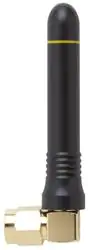
ANT-916-CW-RCS-SMA shown
Features
Applications
• Performance at 902 MHz to 930 MHz
― VSWR: ≤ 2.0
― Peak Gain: 4.8 dBi
― Efficiency: 69%
• Compact size
― 54.0 mm x Ø9.4 mm
• Rotating base allows for optimal positioning
• SMA plug (male pin) or RP-SMA plug (female
socket)
• Low-power, wide-area (LPWA) applications
― LoRaWAN®, ITU-T Y.4480
• ISM applications
• Remote control, sensing and monitoring
― Security systems
― Industrial machinery
― Automated equipment
― AMR (automated meter reading)
• Internet of Things (IoT) devices
• Smart Home networking
Ordering Information
Part Number
Description
ANT-916-CW-RCS-SMA
915 MHz right-angle whip antenna with SMA plug (male pin)
ANT-916-CW-RCS
915 MHz right-angle whip antenna with RP-SMA plug (female socket)
Available from Linx Technologies and select distributors and representatives.
�ANT-916-CW-RCS-ccc
Datasheet
Table 1. Electrical Specifications
Parameter
Value
902 MHz to 930 MHz
Frequency Range
VSWR (max)
2.0
Peak Gain (dBi)
4.8
Average Gain (dBi)
-1.7
Efficiency (%)
69
Polarization
Linear
Radiation
Impedance
50 Ω
Max Power
Omnidirectional
Wavelength
1/4-wave
Electrical Type
5W
Monopole
Electrical specifications and plots measured with a 102 mm x 102 mm (4.0 in x 4.0 in) reference ground plane.
Table 2. Mechanical Specifications
Parameter
Value
Connection
SMA plug (male pin), RP-SMA plug (female socket)
Dimensions
54.0 mm x Ø9.4 mm (2.13 in x Ø0.37 in)
8.4 g (0.30 oz)
Weight
-20 °C to +85 °C
Operating Temp. Range
Product Dimensions
Figure 1 provides dimensions for the ANT-916-CW-RCS-ccc series antenna.
54.0 mm
(2.13 in)
46.0 mm
(1.81 in)
Ø7.0 mm
(0.28 in)
Ø9.4 mm
(0.37 in)
17.4 mm
(0.69 in)
Figure 1. ANT-916-CW-RCS-ccc Antenna Dimensions
Packaging Information
The ANT-916-CW-RCS series antenna is individually packaged in a sealed plastic bag in quantities of 100
pcs. Bags are packaged in cartons. Distribution channels may offer alternative packaging options.
54.0 mm
(2.13 in)
46.0 mm
(1.81 in)
2
Ø7.0 mm
�Datasheet
ANT-916-CW-RCS-ccc
Counterpoise
Quarter-wave or monopole antennas require an associated ground plane counterpoise for proper operation.
The size and location of the ground plane relative to the antenna will affect the overall performance of the
antenna in the final design. When used in conjunction with a ground plane smaller than that used to tune the
antenna, the center frequency typically will shift higher in frequency and the bandwidth will decrease. The
proximity of other circuit elements and packaging near the antenna will also affect the final performance.
For further discussion and guidance on the importance of the ground plane counterpoise, please refer to
Linx Application Note, AN-00501: Understanding Antenna Specifications and Operation.
Antenna Orientation
The ANT-916-CW-RCS-ccc antenna is characterized at the edge of a ground plane as shown in Figure 2.
Characterization at the edge of the ground plane (102 mm x 102 mm) provides insight into antenna
performance when attached to a connector on a metal enclosure. The two orientations represent the most
common end-product use case.
Figure 2. ANT-916-CW-RCS-ccc Test Orientation
3
�ANT-916-CW-RCS-ccc
Datasheet
VSWR
5
930
902
Figure 3 provides the voltage standing wave ratio (VSWR) across the antenna bandwidth. VSWR describes
the power reflected from the antenna back to the radio. A lower VSWR value indicates better antenna
performance at a given frequency. Reflected power is also shown on the right-side vertical axis as a gauge
of the percentage of transmitter power reflected back from the antenna.
VSWR
4
30
3
20
2
10
1
0
900 902 904 906 908 910 912 914 916 918 920 922 924 926 928 930 932
Frequency (MHz)
Reflected Power (%)
40
Figure 3. ANT-916-CW-RCS-ccc Antenna VSWR
Return Loss
0
930
902
Return loss (Figure 4), represents the loss in power at the antenna due to reflected signals. Like VSWR, a
lower return loss value indicates better antenna performance at a given frequency.
-2
Return Loss (dB)
-4
-6
-8
-10
-12
-14
-16
-18
-20
900
902
904
906
908
910
912
914 916 918 920
Frequency (MHz)
922
Figure 4. ANT-916-CW-RCS-ccc Return Loss
4
924
926
928
930
932
�Datasheet
ANT-916-CW-RCS-ccc
Peak Gain
10
930
902
The peak gain across the antenna bandwidth is shown in Figure 5. Peak gain represents the maximum
antenna input power concentration across 3-dimensional space, and therefore peak performance at a given
frequency, but does not consider any directionality in the gain pattern.
Peak Gain (dBi)
5
0
-5
-10
-15
-20
900
902
904
906
908
910
912
914 916 918 920
Frequency (MHz)
922
924
926
928
930
932
Figure 5. ANT-916-CW-RCS-ccc Peak Gain
Average Gain
10
930
902
Average gain (Figure 6), is the average of all antenna gain in 3-dimensional space at each frequency,
providing an indication of overall performance without expressing antenna directionality.
Average Gain (dBi)
5
0
-5
-10
-15
-20
900
902
904
906
908
910
912
914 916 918 920
Frequency (MHz)
922
924
926
928
930
932
Figure 6. ANT-916-CW-RCS-ccc Antenna Average Gain
5
�ANT-916-CW-RCS-ccc
Datasheet
Radiation Efficiency
100
930
902
Radiation efficiency (Figure 7), shows the ratio of power delivered to the antenna relative to the power
radiated at the antenna, expressed as a percentage, where a higher percentage indicates better
performance at a given frequency.
90
80
Efficiency (%)
70
60
50
40
30
20
10
0
900
902
904
906
908
910
912
914 916 918 920
Frequency (MHz)
922
924
926
Figure 7. ANT-916-CW-RCS-ccc Antenna Radiation Efficiency
6
928
930
932
�Datasheet
ANT-916-CW-RCS-ccc
Radiation Patterns
Radiation patterns provide information about the directionality and 3-dimensional gain performance of
the antenna by plotting gain at specific frequencies in three orthogonal planes. Antenna radiation patterns
are shown in Figure 8 using polar plots covering 360 degrees. The antenna graphic at the top of the page
provides reference to the plane of the column of plots below it. Note: when viewed with typical PDF viewing
software, zooming into radiation patterns is possible to reveal fine detail.
XZ-Plane Gain
YZ-Plane Gain
XY-Plane Gain
902 MHz to 930 MHz (915 MHz)
34
35
36 5
1
2
3
0
33
32
4
5
36 5
2
3
4
34
5
36 5
30
9
29
-20
9
29
-20
28
-25
10
28
-25
10
28
-25
11
27
11
27
12
25
13
24
14
23
15
22
21
20
19
18
XZ-Plane Gain
17
16
26
12
25
13
24
14
23
15
22
21
20
19
18
17
16
4
5
6
7
8
-15
-20
26
3
-10
29
27
2
-5
31
8
-15
1
0
32
7
-10
30
35
33
6
-5
31
8
-15
1
0
32
7
-10
30
35
33
6
-5
31
34
9
10
11
26
12
25
13
24
14
23
15
22
YZ-Plane Gain
21
20
19
18
17
16
902 MHz
915 MHz
930 MHz
XY-Plane Gain
Figure 8. ANT-916-CW-RCS-ccc Radiation Patterns
7
�ANT-916-CW-RCS-ccc
Datasheet
Website: http://linxtechnologies.com
Linx Offices: 159 Ort Lane, Merlin, OR, US 97532
Phone:
+1 (541) 471-6256
E-MAIL: info@linxtechnologies.com
Linx Technologies reserves the right to make changes to the product(s) or information contained herein without notice. No liability is assumed as a result of their use
or application. No rights under any patent accompany the sale of any such product(s) or information.
Wireless Made Simple is a registered trademark of Linx Acquisitions LLC. LoRaWAN is a registered trademark of Semtech Corporation. Other product and brand
names may be trademarks or registered trademarks of their respective owners.
Copyright © 2022 Linx Technologies
All Rights Reserved
Doc# DS22170-247ANT
�
很抱歉,暂时无法提供与“ANT-916-CW-RCS”相匹配的价格&库存,您可以联系我们找货
免费人工找货- 国内价格
- 1+113.70240
- 200+45.37080
- 500+43.85880
- 1000+43.10280