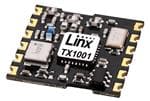
LT Series
Transceiver Module
Data Guide
�! Warning: Some customers may want Linx radio frequency (“RF”)
products to control machinery or devices remotely, including machinery
or devices that can cause death, bodily injuries, and/or property
damage if improperly or inadvertently triggered, particularly in industrial
settings or other applications implicating life-safety concerns (“Life and
Property Safety Situations”).
Table of Contents
1^
1^
1^
NO OEM LINX REMOTE CONTROL OR FUNCTION MODULE
SHOULD EVER BE USED IN LIFE AND PROPERTY SAFETY
SITUATIONS. No OEM Linx Remote Control or Function Module
should be modified for Life and Property Safety Situations. Such
modification cannot provide sufficient safety and will void the product’s
regulatory certification and warranty.
2^
Customers may use our (non-Function) Modules, Antenna and
Connectors as part of other systems in Life Safety Situations, but
only with necessary and industry appropriate redundancies and
in compliance with applicable safety standards, including without
limitation, ANSI and NFPA standards. It is solely the responsibility
of any Linx customer who uses one or more of these products to
incorporate appropriate redundancies and safety standards for the Life
and Property Safety Situation application.
9^
Do not use this or any Linx product to trigger an action directly
from the data line or RSSI lines without a protocol or encoder/
decoder to validate the data. Without validation, any signal from
another unrelated transmitter in the environment received by the
module could inadvertently trigger the action.
All RF products are susceptible to RF interference that can prevent
communication. RF products without frequency agility or hopping
implemented are more subject to interference. This module does not
have a frequency hopping protocol built in.
Do not use any Linx product over the limits in this data guide.
Excessive voltage or extended operation at the maximum voltage could
cause product failure. Exceeding the reflow temperature profile could
cause product failure which is not immediately evident.
Do not make any physical or electrical modifications to any Linx
product. This will void the warranty and regulatory and UL certifications
and may cause product failure which is not immediately evident.
2^
3^
5^
9^
10^
10^
12^
12^
13^
13^
14^
15^
16^
17^
18^
19^
19^
20^
21^
21^
23^
24^
24^
24^
Description
Features
Applications
Ordering Information
Absolute Maximum Ratings
Electrical Specifications
Typical Performance Graphs
PIN Assignments
Pin Descriptions
Module Description
Theory of Operation
Using LADJ
Using the RSSI Line
Using the PDN Line
ESD Concerns
Using the Data Line
Power Supply Requirements
Transferring Data
Typical Applications
Antenna Considerations
Helpful Application Notes from Linx
Protocol Guidelines
Interference Considerations
Pad Layout
Board Layout Guidelines
Microstrip Details
Production Guidelines
Hand Assembly
Automated Assembly
� 26^
General Antenna Rules
28^ Common Antenna Styles
30^ Regulatory Considerations
LT Series Transceiver Module
Data Guide
Description
0.619"
The LT Series transceiver is ideal for the bidirectional
wireless transfer of serial data, control or command
0.630"
TRM-433-LT
information in the favorable 260–470MHz band. The
LOT TX4xxx
transceiver is capable of generating +10dBm into a
50-ohm load and achieves an outstanding typical
sensitivity of –112dBm. Its advanced synthesized
0.125"
architecture delivers outstanding stability and
Figure 1: Package Dimensions
frequency accuracy and minimizes the effects of
antenna pulling. When paired, the transceivers form a reliable wireless
link that is capable of transferring data at rates of up to 10,000bps over
distances of up to 3,000 feet (1000m). Applications operating over shorter
distances or at lower data rates will also benefit from increased link
reliability and superior noise immunity. Housed in a tiny reflow-compatible
SMD package, the transceiver requires no external RF components except
an antenna, which greatly simplifies integration and lowers assembly costs.
Features
•
•
•
•
•
•
Long range
Low cost
PLL-synthesized architecture
Direct serial interface
Data rates up to 10,000bps
No external RF components
required
•
•
•
•
•
•
Low power consumption
Compact surface-mount package
Wide temperature range
RSSI and power-down functions
No production tuning
Easy to use
•
•
Home/industrial automation
Fire/security alarms/access
control
Remote status/position sensing
Long-range RFID
Wire elimination
Applications
•
•
•
•
•
•
•
2-way remote control
Keyless entry
Garage/gate openers
Lighting control
Medical monitoring/call systems
Remote industrial monitoring
Periodic data transfer
•
•
•
– 1 –
Revised 3/18/2015
�Ordering Information
Electrical Specifications
Ordering Information
LT Series Transceiver Specifications
Part Number
Description
Parameter
TRM-315-LT
315MHz Transceiver
Power Supply
TRM-418-LT
418MHz Transceiver
TRM-433-LT
433MHz Transceiver
EVAL-***-LT
Basic Evaluation Kit
*** = 315, 418 (Standard), 433MHz
Transceivers are supplied in tubes of 18 pcs.
Symbol
Min.
Typ.
Max.
Units
Operating Voltage
VCC
2.1
3.0
3.6
VDC
Supply Current
lCC
TX Mode Logic High
12
14
mA
1
TX Mode Logic High
7.6
9.5
mA
2
TX Mode Logic Low
4.0
5.0
mA
6.1
7.9
mA
11.5
20.0
µA
9,10
Receive Mode
Figure 2: Ordering Information
Power Down Current
lPDN
Notes
DATA Line
Absolute Maximum Ratings
Absolute Maximum Ratings
Output Low Voltage
VOL
0.15
VDC
3
Output High Voltage
VOH
VCC–0.26
VDC
4
VDC
5
Supply Voltage Vcc
−0.3
to
+4.0
VDC
Input Low Threshold
VIL
Any Input or Output Pin
−0.3
to
VCC + 0.3
VDC
Input High Threshold
VIH
Operating Temperature
−40
to
+85
ºC
Input Low Threshold
VIL
Storage Temperature
−65
to
+150
ºC
Input High Threshold
VIH
RF Input
0
Soldering Temperature
dBm
+260ºC for 10 seconds
Exceeding any of the limits of this section may lead to permanent damage to the device.
Furthermore, extended operation at these maximum ratings may reduce the life of this
device.
Figure 3: Absolute Maximum Ratings
Warning: This product incorporates numerous static-sensitive
components. Always wear an ESD wrist strap and observe proper ESD
handling procedures when working with this device. Failure to observe
this precaution may result in module damage or failure.
0.1 VCC
0.9 VCC
VDC
Power Down Input
0.1 VCC
0.9 VCC
VDC
5
VDC
RF Section
Frequency Range
FC
TRM-315-LT
315
MHz
TRM-418-LT
418
MHz
TRM-433-LT
433.92
MHz
Center Frequency
Accuracy
–50
+50
kHz
Data Rate
65
10,000
bps
Receiver Section
LO Feedthrough
IF Frequency
Noise Bandwidth
Receiver Sensitivity
–80
dBm
6,9
FIF
10.7
MHz
9
N3DB
280
kHz
9
dBm
7
dB
9
–108
–112
–118
RSSI / Analog
Dynamic Range
Analog Bandwidth
– 2 –
80
Hz
9
Gain
20
15
mV/dB
9
Voltage with No Carrier
430
mV
9
– 3 –
5,000
�Typical Performance Graphs
LT Series Transceiver Specifications Continued
Parameter
Symbol
Min.
Typ.
Max.
Units
Notes
+9.2
+11
dBm
1,6
0.0
4
dBm
2,6
MAX
dB
9
–36
dBc
6
10
9
Transmitter Section
PO
With a 750Ω resistor
on LADJ
PO
Output Power Control
Range
Harmonic Emissions
–4
–30
PH
LADJ Resistance (kΩ)
8
Output Power
RIN
Ω
50
5
4
3
1
9
0
12.00
Timing
Via VCC
2.2
ms
8,9
Via PDN
0.25
ms
8,9
15.0
ms
9
Max. Time Between
Transitions
0.00
-3.00
-6.00
-9.00
-12.00
-15.00
-6
-8
-18.00
-21.00
16
14
Modulation Delay
ms
9
500
µs
9
30.0
ns
9
Transmit to Receive
Switch Time
180
400
µs
9
Receive to Transmit
Switch Time
490
1000
µs
9
µs
9,11
ºC
9
Supply Current (mA)
2.0
Via PDN
10
8
6
4
2
0
290
Environmental
10
8
6
4
2
0
-2
-4
-10
-12
-14
Output Power (dBm)
Figure 6: Output Power vs. Current Consumption
–40
+85
1.6
7.
8.
9.
10.
With a 50% square wave at 1,000bps
Time to valid data output
Characterized, but not tested
Receive Mode on power down (see
Using the PDN Line section)
11. Minimum time before mode change
1.4
1.2
VRSSI (V)
With a 0Ω resistor on LADJ
With a 750Ω resistor on LADJ
ISINK = 500µA
ISOURCE = 500µA
ISINK = 20µA
Into a 50Ω load
3.00
12
Via VCC
Operating Temperature
Range
6.00
Figure 5: Output Power vs. LADJ Resistance
Transmtiter Turn-On Time
Dwell Time
9.00
Output Power (dBm)
Receiver Turn-On Time
1.
2.
3.
4.
5.
6.
6
2
Antenna Port
RF Input Impedance
7
1
0.8
0.6
Figure 4: Electrical Specifications
0.4
0.2
0
-115
-110
-105
-100
-95
-90
-85
-80
-75
-70
-65
RF IN (dBm)
Figure 7: RSSI Curve
– 4 –
– 5 –
-60
-55
-50
-45
-40
-35
-30
�1. 1.00V/div
18.00
2. 2.00V/div
16.00
Supply Current (mA)
14.00
PDN
12.00
2
10.00
TX Icc
RX Icc
8.00
6.00
4.00
DATA
2.00
1
0.00
3.60
3.50
3.40
3.30
3.20
3.10
3.00
2.90
2.80
2.70
2.60
2.50
2.40
2.30
2.20
2.10
500µS/div
Supply Voltage (V) [LADJ = 0]
Figure 8: Current Consumption vs. Supply
1. 1.00V/div
Figure 11: RX Turn-On Time from PDN
2. 2.00V/div
1. 100mV/div
T/R SEL
RFIN
很抱歉,暂时无法提供与“TRM-418-LT”相匹配的价格&库存,您可以联系我们找货
免费人工找货- 国内价格
- 1+403.82280
- 204+161.13600
- 510+155.74680
- 986+153.09000