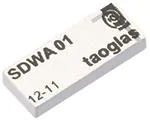
Part No:
SDWA.01
Description:
2.4/5-7.125GHz Wi-Fi (Including Wi-Fi 6) Ceramic SMD Antenna
Features:
High Efficiency/ High Peak Gain
2400-2500MHz, 5150-5825MHz, 5925-7125MHz Wi-Fi coverage
Covers newly established Wi-Fi 6 spectrum for future proof design
Small Footprint
Low Profile
Dimensions: 10*4*1.5mm
RoHS & Reach Compliant
SPE-11-8-129-L
�1.
Introduction
3
2.
Specifications
4
3.
Antenna Characteristics
5
4.
Radiation Patterns
8
5.
Mechanical Drawing
10
6.
Evaluation Board Drawing
11
7.
Matching Circuit
12
8.
Recommended Soldering Conditions
13
9.
Packaging
14
Changelog
15
Taoglas makes no warranties based on the accuracy or completeness of the contents of this document and reserves the right to
make changes to specifications and product descriptions at any time without notice. Taoglas reserves all rights to this document and
the information contained herein. Reproduction, use or disclosure to third parties without express permission is strictly prohibited.
SPE-11-8-129-L
www.taoglas.com
�1.
Introduction
1.
Introduction
1.
Introduction
1.
Introduction
1.
1.
1.
1.
The SDWA.01 SMD ceramic antenna is an embedded, high efficiency, high peak gain solution for Wi-Fi
applications which require high-speed data rates and wide coverage areas. Designed for the 2.4 GHz, 5.8 GHz
and 7.125GHz bands. The antenna covers the newly established Wi-Fi 6 spectrum for future proof design. It
is designed to perform optimally mounted in the corner of a device PCB. Two SDWA.01 antennas can be used
for MIMO applications. The antenna's low profile, at only 1.5mm, allows for use on extremely thin devices
while still maintaining excellent performance characteristics. This antenna is delivered on Tape and Reel for
SMD application.
Introduction
Introduction
Many module manufacturers specify peak gain limits for any antennas that are to be connected to that
module. Those peak gain limits are based on free-space conditions. In practice, the peak gain of an antenna
tested in free space can degrade by at least 1 or 2dBi when put inside a device. So ideally you should go for
a slightly higher peak gain antenna than mentioned on the module specification to compensate for this effect,
giving you better performance.
Introduction
Introduction
Upon testing of any of our antennas with your device and a selection of appropriate layout, integration
technique, or cable, Taoglas can make sure any of our antennas’ peak gain will be below the peak gain limits.
Taoglas can then issue a specification and/or report for the selected antenna in your device that will clearly
show it complying with the peak gain limits, so you can be assured you are meeting regulatory requirements
for that module.
For example, a module manufacturer may state that the antenna must have less than 2dBi peak gain, but
you don’t need to select an embedded antenna that has a peak gain of less than 2dBi in free space. This will
give you a less optimized solution. It is better to go for a slightly higher free-space peak gain of 3dBi or more
if available. Once that antenna gets integrated into your device, performance will degrade below this 2dBi
peak gain due to the effects of GND plane, surrounding components, and device housing. If you want to be
absolutely sure, contact Taoglas and we will test. Choosing a Taoglas antenna with a higher peak gain than
what is specified by the module manufacturer and enlisting our help will ensure you are getting the best
performance possible without exceeding the peak gain limits.
For further information, please contact your regional Taoglas customer support team.
SPE-11-8-129-L
www.taoglas.com
�2.
Specifications
3.
Antenna Characteristics2.Wi-Fi Electrical
Specifications
3.
4.
Band
Frequency (MHz)
Efficiency
(%)
Average Gain
(dB)
Peak Gain
(dBi)
2.4GHz Wi-Fi
2400~2500
55.7
-2.5
3
5.8GHz Wi-Fi
5150~5850
66.2
-1.9
5.9
7.1GHz Wi-Fi 6
5925~7125
44.7
-3.6
4.9
Antenna Characteristics
Impedance Polarization
50 Ω
Linear
Radiation Pattern
Omni-Directional
Antenna Radiation Patterns3.Antenna
Characteristics2.
Specifications
Mechanical
Height
3.
1.5 mm
Planner Dimension
Antenna
Characteristics2.
10 x 4 mm
Specifications
Material
3.
Ceramic
Evaluation Board Dimensions
Antenna
Characteristics
100mm*50mm
Weight
4.
1g
Environmental
Antenna
Radiation Patterns3.Antenna-40°C to +85°C
Operation Temperature
Characteristics
Storage Temperature
4.
4.
-40°C to +105°C
Temperature Coefficient (τf)
0 ± 20 ppm @-20ºC to +80ºC
Humidity
Non-condensing 65°C 95% RH
Recommended Reel Storage Conditions
5°C to 40°C
Relative Humidity 20% to 70%
Moisture Sensitivity Level (MSL)
3 (168 Hours)
Antenna Radiation Patterns
Antenna Radiation Patterns3.Antenna
Characteristics
4.
Antenna Radiation Patterns3.Antenna
Characteristics2.
SPE-11-8-129-L
Specifications
www.taoglas.com
�3.
Antenna Characteristics
3.1
4.
Return Loss
Antenna Radiation Patterns3.Antenna
0
Characteristics
-1
-2
-3
4.
4.
Return Loss (dB)
-4
Antenna Radiation Patterns
-5
-6
-7
-8
-9
Antenna Radiation Patterns3.Antenna
-10
-11
Characteristics
-12
S11 (SDWA.01)
-13
-14
4.
-15
2200
2700
3200
3700
4200
4700
5200
Antenna
Radiation
Patterns3.
Antenna
Frequency
(MHz)
5700
6200
6700
7200
5700
6200
6700
7200
Characteristics
3.2
VSWR
10
4.
Antenna
Radiation Patterns
9
8
7
Antenna
Radiation Patterns
6
VSWR
4.
4.
5
4
Antenna
Radiation Patterns
3
2
VSWR…
4.
1
Antenna Radiation Patterns3.Antenna
0
2200
2700
Characteristics
4.
3200
3700
4200
4700
5200
Frequency (MHz)
Antenna Radiation Patterns3.Antenna
SPE-11-8-129-L
www.taoglas.com
�3.3
Efficiency
100
90
80
Efficiency (%)
Efficiency (%)
70
60
50
40
30
20
10
0
2200
2700
3200
3700
4200
4700
5200
5700
6200
6700
7200
5700
6200
6700
7200
Frequency (MHz)
3.4
Peak Gain
10
9
8
7
Peak Gain (dBi)
6
Peak Gain (dBi)
5
4
3
2
1
0
-1
-2
-3
-4
-5
2200
2700
3200
3700
4200
4700
5200
Frequency (MHz)
SPE-11-8-129-L
www.taoglas.com
�3.5
Average Gain
0
-1
-2
Average Gain (dB)
Average Gain (dB)
-3
-4
-5
-6
-7
-8
-9
-10
2200
2700
3200
3700
4200
4700
5200
5700
6200
6700
7200
Frequency (MHz)
SPE-11-8-129-L
www.taoglas.com
�4.
2D Radiation Patterns
4.
4.
4.
4.1
Antenna Radiation Patterns
Test Setup – On Eval Board
Antenna Radiation Patterns
Z
4.
Antenna Radiation Patterns
Y
4.
Antenna Radiation Patterns
4.
Antenna Radiation Patterns
4.
Antenna Radiation Patterns
4.
Antenna Radiation Patterns
SPE-11-8-129-L
X
www.taoglas.com
�4.2
2D Radiation Patterns
2400-2500MHz
XY Plane
XZ Plane
X
YZ Plane
Z
Z
5
0
-5
-10
-15
-20
-25
-30
Y
5
0
-5
-10
-15
-20
-25
-30
X
5
0
-5
-10
-15
-20
-25
-30
Y
2400 MHz
2400 MHz
2400 MHz
2450 MHz
2450 MHz
2450 MHz
2500 MHz
2500 MHz
2500 MHz
5000-7000MHz
XY Plane
XZ Plane
X
5
0
-5
-10
-15
-20
-25
-30
Y
5000 MHz
5500 MHz
6000 MHz
6500 MHz
7000 MHz
SPE-11-8-129-L
5
0
-5
-10
-15
-20
-25
-30
YZ Plane
Z
Z
X
5000 MHz
5500 MHz
6000 MHz
6500 MHz
7000 MHz
5
0
-5
-10
-15
-20
-25
-30
Y
5000 MHz
5500 MHz
6000 MHz
6500 MHz
7000 MHz
www.taoglas.com
�5.
Mechanical Drawing (Units: mm)
6.
Packaging5.
6.
Packaging
7.
Application Note6. Packaging5.
Mechanical Drawing
Mechanical
Drawing
6.
Packaging5.
Mechanical Drawing
6.
Packaging
7.
Application Note6. Packaging
7.
Application Note
7.
Application Note6. Packaging
7.
Application Note6. Packaging5.
Mechanical
Drawing
6.
Packaging5.
SPE-11-8-129-L
Mechanical Drawing
www.taoglas.com
�6.
Evaluation Board Drawing
4.
Antenna Radiation Patterns3.Antenna
Characteristics
4.
Antenna Radiation Patterns
4.
Antenna Radiation Patterns3.Antenna
Characteristics
4.
Antenna Radiation Patterns3.Antenna
Characteristics
4.
Antenna Radiation Patterns
4.
Antenna Radiation Patterns
4.
Antenna Radiation Patterns
4.
Antenna Radiation Patterns3.Antenna
Characteristics
4.
Antenna Radiation Patterns3.Antenna
SPE-11-8-129-L
www.taoglas.com
�7.
Matching Circuit
Like all antennas, surrounding components, enclosures, and changes to the GND plane dimensions can alter
4.
Antenna Radiation Patterns3.Antenna
performance. A pi-matching network like the one shown below is required in case adjustments need to be made.
Make S1 a zero ohm resistor and leave S2 and S3 unpopulated when building first prototypes. These components
Characteristics
will likely need to be adjusted upon integration to provide the best match between the antenna and transmission
line. The additional zero ohm resistor in the diagram is needed for the ability to solder down a coax pigtail to make
with a vector network analyzer.
4.measurements
Antenna
Radiation Patterns
Antenna
4.
Antenna Radiation Patterns3.Antenna
Characteristics
0 Ohm
Resistor
S1
Transmission Line
S3
Antenna Radiation Patterns3.Antenna
S2
4.
Characteristics
4.
Antenna Radiation Patterns
4.
Antenna Radiation Patterns
4.
Antenna Radiation Patterns
4.
Antenna Radiation Patterns3.Antenna
Characteristics
4.
Antenna Radiation Patterns3.Antenna
SPE-11-8-129-L
www.taoglas.com
�8.
Recommended Soldering Conditions
4.
Antenna Radiation Patterns3.Antenna
Characteristics
4.
Antenna Radiation Patterns
4.
Antenna Radiation Patterns3.Antenna
Characteristics
4.1.
2.
3.
Time shown in the
above figures is
measured from the
point when chip surface
Antenna
Radiation
Patterns3.
Antenna
reaches temperature.
Temperature difference in high temperature part should be within 110°C.
After soldering, do not force cool, allow the parts to cool gradually.
Characteristics
*General attention to soldering:
● High soldering temperatures and long soldering times can cause leaching of the termination, decrease
in adherence strength, and the change of characteristic may occur.
● for soldering, please refer to the soldering curves above. However, please
Keep exposure to temperatures exceeding 200°C to under 50 seconds.
● please use a mild flux (containing less than 0.2wt% Cl). Also, if the flux is water soluble, be sure to wash
thoroughly to remove any residue from the underside of components that could affect resistance.
4.
Antenna Radiation Patterns
Cleaning:
using
ultrasonic cleaning,
the boardPatterns
may resonate if the output power is too high.
4.When
Antenna
Radiation
Since this vibration can cause cracking or a decrease in the adherence of the termination, we
recommend that you use the conditions below.
Frequency: 40 kHz max.
Output power: 20W/Iiter
Cleaning time: 5minutes max.
4.
Antenna Radiation Patterns
4.
Antenna Radiation Patterns3.Antenna
Characteristics
8. Packaging
4.
6.
Antenna Radiation Patterns3.Antenna
Packaging5. Mechanical Drawing
SPE-11-8-129-L
www.taoglas.com
�6.
6.
Packaging
1000pcs SDWA.01 per Tape & Reel
Packaging5.
Mechanical Drawing
Ø330mm
9.
Packaging
28.4mm
SDWA.01 per carton Note6. Packaging5.
7. 1000pcs
Application
Mechanical
Dimensions - 350*340*47mm
Drawing
6.
Packaging5.
47mm
Mechanical Drawing
350mm
6.
340mm
Packaging
5000pcs SDWA.01 per carton
Dimensions - 370*370*300mm
7.
Application Note6. Packaging
300mm
7.
Application Note
370mm
7.
Application Note6. Packaging
7.
Application Note6. Packaging5.
370mm
Mechanical
Drawing
6.
Packaging5.
SPE-11-8-129-L
Mechanical Drawing
www.taoglas.com
�Changelog for the datasheet
SPE-11-8-129 – SDWA.01
Revision: L (Current Version)
Date:
Changes:
Changes Made by:
2022-05-13
Updated Packaging
Jack Conroy
Previous Revisions
Revision: K (Current Version)
Date:
Changes:
Changes Made by:
20208-09-03
Added Wi-Fi 6 test data
Jack Conroy
Revision: J
Revision: F
Date:
Changes:
Changes Made by:
2016-03-08
Amended SPQ
Aine Doyle
Revision: E
Date:
Changes:
Changes Made by:
2019-06-11
Evaluation Board Drawing Updated
Jack Conroy
Revision: I
Date:
Changes:
Changes Made by:
2015-08-20
Packaging Details Updated
Aine Doyle
Revision: D
Date:
Changes:
2019-08-26
EC-19-8-071
Date:
Changes:
Changes Made by:
Jack Conroy
Changes Made by:
Revision: H
2015-03-02
Amended Drawing
Aine Doyle
Revision: C
Date:
Changes:
Changes Made by:
2018-03-08
Packaging Details Updated
Made by Andy Mahoney
Revision: G
Date:
Changes:
Changes Made by:
2013-11-08
Amended Reel Quantity
Aine Doyle
Revision: B
Date:
Changes:
Changes Made by:
SPE-11-8-129-L
2017-03-08
Packaging Details Updated
Aine Doyle
Date:
Changes:
Changes Made by:
2013-08-19
Packaging Details Updated
Aine Doyle
www.taoglas.com
�Revision: A (Original First Release)
Date:
2017-10-27
Notes:
Author:
SPE-11-8-129-L
Technical Writer
www.taoglas.com
�SPE-11-8-129-L
© Taoglas
www.taoglas.com
�
很抱歉,暂时无法提供与“SDWAD.01”相匹配的价格&库存,您可以联系我们找货
免费人工找货- 国内价格
- 1+838.41480
- 200+334.54080