Instruction Sheet
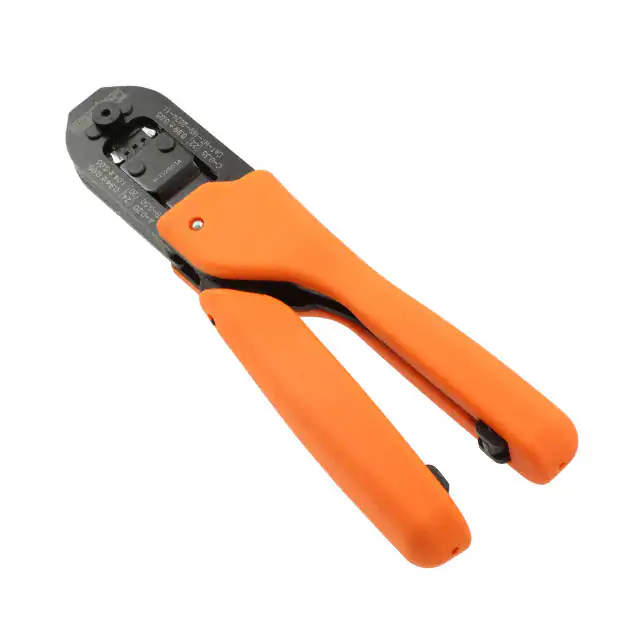
Straight Action Hand Tool
CAT-HT-169-2024-11
STS-M-169-2024-11-A
(416-32 Rev A)
PROPER USE GUIDELINES
Cumulative Trauma Disorders can result from the prolonged use of manually powered hand tools. Hand tools are intended for occasional use and low volume
applications. A wide selection of powered application equipment for extended-use, production operations may be available.
Front of
Tool
Insulation
Crimper
Wire
locator/insulation stop positions the contact, and limits
the insertion distance of the stripped wire into the
contact. In use, the locator/insulation stop rests in the
locator slot of the contact (See Figures 1 and 2). The
ratchet assures full crimping of the contact. Once
engaged, the ratchet will not release until the dies
have been fully closed.
Crimper
3. CRIMPING PROCEDURE
Wire Barrel
Anvil
CAUTION
Do NOT cut or nick the wire strands during wire
stripping.
Insulation
Refer to Figure 2 for wire preparation information
before applying the terminal.
Anvil
1. Hold the tool so that the FRONT side is facing
you.
2. Ensure that the tool ratchet is released by
squeezing the tool handles and allowing them to
open FULLY.
Figure 1
1. INTRODUCTION
This Straight Action Hand Tool
(CAT–HT–169–2024–11) is designed to crimp C&69/
(IPBD–Series) FRQWDFWs.
CAUTION
The wire crimper bottoms against the anvil before
the ratchet releases. This is a design feature that
assures maximum electrical and tensile
performance of the crimp. Do NOT re-adjust the
ratchet.
NOTE
Dimensions in these instructions are in metric
units [with inches in brackets]. Figures are for
reference only and are not drawn to scale.
2. DESCRIPTION
The FRONT of the tool, is marked with the tool part
number, wire size ranges, and crimp height
specifications.
The tool features a fixed die (crimper), a movable die
(anvil), a locator/insulation stop, and a ratchet. Many
tools feature an insulation adjustment knob which is
used to regulate the crimp height of the contact
insulation barrel during the crimping operation. The
3. Holding the contact by its mating portion and
looking straight into the crimp section, insert the
contact from the BACK of the tool into the
appropriate crimp chamber.
4. Position the contact between the crimpers so
that the locator/insulation stop enters the slot in the
contact. The wire barrel should butt against the
locator/insulation stop. Refer to Figure 1.
5. Holding the contact in this position, squeeze the
tool handles together until the insulation anvil starts
entry into the insulation crimper (usually two
ratchet clicks). Do NOT deform the insulation
barrel or wire barrel.
6. Insert a properly stripped wire through the
locator slot and into the wire barrel of the contact
until the insulation butts against the
locator/insulation stop.
7. Holding wire in place, crimp contact to the wire
by squeezing the tool handles together until the
ratchet releases.
8. Allow tool handles to open FULLY and remove
the crimped contact from the tool.
CAUTION
Damaged terminals should not be used. If a
damaged terminal is evident, it should be cut
from the wire and replaced with a new one.
�Straight Action Hand Tool CAT-HT-169-2024-11
TERMINAL
NUMBER
STS-M-169-2024-11-A
WIRE SIZE
mm2 [AWG]
INSULATION
DIAMETER
STRIP
LENGTH
TOOL CRIMP
SYMBOL
CRIMP
HEIGHT
0.20 [24]
1.35-1.50
[.053-.059]
2.67-3.43
[.105-.135]
A
0.94 +0.05
[.037 +.002]
0.50 [20]
1.68-1.83
[.066-.072]
2.67-3.43
[.105-.135]
B
1.04 +0.05
[.041 +.002]
0.35 [22]
1.50-1.65
[.059-.065]
2.67-3.43
[.105-.135]
C
0.99 +0.05
[.039 +.002]
C-169
TERMINAL
SPECIFICATION
STS-A-002
Figure 2
4. MAINTENANCE AND INSPECTION PROCEDURE
It is recommended that a maintenance and inspection
program be performed periodically to ensure
dependable and uniform terminations. Frequency of
inspection depends on:
S The care, amount of use, and handling of the
hand tool,
S The presence of abnormal amounts of dust and
dirt,
S Your own established standards.
The hand tool is inspected before being shipped;
however, it is recommended that the tool be inspected
immediately upon its arrival at your facility to ensure
that the tool has not been damaged during shipment.
4.3. Periodic Inspection
1. Hand tool may be immersed (handles partially
closed) in a reliable commercial degreasing
compound (suitable for plastics) to remove
accumulated dirt, grease and foreign matter.
2. Close tool handles until ratchet releases and
then allow them to open freely. If they do not open
quickly and fully, the spring is defective and must
be replaced. See the Section 5.
3. Inspect head assembly for worn, cracked, or
broken jaws. If damage is evident, return it for
evaluation and repair.
4.4. Crimp Height Inspection
This inspection requires the use of micrometer with a
modified anvil as shown in Figure 3.
A recommended Crimp Height Comparator is
RS–1019–5LP, which can be purchased from:
4.1. Daily Maintenance
1. Remove dust, moisture, and other contaminants
with a clean brush, or a soft, lint–free cloth. Do
NOT use objects that could damage the tool.
Manufacturer
Shearer Industrial Supply Co
717-767-7575
2. Make certain that the retaining pins are in place
and that they are secured with retaining rings.
VALCO
610-691-3205
3. All pins, pivot points, and bearing surfaces
should be protected with a thin coat of any good
SAE 20 oil. Do not oil excessively.
4. When the tool is not in use, keep handles closed
to prevent objects from becoming lodged in the
crimping jaws. Store the tool in a clean, dry area.
4.2. Lubrication
Lubricate all pins, pivot points, and bearing surfaces
with SAE 20 oil as follows:
Tools used in daily production – lubricate daily
Tools used daily (occasional) – lubricate weekly
Tools used weekly – lubricate monthly
Wipe excess oil from tool, particularly from crimping
area. Oil transferred from the crimping area onto
certain terminations may affect the electrical
characteristics of an application.
2 of 3
SAMTEC
All International Rights Reserved.
Telephone
Proceed as follows:
1. Select a contact and a wire (maximum size) for
each crimp section.
2. Refer to the Section 3, and crimp the contact(s).
3. Using a crimp height comparator, measure wire
barrel crimp height as shown in Figure 3. If the
crimp height conforms to that marked on the tool,
the tool is considered dimensionally correct.
Position Point
On Center of
Wire Barrel
Opposite Seam
Wire Barrel
Crimp Height
Modified
Anvil
CUSTOMER SERVICE 1-800-SAMTEC9
Figure 3
�Straight Action Hand Tool CAT-HT-169-2024-11
4.5. Ratchet Inspection
4. Hold the wire in place and squeeze the handles
until the ratchet releases. Hold the handles in this
position, maintaining just enough tension to keep
the dies closed.
The ratchet feature on these hand tools should be
checked to ensure that the ratchet does not release
prematurely, allowing the crimping dies to open before
they have fully bottomed. Obtain a 0.025–mm
[.001–in.] shim that is suitable for checking the
clearance between the bottoming surfaces of the
crimping dies. Proceed as follows:
5. Check the clearance between the bottoming
surfaces of the wire crimper and the wire anvil. See
Figure 1. If the clearance is 0.025 mm [.001 in.] or
less (on at least two of the bottoming surfaces), the
ratchet is satisfactory. If clearance exceeds 0.025
mm [.001 in.], the ratchet is out of adjustment and
must be repaired. See Section 5.
1. Select the maximum size wire and strip it
according to dimensions listed in the drawing
shipped with the tool.
2. Select contact and crimp section corresponding
to the selected wire size (refer to the drawing
shipped with the tool).
3. Position the contact and wire in the crimping
dies, as described in the CRIMPING
PROCEDURE section.
STS-M-169-2024-11-A
The insulation crimper does not bottom on the
NOTE
insulation anvil.
5. REVISION SUMMARY
S Initial release of document
52 [2.1] Closed
30 [1.2]
303 [11.9]
Weight: Approx. 622.6 g [1 lb. 6 oz.]
Figure 4
SAMTEC
All International Rights Reserved.
CUSTOMER SERVICE 1-800-SAMTEC9
3 of 3
�
很抱歉,暂时无法提供与“CAT-HT-169-2024-11”相匹配的价格&库存,您可以联系我们找货
免费人工找货