Page 1 of 2
DIGI POT 2 click
From MikroElektonika Documentation
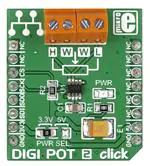
DIGI POT 2 click is a mikroBUS™ add-on board with a single channel digital potentiometer TPL0501
with 256 wiper positions. The IC has 100 kilo Ohms end-to-end resistance, with ±20% tolerance. The
board features two pairs of screw terminals for interfacing with the IC DIGI POT 2 click communicates
with the target MCU through the mikroBUS™ SPI pins (MISO, MOSI, SCK, CS). The board is
designed to use either a 3.3 or a 5V power supply.
DIGI POT 2 click
Features and usage notes
Digital potentiometers are mixed signal devices
intended as replacements for mechanical
potentiometers. They can be used for consumer
electronics, adjustable power supplies, precision
calibration and sensor trimming.
The device has three terminals: High termianl, low
terminal and a wiper terminal which is in-between.
The wiper terminal is adjusted through SPI, moving
through the specified 256 steps.
Schematic also available in PDF (http://cdndocs.mikroe.com/images/e/ea/DIGI_POT_2_click_sc
◾
◾
◾ Rheostat mode B
DIGI POT click can operate in several
configurations:
Voltage Divider mode
Rheostat mode A
More details on each one can be found in the TPL0501 data sheet.
Digital potentiomenters can be have any kind of interface. Not just knobs like mechanical
potentiometers, but also buttons, capacitive inputs etc).
Another advantage of digital potentiometers is that you can create any desirable sweep profile (linear,
digital or any other function).
DIGI POT 2 click
IC/Module Texas Instruments TPL0501
(http://www.ti.com/lit/ds/symlink/tpl0501100.pdf)
Interface
SPI (MISO, MOSI, SCK, CS)
Power
supply
3.3V, 5V
Website
www.mikroe.com/click/digipot-2
(http://www.mikroe.com/click/digipot-2)
The operating temperature of TPL0501 is between -40ºC to 125ºC. ESD performance is tested per JESD 22 requirements (human body model).
DIGI POT 2 click can be used both with a 3.3V or a 5V power supply, as determined by the position of the onboard jumper (soldered to 3.3V position by
default).
Programming
The following code snippet shows a larger part of the DIGI POT 2 click example we supply:
1 void main() {
2
3
Delay_ms(100);
4
5
while (1) {
// Endless loop
6
7
DigPot_CS = 0;
// Select PotentioMeter chip
8
SPI1_Write(0);
9
SPI1_Write(counter);
10
SPI1_Write(0x20);
11
SPI1_Write(counter);
12
DigPot_CS = 1;
// Deselect PotentioMeter chip
13
14
adc_value = ADC_Read(1);
// Get 10-bit results of AD conversion
15
PORTD = (unsigned char)(adc_value >> 2);
16
17
if (PINB2_bit)
// Press PB2 to decrease resistance between W and L
18
counter ++;
19
if (PINB3_bit)
// Press PB3 to increase resistance between W and L
20
counter --;
21
22
Delay_ms(50);
// Delay for debouncing
23
24
}
25
26 }
Code examples that demonstrate the usage of DIGI POT 2 click with MikroElektronika hardware, written for mikroC for are available on Libstock
(http://libstock.mikroe.com/projects/view/1825/digi-pot-2-click).
�Page 2 of 2
Resources
- Texas Instruments TPL0501 (http://www.ti.com/lit/ds/symlink/tpl0501-100.pdf) Vendor’s data sheet]
- DIGI POT 2 click (http://libstock.mikroe.com/projects/view/1825/digi-pot-2-click)
- mikroBUS™ standard specifications (http://www.mikroe.com/downloads/get/1737/mikrobus_specification.pdf)
Retrieved from "http://docs.mikroe.com/index.php?title=DIGI_POT_2_click&oldid=450"
◾ This page was last modified on 23 June 2016, at 22:10.
◾ Content is available under Creative Commons Attribution unless otherwise noted.
http://docs.mikroe.com/index.php?title=DIGI_POT_2_click&printable=yes
7/11/2016
�
很抱歉,暂时无法提供与“MIKROE-2332”相匹配的价格&库存,您可以联系我们找货
免费人工找货- 国内价格 香港价格
- 1+175.808071+22.82781