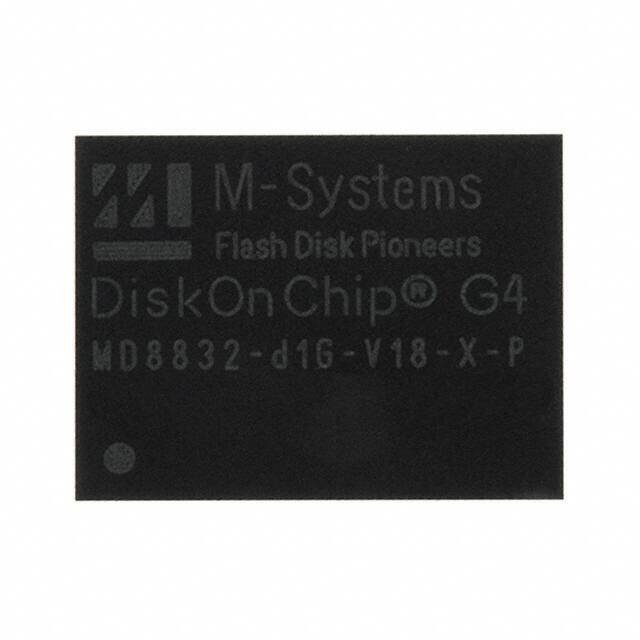
DiskOnChip G4 128MB (1Gb)/256MB (2Gb) 1.8V
Flash Disk with MLC NAND and M-Systems’ x2 Technology
Data Sheet, November 2005
Highlights
DiskOnChip G4 is M-Systems' 4th generation of
the DiskOnChip family of products. Based on
Multi-Level Cell (MLC) NAND, utilizing
Toshiba’s 90nm MLC NAND Large Block
flash technology and x2 technology from MSystems, it is one of the industry’s most
efficient storage solutions. MLC NAND flash
technology provides the smallest die size by
storing 2 bits of information in a single memory
cell. x2 technology enables MLC NAND to
achieve highly reliable, high-performance data
and code storage with a specially designed error
detection and correction mechanism, optimized
file management, and proprietary algorithms for
enhanced performance.
Further cost benefits derive from the
cost-effective architecture of DiskOnChip G4,
which includes a boot block that can replace
expensive NOR flash, and incorporates both the
flash array and an embedded thin controller in a
single die.
Small form factors:
69-ball FBGA 9x12 mm package
Enhanced performance by implementation
of:
DMA support
MultiBurst operation
Unrivaled data integrity with a robust Error
Detection Code/Error Correction Code
(EDC/ECC) tailored for MLC NAND flash
technology
Maximized flash endurance with TrueFFS®
6.3.2 (and higher)
Support for major operating systems (OSs),
including Symbian OS, Microsoft Windows
Mobile, Palm OS, Nucleus, Linux, OSE,
Windows CE, and more.
Compatible with major CPUs, including
TI OMAP, TI DBB, Intel XScale, Infinion,
EGold and SGold, ADI 652x, Freescale
MX, and Qualcomm MSMxxxx.
DiskOnChip G4 provides:
Flash disk for both code and data storage
Low voltage: 1.8V core and I/O
Hardware protection and security-enabling
features
High capacity: single die - 1Gb (128MB),
dual die - 2Gb (256MB)
Device cascade capacity: up to 4Gb
(512MB)
Enhanced Programmable Boot Block
enabling eXecute In Place (XIP)
functionality using 16-bit interface
1
Data Sheet (Preliminary) Rev. 0.3
92-DS-1105-00
�DiskOnChip G4 128MB (1Gb)/256MB (2Gb) 1.8V
Performance
Boot Capability
MultiBurst read: 15 MB/sec
Sustained read: 9 MB/sec
Sustained write: 2.4 MB/sec
Access time:
Normal: 33 nsec
Protection & Security-Enabling Features
16-byte Unique Identification (UID)
number
16KByte user-controlled One Time
Programmable (OTP) area
Two configurable hardware-protected
partitions for data and code:
Read-only mode
Write-only mode
One-Time Write mode (ROM-like)
partition
Protection key and LOCK# signal
Sticky Lock (SLOCK) to lock boot
partition
Protected Bad Block Table
Hardware Compatibility
Reliability and Data Integrity
2
Hardware- and software-driven, on-the-fly
EDC and ECC algorithms
4-bit Error Detection Code/Error Correction
Code (EDC/ECC), based on a patented
combination of BCH and Hamming code
algorithms, tailored for MLC NAND flash
technology
Guaranteed data integrity after power
failure
Transparent bad-block management
Dynamic and static wear-leveling
2KB Programmable Boot Block with XIP
capability to replace boot NOR
Download Engine (DE) for automatic
download of boot code from Programmable
Boot Block
Asynchronous Boot mode to boot from
ARM-based CPUs, e.g. XScale, TI OMAP,
Freescale MX without the need for external
glue logic
Virtual and Paged RAM boot modes.Enable
booting from DiskOnChip under Secure
Boot platforms
Exceptional boot performance with
MultiBurst operation and DMA support
enhanced by external clock
Configurable interface: simple NOR-like or
multiplexed address/data interface
CPU compatibility, including:
ARM-based CPUs
Texas Instruments OMAP, DBB
Intel XScale PXAxxx family
Infinion xGold family
Analog Devices (ADI) AD652x
family
Freescale MX family
Zoran ER4525
Renesas SH mobile
Qualcomm MSMxxxx
AMD Alchemy
Motorola PowerPC™ MPC8xx
Hitachi SuperH™ SH-x
Supports 8-, 16- and 32-bit architectures
Data Sheet (Preliminary) Rev. 0.3
92-DS-1105-00
�DiskOnChip G4 128MB (1Gb)/256MB (2Gb) 1.8V
TrueFFS® Software
Full hard-disk read/write emulation for
transparent file system management
Patented TrueFFS
Flash file system management
Automatic block management
Data management to maximize the
limit of typical flash life expectancy
Dynamic virtual mapping
Dynamic and static wear-leveling
Programming, duplicating, testing and
debugging tools available in source code
Operating Environment
3
Power Requirements
Capacity and Packaging
Wide OS support, including:
Symbian OS
Microsoft Windows Mobile
Palm OS
Nucleus
Windows CE
Linux
OSE
VxWorks
TrueFFS Software Development Kit (SDK)
for quick and easy support for proprietary
OSs, or OS-less environment
TrueFFS Boot Software Development Kit
(BDK)
Operating voltage
Core, I/O: 1.65 to 1.95V
Current Consumption
Active mode:
Read 4.2mA
Program 7.4mA
Erase 7.4mA
Deep Power-Down mode:
10 µA (1Gb/128MB)
20 µA (2Gb/256MB)
128MB (1Gb) capacity (single die):
Device cascading option for up to
four devices (4Gb)
69-ball FBGA package:
9x12x1.2 mm (width x length x
height)
Ballout compatible with
DiskOnChip G3/P3, G3/P3 LP and
H1 FBGA products
256MB (2Gb) capacity (dual die):
Device cascading option for up to
two devices (4Gb)
69-ball FBGA package:
9x12x1.4 mm (width x length x
height)
Ballout compatible with
DiskOnChip G3/P3, G3/P3 LP, H1
and, H3 FBGA products
Data Sheet (Preliminary) Rev. 0.3
92-DS-1105-00
�DiskOnChip G4 128MB (1Gb)/256MB (2Gb) 1.8V
REVISION HISTORY
Doc. No
Revision
92-DT-0305-00
0.1
March 2005
Preliminary version
0.2
October 2005
Device ball number was reduced
from 115 to 69 balls (only not
connected balls were reduced).
Section 2
Updated mechanical dimensions.
Section 10.4
Updated Ordering Information.
Section 11
92-DS-1105-00
4
0.3
Date
November
Description
Updated electrical information
Data Sheet (Preliminary) Rev. 0.3
Reference
-
-
92-DS-1105-00
�DiskOnChip G4 128MB (1Gb)/256MB (2Gb) 1.8V
TABLE OF CONTENTS
1. Introduction ............................................................................................................................... 9
2. Product Overview .................................................................................................................... 10
2.1
Product Description .......................................................................................................... 10
2.2
Standard Interface ............................................................................................................ 11
2.3
2.2.1
Ball Diagrams ..................................................................................................................... 11
2.2.2
System Interface ................................................................................................................ 12
2.2.3
Signal Description .............................................................................................................. 13
Multiplexed Interface ........................................................................................................ 15
2.3.1
Ball Diagram ....................................................................................................................... 15
2.3.2
System Interface ................................................................................................................ 16
2.3.3
Signal Description .............................................................................................................. 17
3. Theory of Operation ................................................................................................................ 19
3.1
Overview........................................................................................................................... 19
3.2
System Interface............................................................................................................... 20
3.2.1
Standard (NOR-Like) Interface........................................................................................... 20
3.2.2
Multiplexed Interface .......................................................................................................... 20
3.3
Configuration Interface ..................................................................................................... 20
3.4
Protection and Security-Enabling Features ...................................................................... 21
3.4.1
Read/Write Protection ........................................................................................................ 21
3.4.2
Unique Identification (UID) Number ................................................................................... 21
3.4.3
One-Time Programmable (OTP) Area ............................................................................... 21
3.4.4
One-Time Write (ROM-Like) Partition ................................................................................ 22
3.4.5
Sticky Lock (SLOCK).......................................................................................................... 22
3.5
Programmable Boot Block with eXecute In Place (XIP) Functionality.............................. 22
3.6
Download Engine (DE) ..................................................................................................... 22
3.7
Error Detection Code/Error Correction Code (EDC/ECC) ................................................ 23
3.8
Control and Status............................................................................................................ 23
3.9
Flash Architecture............................................................................................................. 23
4. x2 Technology ......................................................................................................................... 25
4.1
MultiBurst Operation......................................................................................................... 25
4.2
DMA Operation................................................................................................................. 28
4.3
Combined MultiBurst Mode and DMA Operation ............................................................. 29
5. Hardware Protection ............................................................................................................... 30
5
Data Sheet (Preliminary) Rev. 0.3
92-DS-1105-00
�DiskOnChip G4 128MB (1Gb)/256MB (2Gb) 1.8V
5.1
Method of Operation......................................................................................................... 30
6. Modes of Operation................................................................................................................. 31
6.1
Normal Mode .................................................................................................................... 32
6.2
Reset Mode ...................................................................................................................... 32
6.3
Deep Power-Down Mode ................................................................................................. 32
6.4
TrueFFS Technology........................................................................................................ 33
6.4.1
General Description............................................................................................................ 33
6.4.2
Built-In Operating System Support..................................................................................... 34
6.4.3
TrueFFS Software Development Kit (SDK)........................................................................ 34
6.4.4
File Management................................................................................................................ 34
6.4.5
Bad-Block Management ..................................................................................................... 34
6.4.6
Wear-Leveling .................................................................................................................... 34
6.4.7
Power Failure Management ............................................................................................... 35
6.4.8
Error Detection/Correction.................................................................................................. 36
6.4.9
Special Features Through I/O Control (IOCTL) Mechanism.............................................. 36
6.4.10 Compatibility ....................................................................................................................... 36
6.5
8KB Memory Window ....................................................................................................... 36
7. Register Descriptions ............................................................................................................. 38
7.1
Definition of Terms ........................................................................................................... 38
7.2
Reset Values .................................................................................................................... 39
7.3
RAM Page Command Register ........................................................................................ 39
7.4
RAM Page Select Register............................................................................................... 39
7.5
Paged RAM COTP Status Download Register....................... Error! Bookmark not defined.
7.6
Paged RAM COTP Select Register........................................ Error! Bookmark not defined.
7.7
Paged RAM Unique ID Download Register...................................................................... 40
7.8
No Operation (NOP) Register........................................................................................... 40
7.9
Chip Identification (ID) Register [0:1]................................................................................ 40
7.10 Test Register .................................................................................................................... 41
7.11 Endian Control Register ................................................................................................... 41
7.12 DiskOnChip Control Register/Control Confirmation Register ........................................... 42
7.13 Device ID Select Register................................................................................................. 43
7.14 Configuration Register...................................................................................................... 43
7.15 Interrupt Control Register ................................................................................................. 44
7.16 Interrupt Status Register................................................................................................... 45
7.17 Output Control Register.................................................................................................... 45
6
Data Sheet (Preliminary) Rev. 0.3
92-DS-1105-00
�DiskOnChip G4 128MB (1Gb)/256MB (2Gb) 1.8V
7.18 DPD Control Register ....................................................................................................... 46
7.19 DMA Control Register [1:0]............................................................................................... 47
7.20 MultiBurst Mode Control Register..................................................................................... 48
7.21 Virtual/Paged RAM Status Register ................................................................................. 49
8. Booting from DiskOnChip G4................................................................................................. 51
8.1
Introduction....................................................................................................................... 51
8.2
Boot Replacement ............................................................................................................ 51
8.2.1
Asynchronous Boot Mode .................................................................................................. 51
8.2.2
Virtual RAM Boot ................................................................................................................ 51
8.2.3
Paged RAM Boot................................................................................................................ 52
9. Design Considerations ........................................................................................................... 53
9.1
General Guidelines........................................................................................................... 53
9.2
Standard NOR-Like Interface ........................................................................................... 54
9.3
Multiplexed Interface ........................................................................................................ 56
9.4
Connecting Control Signals .............................................................................................. 56
9.5
9.4.1
Standard Interface.............................................................................................................. 56
9.4.2
Multiplexed Interface .......................................................................................................... 57
Implementing the Interrupt Mechanism ............................................................................ 58
9.5.1
Hardware Configuration ..................................................................................................... 58
9.5.2
Software Configuration....................................................................................................... 58
9.6
Device Cascading............................................................................................................. 59
9.7
Boot Replacement ............................................................................................................ 60
9.8
Platform-Specific Issues ................................................................................................... 61
9.9
9.8.1
Wait State ........................................................................................................................... 61
9.8.2
Big and Little Endian Systems............................................................................................ 61
9.8.3
Busy Signal......................................................................................................................... 61
9.8.4
Working with 8/16/32-Bit Systems...................................................................................... 61
Design Environment ......................................................................................................... 63
10. Product Specifications ........................................................................................................... 64
10.1 Environmental Specifications ........................................................................................... 64
10.1.1 Operating Temperature ...................................................................................................... 64
10.1.2 Thermal Characteristics ..................................................................................................... 64
10.1.3 Humidity.............................................................................................................................. 64
10.1.4 Endurance ................................................................................ Error! Bookmark not defined.
10.2 Electrical Specifications.................................................................................................... 64
10.2.1 Absolute Maximum Ratings................................................................................................ 64
7
Data Sheet (Preliminary) Rev. 0.3
92-DS-1105-00
�DiskOnChip G4 128MB (1Gb)/256MB (2Gb) 1.8V
10.2.2 Capacitance........................................................................................................................ 64
10.2.3 DC Electrical Characteristics over Operating Range ......................................................... 65
10.2.4 AC Operating Conditions.................................................................................................... 67
10.3 Timing Specifications........................................................................................................ 68
10.3.1 Read Cycle Timing Standard Interface .............................................................................. 68
10.3.2 Write Cycle Timing Standard Interface .............................................................................. 71
10.3.3 Read Cycle Timing Multiplexed Interface........................................................................... 72
10.3.4 Write Cycle Timing Multiplexed Interface........................................................................... 74
10.3.5 Read Cycle Timing MultiBurst ............................................................................................ 76
10.3.6 Flash Characteristics.......................................................................................................... 78
10.3.7 Power Supply Sequence .................................................................................................... 78
10.3.8 Power-Up Timing................................................................................................................ 79
10.3.9 Interrupt Timing .................................................................................................................. 81
10.3.10 DMA Request Timing ......................................................................................................... 81
10.4 Mechanical Dimensions.................................................................................................... 83
11. Ordering Information............................................................................................................... 84
How to Contact Us ........................................................................................................................ 85
8
Data Sheet (Preliminary) Rev. 0.3
92-DS-1105-00
�DiskOnChip G4 128MB (1Gb)/256MB (2Gb) 1.8V
1.
INTRODUCTION
This data sheet includes the following sections:
Section 1:
Overview of data sheet contents
Section 2:
Product overview, including a brief product description, ball diagrams and signal
descriptions
Section 3:
Theory of operation for the major building blocks
Section 4:
Major features and benefits of x2 technology
Section 5:
Detailed description of hardware protection and security-enabling features
Section 6:
Detailed description of modes of operation and TrueFFS technology, including
power failure management and 8KByte memory window
Section 7:
DiskOnChip G4 register descriptions
Section 8:
Overview of how to boot from DiskOnChip G4
Section 9:
Hardware and software design considerations
Section 10:
Environmental, electrical, timing and product specifications
Section 11:
Information on ordering DiskOnChip G4
For additional information on M-Systems’ flash disk products, please contact one of the offices
listed on the back page.
9
Data Sheet (Preliminary) Rev. 0.3
92-DS-1105-00
�DiskOnChip G4 128MB (1Gb)/256MB (2Gb) 1.8V
2.
PRODUCT OVERVIEW
2.1
Product Description
DiskOnChip G4 is the latest addition to M-Systems’ DiskOnChip product family. DiskOnChip G4,
packed in a small FBGA package with 128MB (1Gb) capacity, is a single-die device with an
embedded thin flash controller and flash memory. It uses Toshiba’s cutting-edge, 90nm NANDbased Multi-Level Cell (MLC) large block flash technology, enhanced by M-Systems’ proprietary
x2 technology. A dual-die device is available with a single chip capacity of 256MB (2Gb).
MLC NAND technology enables two bits of data to be stored on a single cell, cutting in half the
physical die size. M-Systems’ proprietary x2 technology overcomes MLC-related error patterns and
slow transfer rates by using a robust error detection and correction (EDC/ECC) mechanism.
Furthermore, it provides performance enhancement with multi-plane operation, DMA support, turbo
operation and MultiBurst operation. The combination of MLC and x2 technology results in a lowcost, minimal-sized flash disk that achieves unsurpassed reliability levels and enhanced
performance.
This breakthrough in performance, size and cost makes DiskOnChip G4 the ideal solution for
product manufacturers who require high-capacity, small size, high-performance, and above all,
high-reliability storage to enable applications such as Digital TVs (DTVs), rugged handheld
terminals, Digital Still Cameras (DSCs), Mobile Point of Sale (POS), telecom equipment,
multimedia phones, camera and Video on Demand (VOD) phones, MP3 phones, enhanced
Multimedia Messaging Service (MMS), gaming, video and Personal Information Management
(PIM) on mobile handsets, and Personal Digital Assistants (PDAs).
As with the DiskOnChip G3, DiskOnChip G4 content protection and security-enabling features
offer several benefits. Two write- and read-protected partitions, with both software- and hardwarebased protection, can be configured independently for maximum design flexibility. The 16-byte
Unique ID (UID) identifies each flash device, eliminating the need for a separate ID device on the
motherboard. The 16KB One Time Programmable (OTP) area is written to once and then locked to
prevent data and code from being altered, is ideal for storing customer and product-specific
information.
DiskOnChip G4 has a 2KB Programmable Boot Block. This block provides eXecute In Place (XIP)
functionality, enabling DiskOnChip G4 to replace the boot device and function as the only
non-volatile memory device on-board. Eliminating the need for an additional boot device reduces
hardware expenditures, board real estate, programming time, and logistics.
M-Systems’ patented TrueFFS software technology fully emulates a hard disk to manage the files
stored on DiskOnChip G4. This transparent file system management enables read/write operations
that are identical to a standard, sector-based hard disk. In addition, TrueFFS employs patented
methods, such as virtual mapping, dynamic and static wear-leveling, and automatic block
management to ensure high data reliability and to maximize flash life expectancy.
10
Data Sheet (Preliminary) Rev. 0.3
92-DS-1105-00
�DiskOnChip G4 128MB (1Gb)/256MB (2Gb) 1.8V
2.2
Standard Interface
2.2.1
Ball Diagrams
See Figure 1 for the DiskOnChip G4 128MB (1Gb)/256MB (2Gb) ballout for the standard interface.
To ensure proper device functionality, balls marked RSRVD are reserved for future use and should
not be connected.
Note: Fourth-generation DiskOnChip G4 is designed as a drop-in replacement for all DiskOnChip products.
assuming that the latter were integrated according to migration guide guidelines. Refer to the DiskOnChip
G3/P3 to G3/P3 LP, G4/P4, H1 to DiskOnChip H3 migration guide for further information.
9x12 FBGA Package
1
2
3
4
5
6
7
8
9
10
A
NC
NC
B
NC
NC
C
NC
A3
D
A6
RSRVD
RSRVD
WE#
A8
A11
RSRVD
RSTIN#
RSRVD
RSRVD
A12
RSRVD
BUSY#
RSRVD
A9
LOCK#
RSRVD
A2
A5
NC
NC
A1
A4
IF_CFG
A10
ID0
IRQ#
NC
NC
A0/DPD
VSS
D1
D6
DMARQ#
ID1
NC
CE#
OE#
D9
D3
D4
D13
D15
RSRVD
D0
D10
VCC
VCCQ
D7
VSS
D8
D2
D11
CLK
E
F
A7
G
H
RSRVD
J
D12
D5
D14
K
L
M
NC
NC
NC
NC
Figure 1: 9x12 FBGA Ballout for Standard Interface
11
Data Sheet (Preliminary) Rev. 0.3
92-DS-1105-00
�DiskOnChip G4 128MB (1Gb)/256MB (2Gb) 1.8V
2.2.2
System Interface
See Figure 2 for a simplified I/O diagram for a standard interface of DiskOnChip G4 128MB (1Gb)
and 256MB (2Gb).
BUSY#
CE#. OE#, WE#
RSTIN#
CLK
A[12:0]
DiskOnChip G4
DMARQ#
IRQ#
D[15:0[
DPD
ID[1:0]
System Interface
IF_CFG
LOCK#
Configuration
Control
Figure 2: Standard Interface Simplified I/O Diagram
12
Data Sheet (Preliminary) Rev. 0.3
92-DS-1105-00
�DiskOnChip G4 128MB (1Gb)/256MB (2Gb) 1.8V
2.2.3
Signal Description
DiskOnChip G4 FBGA related ball designations are listed in the signal descriptions, presented in
logic groups, in Table 1.
Table 1: Signal Descriptions for Standard Interface
Signal
Ball No.
Input
Type1
Description
Signal Type
System Interface
A[12:11]
A[10:8]
A[7:4]
A[3:0]
D8, C8
F7, E7, C7
C3, D3, E3, F3
D2, E2, F2, G2
ST
Address bus. A0 is multiplexed with the DPD ball.
D[15:14]
D[13:12]
D[11:8]
H8, K8
H7, J7
K5, J4, H4, K3
ST, R8
J8, G7
K7, H6, H5
K4, G4, J3
CE#
Input
Data bus, high byte. Not used and may be left
floating when IF_CFG is set to 0 (8-bit mode).
Input/
Output
ST
Data bus, low byte.
Input/
Output
H2
ST
Chip Enable, active low.
Input
OE#
H3
ST
Output Enable, active low.
Input
WE#
C6
ST
Write Enable, active low.
Input
D[7:6]
D[5:3]
D[2:0]
Configuration
ID[1:0]
G9, F8
ST
Identification. Configuration control.
Input
DiskOnChip G4 128MB(1Gb) supports up to four
chips cascaded in the same memory window:
Chip 1 = ID1, ID0 = VSS, VSS (0,0); must be
used for single chip configuration.
Chip 2 = ID1, ID0 = VSS, VCCQ (0,1)
Chip 3 = ID1, ID0 = VCCQ, VSS (1,0)
Chip 4 = ID1, ID0 = VCCQ, VCCQ (1,1)
DiskOnChip G4 256MB(2Gb) supports up to two
chips cascaded in the same memory window:
Chip 1 = ID1, ID0 = VSS, VSS (0,0); must be used
for single chip configuration
Chip 2 = ID1, ID0 = VCCQ, VCCQ (1,1)
LOCK#
E8
ST
Lock, active low. When active, provides full
hardware data protection of selected partitions.
Input
IF_CFG
F4
ST
Interface Configuration, 1 (VCCQ) for 16-bit
interface mode, 0 (VSS) for 8-bit interface mode.
Input
13
Data Sheet (Preliminary) Rev. 0.3
92-DS-1105-00
�DiskOnChip G4 128MB (1Gb)/256MB (2Gb) 1.8V
Signal
Ball No.
Input
Type1
Description
Signal Type
Output
Control
BUSY#
E5
OD
Busy, active low, open drain. Indicates that
DiskOnChip is initializing and should not be
accessed. A 10 KΩ pull-up resistor is required if this
ball drives an input. A 10 KΩ pull-up resistor is
recommended even if this ball is not used.
RSTIN#
D5
ST
Reset, active low.
Input
CLK
K6
ST
System Clock.
Input
DMARQ#
G8
OD
DMA Request, active low. A 10 KΩ pull-up resistor is
required if this ball drives an input. A 10 KΩ pull-up
resistor is recommended even if this ball is not used.
Output
IRQ#
F9
OD
Interrupt Request, active low. A 10 KΩ pull-up
resistor is required if this ball drives an input. A 10
KΩ pull-up resistor is recommended even if this ball
is not used.
Output
DPD
G2
ST
Deep Power-Down. Used to enter and exit Deep
Power-Down mode. This ball is assigned A0 instead
of DPD when working in 8-bit mode.
Input
Power
VCC
J5
-
Device supply. Requires a 10 nF and 0.1 µF
capacitor.
Supply
VCCQ
J6
-
I/O power supply. Sets the logic 1 voltage level
range of I/O balls. VCCQ may be 1.65V to 1.95V.
Requires a 10 nF and
0.1 µF capacitor.
Supply
G3, J9
-
Ground. All VSS balls must be connected.
Supply
VSS
Other
RSRVD
1.
14
See Figure 1
-
Reserved. Other reserved signals are not connected
internally and must be left floating to guarantee
forward compatibility with future products.
M
-
Mechanical. These balls are for mechanical
placement, and are not connected internally.
The following abbreviations are used: IN - Standard (non-Schmidt) input, ST - Schmidt Trigger input, OD - Open drain output, R8 - Nominal
22K pull-up resistor, enabled only for 8-bit interface mode (IF_CFG input is 0)
Data Sheet (Preliminary) Rev. 0.3
92-DS-1105-00
�DiskOnChip G4 128MB (1Gb)/256MB (2Gb) 1.8V
2.3
Multiplexed Interface
2.3.1
Ball Diagram
See Figure 3 for the DiskOnChip G4 ballout for the multiplexed interface. To ensure proper device
functionality, balls marked RSRVD are reserved for future use and should not be connected.
Note: Forth-generation DiskOnChip G4 is designed as a drop-in replacement for all DiskOnChip
products, assuming that the latter were integrated according to migration guide guidelines.
Refer to the DiskOnChip G3/P3 to G3/P3 LP, G4/P4, H1 to DiskOnChip H3 migration guide
for further information.
9x12 FBGA Package
1
2
3
4
5
6
7
8
9
10
A
NC
NC
B
NC
NC
C
NC
VSS
D
RSRVD
VSS
RSRVD
RSRVD
RSTIN#
BUSY#
WE#
RSRVD
VSS
VSS
RSRVD
VSS
RSRVD
VSS
LOCK#
RSRVD
VSS
VSS
NC
NC
VSS
VSS
VCCQ
VSS
ID0
IRQ #
NC
NC
DPD
VSS
AD1
AD6
DMARQ #
AVD#
NC
CE#
OE#
AD9
AD3
AD4
AD13
AD15
RSRVD
RSRVD
AD0
AD10
VCC
VCCQ
AD12
AD7
VSS
AD8
AD2
AD11
CLK
AD5
AD14
E
F
VSS
RSRVD
G
H
J
K
NC
NC
NC
NC
L
M
Figure 3 Ballout for Multiplexed Interface
15
Data Sheet (Preliminary) Rev. 0.3
92-DS-1105-00
�DiskOnChip G4 128MB (1Gb)/256MB (2Gb) 1.8V
2.3.2
System Interface
See Figure 4 for a simplified I/O diagram of DiskOnChip G4.
BUSY#
RSTIN#
CE ,#OC ,#WE#
CLK
DiskOnChip G 4
DMARQ#
AD[15:0]
IRQ#
DPD
ID0
System Interface
AVD#
LOCK#
Configuration
Control
Figure 4: Multiplexed Interface Simplified I/O Diagram
16
Data Sheet (Preliminary) Rev. 0.3
92-DS-1105-00
�DiskOnChip G4 128MB (1Gb)/256MB (2Gb) 1.8V
2.3.3
Signal Description
DiskOnChip G4 FBGA related ball designations are listed in the signal descriptions, presented in
logic groups, in Table 2.
Table 2: Signal Descriptions for Multiplexed Interface
Signal
Pin No.
Input
Type1
Description
Signal
Type
System Interface
AD[15:14]
AD[13:12]
AD[11:9]
AD[8:6]
AD[5:3]
AD[2:0]
H8, K8
ST
Multiplexed bus. Address and data signals
H7, J7
Input/
Output
K5, J4, H4
K3, J8, G7
K7, H6, H5
K4, G4, J3
CE#
H2
ST
Chip Enable, active low
Input
OE#
H3
ST
Write Enable, active low
Input
WE#
C6
ST
Output Enable, active low
Input
Configuration
AVD#
G9
ST
Address Valid. Set multiplexed interface
Input
ID0
F8
ST
Identification. Configuration control to support up to two chips Input
cascaded in the same memory window.
Chip 1 = ID0 = VSS; must be used for single-chip
configuration
Chip 2 = ID0 = VCC
LOCK#
E8
ST
Lock, active low. When active, provides full hardware data
protection of selected partitions.
Input
Control
BUSY#
E5
OD
Busy, active low, open drain. Indicates that DiskOnChip is
Output
initializing and should not be accessed A 10 KΩ pull-up
resistor is required if this ball drives an input. A 10 KΩ pull-up
resistor is recommended even if this ball is not used.
RSTIN#
D5
ST
Reset, active low.
Input
CLK
K6
ST
System Clock.
Input
DMARQ#
G8
OD
DMA Request, active low. A 10 KΩ pull-up resistor is required Output
if this ball drives an input. A 10 KΩ pull-up resistor is
recommended even if this ball is not used.
IRQ#
F9
OD
Output
Interrupt Request, active low. A 10 KΩ pull-up resistor is
required if this ball drives an input. A 10 KΩ pull-up resistor is
recommended even if this ball is not used.
17
Data Sheet (Preliminary) Rev. 0.3
92-DS-1105-00
�DiskOnChip G4 128MB (1Gb)/256MB (2Gb) 1.8V
Signal
DPD
Pin No.
Input
Type1
G2
ST
Description
Deep Power-Down. Used to enter and exit Deep PowerDown mode. Pin is assigned A0 instead of DPD when
working in 8-bit mode.
Signal
Type
Input
Power
VCC
VCCQ
VSS
J5
-
Device core supply. Requires a 10 nF and 0.1 µF capacitor.
Supply
J6, F4
-
I/O power supply. Sets the logic 1 voltage level range of I/O
balls. VCCQ may be 1.65V to 1.95V. Requires a 10 nF and
0.1 µF capacitor.
Supply
G3, J9, D8,
C8, F7, E7,
C7, C3, D3,
E3, F3, D2,
E2, F2
-
Ground. All VSS pins must be connected.
Supply
Other
RSRVD
See Figure 3
M
1.
18
-
Reserved. Reserved signals are not connected internally and
must be left floating to guarantee forward compatibility with
future products.
Mechanical. These balls are for mechanical placement, and
are not connected internally.
The following abbreviations are used: IN - Standard (non-Schmidt) input, ST - Schmidt Trigger input, OD - Open drain output
Data Sheet (Preliminary) Rev. 0.3
92-DS-1105-00
�DiskOnChip G4 128MB (1Gb)/256MB (2Gb) 1.8V
3.
THEORY OF OPERATION
3.1
Overview
DiskOnChip G4 consists of the following major functional blocks, as shown in Figure 5.
*ADDR[0] and DPD are multiplexed on the same ball/pin.
Figure 5: Simplified Block Diagram, Standard Interface
These components are described briefly below and in more detail in the following sections.
19
•
System Interface for the host interface.
•
Configuration Interface for configuring DiskOnChip G4 to operate in 8-bit, 16-bit mode,
cascaded configuration, hardware read/write protection and entering/exiting Deep PowerDown mode.
•
Read/Write Protection and OTP for advanced data/code security and protection.
•
Programmable Boot Block with XIP functionality enhanced with a Download Engine
(DE) for system initialization capability.
•
Error Detection and Error Correction Code (EDC/ECC) for on-the-fly error handling.
•
Data Pipeline through which the data flows from the system to the NAND flash arrays.
•
Control & Status block that contains registers responsible for transferring the address, data
and control information between the TrueFFS driver and the flash media.
•
Flash Interface that interfaces to two NAND flash planes.
•
Bus Control for translating the host bus address, and data and control signals into valid
NAND flash signals.
•
Address Decoder to enable the relevant unit inside the DiskOnChip controller, according to
the address range received from the system interface.
Data Sheet (Preliminary) Rev. 0.3
92-DS-1105-00
�DiskOnChip G4 128MB (1Gb)/256MB (2Gb) 1.8V
3.2
System Interface
3.2.1
Standard (NOR-Like) Interface
The system interface block provides an easy-to-integrate NOR-like (also SRAM and EEPROMlike) interface to DiskOnChip G4 enabling it to interface with various CPU interfaces, such as a
local bus, ISA bus, NOR interface, SRAM interface, EEPROM interface or any other compatible
interface. In addition, the EEPROM-like interface enables direct access to the Programmable Boot
Block to permit XIP (Execute-In-Place) functionality during system initialization.
A 13-bit wide address bus enables access to the DiskOnChip G4 8KB memory window (as shown
in Section 6.5).
The Chip Enable (CE#), Write Enable (WE#) and Output Enable (OE#) signals trigger read and
write cycles. A write cycle occurs while both the CE# and the WE# inputs are asserted. Similarly, a
read cycle occurs while both the CE# and OE# inputs are asserted. Note that DiskOnChip G4 does
not require a clock signal. It features a unique analog static design, optimized for minimal power
consumption. The CE#, WE# and OE# signals trigger the controller (e.g., system interface block,
bus control and data pipeline) and flash access.
The Reset In (RSTIN#) and Busy (BUSY#) control signals are used in the reset phase.
The Interrupt Request (IRQ#) signal can be used when long I/O operations, such as Block Erase,
delay the CPU resources. The signal is also asserted when a Data Protection violation has occurred.
This signal frees the CPU to run other tasks, continuing read/write operations with DiskOnChip G4
only after the IRQ# signal has been asserted and an interrupt handling routine (implemented in the
OS) has been called to return control to the TrueFFS driver.
The DMARQ# output is used to control multi-page DMA operations, and the CLK input is used to
support MultiBurst operation when reading flash data. See Section 4.1 for further information.
3.2.2
Multiplexed Interface
In this configuration, the address and data signals are multiplexed. The ID[1] input is driven by the
host AVD# signal, and the D[15:0] pins/balls, used for both address inputs and data, are connected
to the host AD[15:0] bus. While AVD# is asserted, the host drives AD[11:0] with bits [12:1] of the
address. Host signals AD[15:12] are not significant during this part of the cycle.
This interface is automatically used when a falling edge is detected on ID[1]. This edge must occur
after RSTIN# is negated and before the first read or write cycle to the controller. When using a
multiplexed interface, the value of ID[1] is internally forced to logic-0. The only possible device ID
values are 0 and 1; therefore, only up to two DiskOnChip G4 128MB (1Gb) devices may be
cascaded in multiplexed configuration (dual-die DiskOnChip G4 256MB (2Gb) cannot be cascaded
when used in a multiplexed interface).
3.3
Configuration Interface
The Configuration Interface block enables the designer to configure DiskOnChip G4 to operate in
different modes. The ID[1:0] signals are used in a cascaded configuration (refer to Section 9.6), the
DPD signal is used to enter and exit Deep Power-Down mode (see Section 6.3), the LOCK# signal
20
Data Sheet (Preliminary) Rev. 0.3
92-DS-1105-00
�DiskOnChip G4 128MB (1Gb)/256MB (2Gb) 1.8V
is used for hardware write/read protection, and the IF_CFG signal is used to configure 8/16-bit
access.
3.4
Protection and Security-Enabling Features
The Protection and Security-Enabling block, consisting of read/write protection, UID and an OTP
area, enables advanced data and code security and content protection. Located on the main route of
traffic between the host and the flash, this block monitors and controls all data and code transactions
to and from DiskOnChip G4.
3.4.1
Read/Write Protection
Data and code protection is implemented through a Protection State Machine (PSM). The user can
configure one or two independently programmable areas of the flash memory as read protected,
write protected, or read/write protected.
A protected partition may be protected by either/both of these hardware mechanisms:
•
64-bit protection key
•
Hard-wired LOCK# signal
If the Lock option is enabled (by means of software) and the LOCK# signal is asserted, the
protected partition has an additional hardware lock that prevents read/write access to the partition,
even with the use of the correct protection key.
The size and protection attributes of the protected partition are defined during the media-formatting
stage.
In the event of an attempt to bypass the protection mechanism, illegally modify the protection key
or in any way sabotage the configuration parameters, the entire DiskOnChip G4 becomes both read
and write protected, and is completely inaccessible.
For further information on hardware protection, please refer to the TrueFFS Software Development
Kit (SDK) developer guide.
3.4.2
Unique Identification (UID) Number
Each DiskOnChip G4 is assigned a 16-byte UID number. Burned onto the flash during production,
the UID cannot be altered and is unique worldwide. The UID is essential in security-related
applications, and can be used to identify end-user products in order to fight fraudulent duplication
by imitators.
3.4.3
One-Time Programmable (OTP) Area
The 16KB OTP area is user programmable for complete customization. The user can write to this
area once, after which it is automatically and permanently locked. After it is locked, the OTP area
becomes read only, just like a ROM device.
Regardless of the state of any of the LOCK bytes, the OTP pages cannot be erased.
Typically, the OTP area is used to store customer and product information such as: product ID,
software version, production data, customer ID, Service provider information and tracking
information.
21
Data Sheet (Preliminary) Rev. 0.3
92-DS-1105-00
�DiskOnChip G4 128MB (1Gb)/256MB (2Gb) 1.8V
3.4.4
One-Time Write (ROM-Like) Partition
A partition in the DiskOnChip G4 can be set as One-Time Write. After it is locked, this partition
becomes read only, just like a ROM device. Its capacity is defined during the media-formatting
stage.
3.4.5
Sticky Lock (SLOCK)
The boot partition can be locked automatically by hardware after the boot phase is completed and
the device is in Normal mode. This is done by setting the Sticky Lock (SLOCK) bit in the Output
Control register to 1. This has the same effect as asserting the LOCK# signal. Once set, SLOCK can
only be cleared by asserting the RSTIN# input. Like the LOCK# input, assertion of this bit prevents
the protection key from disabling the protection for a given partition. There is no need to mount the
partition before calling a hardware protection routine.
This feature can be useful when the boot code in the boot partition must be read/write protected.
Upon power-up, the boot code must be unprotected so the CPU can boot directly from DiskOnChip.
At the end of the boot process, protection can be set until the next power-up or reset.
3.5
Programmable Boot Block with eXecute In Place (XIP) Functionality
The Programmable Boot Block with XIP functionality enables DiskOnChip G4 to act as a boot
device in addition to performing flash disk data storage functions. This eliminates the need for
expensive, legacy NOR flash or any other boot device on the motherboard.
The Programmable Boot Block on DiskOnChip G4 is 2KB in size. The Download Engine (DE),
described in the next section, expands the functionality of this block by copying the boot code from
the flash into the boot block.
DiskOnChip G4 128MB (1Gb) devices may be cascaded in order to form a larger flash disk. When
DiskOnChip G4 128MB (1Gb) is connected with a standard NOR-like interface, up to four devices
may be cascaded to create a 4Gb flash disk. When DiskOnChip G4 128MB (1Gb) is connected with
a multiplexed interface, up to two devices may be cascaded to create a 256MB (2Gb) flash disk.
Notes: 1. When more than one DiskOnChip G4 128MB (1Gb) device is cascaded, a maximum
boot block of 2KB is available.
2. The Programmable Boot Block size available for DiskOnChip G4 256MB (2Gb) is 2 KB
as well.
3.6
Download Engine (DE)
Upon power-up or when the RSTIN# signal is asserted, the DE automatically downloads the Initial
Program Loader (IPL) to the Programmable Boot Block. The IPL is responsible for starting the
booting process. The download process is quick, and is designed so that when the CPU accesses
DiskOnChip G4 for code execution, the IPL code is already located in the Programmable Boot
Block. During the download process, DiskOnChip G4 does not respond to read or write accesses.
Host systems must therefore observe the requirements described in Section 10.3.8.
In addition, the DE downloads the data protection rules from the flash to the Protection State
Machines (PSM), so that DiskOnChip G4 is secure and protected from the first moment it is active.
22
Data Sheet (Preliminary) Rev. 0.3
92-DS-1105-00
�DiskOnChip G4 128MB (1Gb)/256MB (2Gb) 1.8V
During the download process, DiskOnChip G4 asserts the BUSY# signal to indicate to the system
that it is not yet ready to be accessed. Once BUSY# is negated, the system can access
DiskOnChip G4.
A failsafe mechanism prevents improper initialization due to a faulty VCC or invalid assertion of
the RSTIN# input. Another failsafe mechanism is designed to overcome possible NAND flash data
errors. It prevents internal registers from powering up in a state that bypasses the intended data
protection. In addition, any attempt to sabotage the data structures causes the entire DiskOnChip to
become both read and write protected, and completely inaccessible.
3.7
Error Detection Code/Error Correction Code (EDC/ECC)
Because NAND-based MLC flash is prone to errors, it requires unique error-handling capability. MSystems’ x2 technology implements 4-bit Error Detection Code/Error Correction Code (EDC/ECC),
based on a patented combination of Bose, Chaudhuri and Hocquenghem (BCH) and Hamming code
algorithms. Error Detection Code (EDC) is implemented in hardware to optimize performance,
while Error Correction Code (ECC) is performed in software, when required, to save silicon costs.
Each time a 512-byte page is written, additional parity bits are calculated and written to the flash.
Each time data is read from the flash, the parity bits are read and used to calculate error locations.
The Hamming code can detect 2 errors per page and correct 1 error per page. The BCH code can
detect and correct 4 errors per page. It can even detect 5 errors per page with a probability of 99.9%.
It ensures that the minimal amount of code required is used for detection and correction to deliver
the required reliability without degrading performance.
3.8
Control and Status
The Control and Status block contains registers responsible for transferring address, data and
control information between the DiskOnChip TrueFFS driver and the flash media. Additional
registers are used to monitor the status of the flash media (ready/busy) and the DiskOnChip
controller. For further information on the DiskOnChip registers, refer to Section 7.
3.9
Flash Architecture
DiskOnChip G4 128MB (1Gb) consists of one 128MB (1Gb) flash planes that consist of 512
blocks, organized in 128 pages, as follows:
•
Page – Each page contains 2048 bytes of user data and a 64-byte extra area that is used to
store flash management and EDC/ECC signature data, as shown in Figure 6.
•
Block (Erase Unit) – Each block contains 128 pages (total of 256KB), as shown in Figure
7. A block is the minimal unit that can be erased, and is sometimes referred to as an erase
block.
User Data
512 Bytes
Flash Management &
ECC/EDC Signature
16 Bytes
2 KB
23
Data Sheet (Preliminary) Rev. 0.3
92-DS-1105-00
�DiskOnChip G4 128MB (1Gb)/256MB (2Gb) 1.8V
Figure 6: Page Structure
2 KB
64 Bytes
Page 0
Page 1
256 KB
Page 126
Page 127
Figure 7: Block Structure
24
Data Sheet (Preliminary) Rev. 0.3
92-DS-1105-00
�DiskOnChip G4 128MB (1Gb)/256MB (2Gb) 1.8V
4.
X2 TECHNOLOGY
DiskOnChip G4 enhances performance using various proprietary techniques:
•
MultiBurst operation to read large chunks of data, providing a MultiBurst read speed of up
to 15 MB/sec.
•
DMA operation to release the CPU for other tasks in coordination with the platform’s DMA
controller. This is especially useful during the boot stage. Up to 256KB of data can be
transferred during a DMA operation.
4.1
MultiBurst Operation
MultiBurst operation is especially effective for large file reads that are typical during boot-up.
During MultiBurst operation, data is read from the flash through a 16-bit wide internal flash
interface. Data is read by the host one 16-bit word after another using the CLK input, resulting in a
MultiBurst read mode of up to 15 MB/sec. MultiBurst operation can only be performed on hosts
that support burst reads. See Figure 8 below.
Note: A 30 nsec cycle time during MultiBurst can be achieved at VCC = VCCQ = 1.65 ~ 1.95V).
16-Bit Data Mux
WORD 7
WORD 6
WORD 5
WORD 4
WORD 3
WORD 2
WORD 1
16 -bit to
Host
WORD 0
FIFO
16- bit Data
W
O
R
D
1
Flash Plane
Internal data transfers
/ Flash _ OE
Data transfer from
Flash Planesto FIFO
16- bit Transfer
16 - bit Transfer
External data transfers
/ DiskOnChip _ OE
Data transfer from
FIFO to Host
16- bit Transfer
16- bit Transfer
16- bit Transfer
16- bit Transfer
Figure 8: MultiBurst Operation
Note: DiskOnChip G4 does not support MultiBurst write operations.
25
Data Sheet (Preliminary) Rev. 0.3
92-DS-1105-00
�DiskOnChip G4 128MB (1Gb)/256MB (2Gb) 1.8V
MultiBurst operation is controlled by 5 bits in the MultiBurst Mode Control register: BURST_EN,
CLK_INV, LATENCY, HOLD and LENGTH. For full details on this register, please refer to
Section 7.
MultiBurst mode read cycles are supported via the CLK input, which is enabled by setting the
BURST_EN bit in the MultiBurst Mode Control register.
To determine whether the rising or falling edge of the CLK input is sampled (called CLK0), the
CLK_INV bit in the MultiBurst Mode Control register must be specified. When the CLK_INV bit
is set to 0, CE# and OE# are sampled on the rising edge of CLK; when the CLK_INV bit is set to 1,
sampling is done on the falling edge of CLK.
Notes: 1. When the CLK_INV bit is set to 1, sampling is done on the falling edge of CLK, and an
additional half-clock cycle of latency is incurred. Data continues to be output on D[15:0]
on the rising edge of CLK.
2. Burst mode is disabled upon assertion of the RSTIN# input, and the signal may therefore
be left floating.
The LATENCY field is the third field that must be set in the MultiBurst Mode Control register.
When the LATENCY field is set to 0, the host can latch the first 16-bit data word two clock cycles
after CLK0. This time can be extended by up to seven clock cycles by programming the LATENCY
field. After latching the first word, additional 16-bit data words can be latched on each subsequent
clock cycle.
The HOLD bit in the MultiBurst Mode Control register can be set to hold each data word valid for
two clock cycles rather than one.
The LENGTH field in the MultiBurst Mode Control register must be programmed with the length
of the burst to be performed. As read cycles from the flash are volatile, each burst cycle must read
exactly this number of words.
The CLK input can be toggled continuously or can be halted. When halting the CLK input, the
following guidelines must be observed:
•
After asserting OE# and CE#, LATENCY + 2 CLK cycles are required prior to latching the
first word (2.5 CLK cycles if CLK_INV is set to 1).
•
If the HOLD bit is set to 0, the host must provide one rising CLK edge for each word read,
except for the last word latched, for which CLK does not need to be toggled.
•
If the HOLD bit is set to 1, the host must provide two rising CLK edges for each word read,
except for the last word, for which the second of the two CLK rising edges is not required.
•
Subsequent toggling of the CLK is optional.
Two modes are provided to improve compatibility with hosts which can provide only a high CLK
frequency. In each of these modes, a clock divider is used to generate only one DiskOnChip clock
cycle for every two cycles of the CLK input.
•
26
Hold mode: Causes each data word to be held for two clock cycles instead of one. Best used
on platforms which support Hold mode and offer large burst lengths.
Data Sheet (Preliminary) Rev. 0.3
92-DS-1105-00
�DiskOnChip G4 128MB (1Gb)/256MB (2Gb) 1.8V
•
FIFO mode: Enables FIFO in the data path. The FIFO outputs data on each cycle of the
CLK input, while the FIFO is filled with Flash data on every other cycle.
o 16-bit hosts: Burst length is limited to 16 bytes. One cycle of latency is
required for each word in the burst length. Best used on platforms which do
not support Hold mode or which offer only shorter burst lengths.
o 8-bit host: No special limits on burst length, and only one additional cycle of
latency is required.
Note: Hold and FIFO modes are enabled by the HOLD and FIFO bits bit of Burst Mode control Register respectively. Usage of these modes is
mutually exclusive.
27
Data Sheet (Preliminary) Rev. 0.3
92-DS-1105-00
�DiskOnChip G4 128MB (1Gb)/256MB (2Gb) 1.8V
4.2
DMA Operation
DiskOnChip G4 provides a DMARQ# output that enables up to 256KB to be read from the flash by
the host DMA controller. During DMA operation, the DMARQ# output is used to notify the host
DMA controller that the next flash page is ready to be read, and the IRQ# pin indicates whether an
error occurred while reading the data from the flash or the end of the DMA transfer was reached.
The DMARQ# output sensitivity is chosen by setting the EDGE bit in the DMA Control register[0]:
•
Edge − The DMARQ# output pulses to logic 0 for 250~500 nsec to indicate to the DMA
controller that a flash page is ready to be read. The EDGE bit is set to 1 for this mode.
•
Level − The DMARQ# output is asserted to initiate the block transfer and returns to the
negated state at the end of each block transfer. The EDGE bit is set to 0 for this mode.
The following steps are required to initiate a DMA operation:
1.
Initialize the platform’s DMA controller to transfer 512 bytes upon each assertion of the
DMARQ# output. If the DMA controller supports an edge-sensitive DMARQ# signal, then
initialize the DMA controller to transfer 512 bytes upon each DMA request. If the DMA
controller supports a level-sensitive DMARQ# signal, then initialize the DMA controller to
transfer data while DMARQ# is asserted.
2.
Set the bits in the Interrupt Control register (see Section 7) to enable interrupts on an ECC error
and at the end of the DMA operation.
3.
Write to the DMA Control register[0] to set the DMA_EN bit, the EDGE bit and the number of
sectors (SECTOR_COUNT field) to be transferred to the host. At this point, DiskOnChip G4
generates a DMA request to indicate to the host that it is ready to transfer data.
4.
The host DMA controller reads one sector (512 bytes) of data from DiskOnChip G4.
5.
If an ECC error is detected, an interrupt is generated (IRQ# signal asserted), the transfer of data
is halted and control is returned to the host. If no ECC error is detected, a DMA request is
initiated (DMARQ# signal asserted) and the next sector is read by the host.
6.
The process continues until the last sector is read, after which DiskOnChip G4 generates an
interrupt (IRQ# signal asserted) to indicate that it has transferred the last byte.
Notes: 1. DiskOnChip G4 generates a DMA request (DMARQ# signal asserted) after the last byte
is read. It may therefore be necessary to clear the final DMA request from the DMA
controller.
2. DMA operation may be aborted after transferring each 512-byte block (step 4) by
clearing the DMA_EN bit in the DMA Control register[0].
28
Data Sheet (Preliminary) Rev. 0.3
92-DS-1105-00
�DiskOnChip G4 128MB (1Gb)/256MB (2Gb) 1.8V
4.3
Combined MultiBurst Mode and DMA Operation
When using MultiBurst mode and DMA operation together, and an interrupt is generated (IRQ#
signal asserted), the Download Status register cannot be polled, as it will not comply with the
MultiBurst mode timing specification. The following sequence is therefore required to respond to
an interrupt request while in MultiBurst mode:
29
•
Perform 7 write cycles to the NOP register.
•
Turn off MultiBurst mode by writing to the MultiBurst Mode Control register.
Data Sheet (Preliminary) Rev. 0.3
92-DS-1105-00
�DiskOnChip G4 128MB (1Gb)/256MB (2Gb) 1.8V
5.
HARDWARE PROTECTION
5.1
Method of Operation
DiskOnChip G4 enables the user to define two partitions that are protected (in hardware) against
any combination of read or write operations. The two protected areas can be configured as read
protected or write protected, and are protected by a protection key (i.e. password) defined by the
user. Each of the protected areas can be configured separately and can function separately,
providing maximum flexibility for the user.
The size and protection attributes (protection key, read, write, changeable, lock) of the protected
partition are defined in the media formatting stage (DFORMAT utility or the format function in the
TrueFFS SDK).
In order to set or remove read/write protection, the protection key (i.e., password) must be used, as
follows:
•
Insert the protection key to remove read/write protection.
•
Remove the protection key to set read/write protection.
DiskOnChip G4 has an additional hardware safety measure. If the Lock option is enabled (by means
of software) and the LOCK# signal is asserted, the protected partition has an additional hardware
lock that prevents read/write access to the partition, even with the use of the correct protection key.
It is possible to set the Lock protection for one session only; that is, until the next power-up or reset.
This Sticky Lock feature can be useful when the boot code in the boot partition must be read/write
protected. Upon power-up, the boot code must be unprotected so the CPU can run it directly from
DiskOnChip G4. At the end of the boot process, protection can be set until the next power-up or
reset.
Setting the Sticky Lock (SLOCK) bit in the Output Control register to 1 has the same effect as
asserting the LOCK# signal. Once set, SLOCK can only be cleared by asserting the RSTIN# input.
Like the LOCK# input, the assertion of this bit prevents the protection key from disabling the
protection for a given partition. For more information, see Section 3.4.5. The target partition does
require mounting before calling a hardware protection routine.
The only way to read or write from a protected partition is to insert the key (even DFORMAT
cannot remove the protection). This is also true for modifying its attributes (protection key, read,
write and lock). Read/write protection is disabled (the key is automatically removed) in each of the
following events:
•
Power-down
•
Change of any protection attribute (not necessarily in the same partition)
•
Write operation to the IPL area
•
Removal of the protection key.
For further information on hardware protection, please refer to the TrueFFS Software Development
Kit (SDK) developer guide.
30
Data Sheet (Preliminary) Rev. 0.3
92-DS-1105-00
�DiskOnChip G4 128MB (1Gb)/256MB (2Gb) 1.8V
6.
MODES OF OPERATION
DiskOnChip G4 operates in one of three basic modes:
•
Normal mode
•
Reset mode
•
Deep Power-Down mode
The current mode of the chip can always be determined by reading the DiskOnChip Control
register. Mode changes can occur due to any of the following events:
•
Assertion of the RSTIN# signal sets the device in Reset mode.
•
During host power-up, boot detector circuitry sets the device in Reset mode.
•
A valid write sequence to DiskOnChip G4 sets the device in Normal mode. This is done
automatically by the TrueFFS driver on power-up (reset sequence end).
•
Switching back from Normal mode to Reset mode can be done by a valid write sequence to
DiskOnChip G4, or by triggering the boot detector circuitry (via a soft reset).
•
Deep Power-Down
• A valid write sequence, initiated by software, sets the device from Normal mode to Deep
Power-Down mode. Twelve read cycles from offset 0x1FFF set the device back to Normal
mode. Alternately, the device can be set back to Normal mode with an extended access
time during a read from the Programmable Boot Block.
• Asserting the RSTIN# signal and holding it in this state puts the device in Deep PowerDown mode. When RSTIN# is released, the device is left in Reset mode.
• Toggling the DPD signal as defined by the DPD Control register.
Power-Up
Reset Mode
Power Off
Power-Down
Power-Down
Power-Down
Assert RSTIN#,
Boot Detect or
Software Control
Assert RSTIN#
Reset
Sequence
End
Release RSTIN#
Deep PowerDown Mode
12x Read Cycles from
offset 0x1FFF or
extended read cycle
Normal Mode
Assert RSTIN#
Software Control
Figure 9: Operation Modes and Related Events
31
Data Sheet (Preliminary) Rev. 0.3
92-DS-1105-00
�DiskOnChip G4 128MB (1Gb)/256MB (2Gb) 1.8V
6.1
Normal Mode
This is the mode in which standard operations involving the flash memory are performed. Normal
mode is entered when a valid write sequence is sent to the DiskOnChip Control register and Control
Confirmation register. A write cycle occurs when both the CE# and WE# inputs are asserted.
Similarly, a read cycle occurs when both the CE# and OE# inputs are asserted. Because the flash
controller generates its internal clock from these CPU bus signals and some read operations return
volatile data, it is essential that the timing requirements specified in Section 10.3 be met. It is also
essential that read and write cycles not be interrupted by glitches or ringing on the CE#, WE#, and
OE# inputs. All inputs to DiskOnChip G4 are Schmidt Trigger types to improve noise immunity.
6.2
Reset Mode
In Reset mode, DiskOnChip G4 ignores all write cycles, except for those to the DiskOnChip
Control register and Control Confirmation register. All register read cycles return a value of 00H.
Before attempting to perform any operation, the device is set to Normal mode by TrueFFS software.
6.3
Deep Power-Down Mode
While in Deep Power-Down mode, DiskOnChip G4’s quiescent power dissipation is reduced by
disabling internal high current consumers (e.g. voltage regulators, input buffers, oscillator etc.). The
following signals are also disabled in this mode:
•
Standard interface: Input buffers A[12:0], WE#, D[15:0] and OE# (when CE# is negated)
•
Multiplexed interface: Input buffers AD[15:0], AVD#, WE# and OE# (when CE# is
negated).
To enter Deep Power-Down mode, a proper sequence must be written to the DiskOnChip G4
Control registers and the CE# input must be negated. All other inputs should be VSS or VCC.
Asserting the RSTIN# signal and holding it in low state puts the device in Deep Power-Down mode.
When the RSTIN# signal is released, the device is left in Reset mode.
Toggling the DPD signal, as defined by the DPD Control register, puts the device in Power-Down
mode as well.
In Deep Power-Down mode, write cycles have no effect and read cycles return indeterminate data
(DiskOnChip G4 does not drive the data bus). Entering Deep Power-Down mode and then returning
to the previous mode does not affect the value of any register.
To exit Deep Power-Down mode, use one of the following methods:
32
•
Read twelve times from address 1FFFH (Programmable Boot Block). The data returned is
undefined.
•
Perform a single read cycle from the Programmable Boot Block with an extended access
time and address hold time as specified in the timing diagrams. The data returned will be
correct. Please note that this option can only be used with a standard interface, not with a
multiplexed interface.
Data Sheet (Preliminary) Rev. 0.3
92-DS-1105-00
�DiskOnChip G4 128MB (1Gb)/256MB (2Gb) 1.8V
•
Toggle the DPD input as defined by the DPD Control register, wait a minimum of 700 nS,
and then perform a read/write cycle with normal timing, as specified in the timing diagrams.
Applications that use DiskOnChip G4 as a boot device must ensure that the device is not in Deep
Power-Down mode before reading the Boot vector/instructions. This can be done by pulsing
RSTIN# to the asserted state and waiting for the BUSY# output to be negated, toggling the DPD
signal, or by entering Reset mode via software.
6.4
TrueFFS Technology
6.4.1
General Description
M-Systems’ patented TrueFFS technology was designed to maximize the benefits of flash memory
while overcoming inherent flash limitations that would otherwise reduce its performance, reliability
and lifetime. TrueFFS emulates a hard disk, making it completely transparent to the OS. In addition,
since it operates under the OS file system layer (see Figure 10), it is completely transparent to the
application.
Application
OS File System
TrueFFS
DiskOnChip
Figure 10: TrueFFS Location in System Hierarchy
TrueFFS technology support includes:
•
Binary driver support for all major OSs
•
TrueFFS Software Development Kit (TrueFFS SDK)
•
Boot Software Development Kit (BDK)
•
Support for all major CPUs, including 8, 16 and 32-bit bus architectures.
TrueFFS technology features:
33
•
Block device API
•
Flash file system management
•
Bad-block management
•
Dynamic virtual mapping
•
Dynamic and static wear-leveling
Data Sheet (Preliminary) Rev. 0.3
92-DS-1105-00
�DiskOnChip G4 128MB (1Gb)/256MB (2Gb) 1.8V
•
Power failure management
•
Implementation of MLC-tailored EDC/ECC
•
Performance optimization
•
Compatibility with all DiskOnChip products
6.4.2
Built-In Operating System Support
The TrueFFS driver is integrated into all major OSs, including Symbian, Palm OS, Microsoft
Windows Mobile, Windows CE, Linux (various kernels), Nucleus, OSE and others. For a complete
listing of all available drivers, please refer to M-Systems’ website, www.m-systems.com. It is
advised to use the latest driver versions that can be downloaded from the website.
6.4.3
TrueFFS Software Development Kit (SDK)
The basic TrueFFS Software Development Kit (SDK) developer guide provides the source code for
the TrueFFS driver. It can be used in an OS-less environment or when special customization of the
driver is required for proprietary OSs.
When using DiskOnChip G4 as the boot replacement device, TrueFFS SDK also incorporates in its
source code the boot software that is required for this configuration (this package is also available
separately). Please refer to the DiskOnChip Boot Software Development Kit (BDK) developer guide
for further information on using this software package.
Note: DiskOnChip G4 is supported by TrueFFS 6.3 and above.
6.4.4
File Management
TrueFFS accesses the flash memory within DiskOnChip G4 through an 8KB window in the CPU
memory space. TrueFFS provides block device API by using standard file system calls, identical to
those used by a mechanical hard disk, to enable reading from and writing to any sector on
DiskOnChip G4. This makes DiskOnChip G4 compatible with any file system and file system
utilities, such as diagnostic tools and applications.
Note: DiskOnChip G4 is shipped unformatted and contains virgin media.
6.4.5
Bad-Block Management
Since NAND flash is an imperfect storage media, it can contain bad blocks that cannot be used for
storage because of their high error rates. TrueFFS automatically detects and maps out bad blocks
upon system initialization, ensuring that they are not used for storage. This management process is
completely transparent to the user, who is unaware of the existence and location of bad blocks,
while remaining confident of the integrity of data stored.
6.4.6
Wear-Leveling
Flash memory can be erased a limited number of times. This number is called the erase cycle limit,
or write endurance limit, and is defined by the flash array vendor. The erase cycle limit applies to
each individual erase block in the flash device.
34
Data Sheet (Preliminary) Rev. 0.3
92-DS-1105-00
�DiskOnChip G4 128MB (1Gb)/256MB (2Gb) 1.8V
In a typical application, and especially if a file system is used, specific pages are constantly updated
(e.g., the page/s that contain the FAT, registry, etc.). Without any special handling, these pages
would wear out more rapidly than other pages, reducing the lifetime of the entire flash.
To overcome this inherent deficiency, TrueFFS uses M-Systems’ patented wear-leveling algorithm.
This wear-leveling algorithm ensures that consecutive writes of a specific sector are not written
physically to the same page in the flash. This spreads flash media usage evenly across all pages,
thereby maximizing flash lifetime.
Dynamic Wear-Leveling
TrueFFS uses statistical allocation to perform dynamic wear-leveling on newly written data. This
minimizes the number of erase cycles per block. Because a block erase is the most time-consuming
operation, dynamic wear-leveling has a major impact on overall performance. This impact cannot
be noticed during the first write to flash (since there is no need to erase blocks beforehand), but it is
more and more noticeable as the flash media becomes full.
Static Wear-Leveling
Areas on the flash media may contain static files, characterized by blocks of data that remain
unchanged for very long periods of time, or even for the whole device lifetime. If wear-leveling
were only applied on newly written pages, static areas would never be cycled. This limited
application of wear-leveling would lower life expectancy significantly in cases where flash memory
contains large static areas. To overcome this problem, TrueFFS forces data transfer in static areas as
well as in dynamic areas, thereby applying wear-leveling to the entire media.
6.4.7
Power Failure Management
TrueFFS uses algorithms based on “erase after write” instead of "erase before write" to ensure data
integrity during normal operation and in the event of a power failure. Used areas are reclaimed for
erasing and writing the flash management information into them only after an operation is
complete. This procedure serves as a check on data integrity.
The “erase after write” algorithm is also used to update and store mapping information on the flash
memory. This keeps the mapping information coherent even during power failures. The only
mapping information held in RAM is a table pointing to the location of the actual mapping
information. This table is reconstructed during power-up or after reset from the information stored
in the flash memory.
To prevent data from being lost or corrupted, TrueFFS uses the following mechanisms:
35
•
When writing, copying, or erasing the flash device, the data format remains valid at all
intermediate stages. Previous data is never erased until the operation has been completed
and the new data has been verified.
•
A data sector cannot exist in a partially written state. The operation is either successfully
completed, in which case the new sector contents are valid, or the operation has not yet been
completed or has failed, in which case the old sector contents remain valid.
Data Sheet (Preliminary) Rev. 0.3
92-DS-1105-00
�DiskOnChip G4 128MB (1Gb)/256MB (2Gb) 1.8V
6.4.8
Error Detection/Correction
TrueFFS implements a unique MLC-tailored Error Correction Code (ECC) algorithm to ensure data
reliability. Refer to Section 3.7 for further information on the EDC/ECC mechanism.
6.4.9
Special Features through I/O Control (IOCTL) Mechanism
In addition to standard storage device functionality, the TrueFFS driver provides extended
functionality. This functionality goes beyond simple data storage capabilities to include features
such as: formatting the media, read/write protection, boot partition(s) access, flash defragmentation
and other options. This unique functionality is available in all TrueFFS-based drivers through the
standard I/O control command of the native file system.
6.4.10 Compatibility
DiskOnChip G4 requires TrueFFS driver 6.3 or higher. Migrating from other than DiskOnChip G4
to DiskOnChip G4 requires changing the TrueFFS driver. TrueFFS 6.3.supports all DiskOnChip
product lines including DiskOnChip G4/P4, DiskOnChip G3/P3, DiskOnChip H1 and DiskOnChipbased MCP.
When using different drivers (e.g. TrueFFS SDK, BDK, etc.) to access DiskOnChip G4, verify that
all software is based on the same code base version. It is also important to use only tools (e.g.
DFORMAT, DINFO, DIMAGE, etc.) from the same version as the TrueFFS drivers used in the
application. Failure to do so may lead to unexpected results, such as lost or corrupted data. The
driver version can be verified by the sign-on messages displayed, or by the version information
presented by the driver or tool.
6.5
8KB Memory Window
TrueFFS utilizes an 8KB memory window in the CPU address space, consisting of four 2KB
sections as depicted in Figure 11. When in Reset mode, read cycles from sections 1 and 2 always
return the value 00H to create a fixed and known checksum. When in Normal mode, these two
sections are used for the internal registers. The 2KB Programmable Boot Block is in section 0 and
section 3, to support systems that search for a checksum at the boot stage both from the top and
bottom of memory. The addresses described here are relative to the absolute starting address of the
8KB memory window.
36
Data Sheet (Preliminary) Rev. 0.3
92-DS-1105-00
�DiskOnChip G4 128MB (1Gb)/256MB (2Gb) 1.8V
000H
Reset Mode
Normal Mode
Programmable
Boot Block
Programmable
Boot Block
Section 0
800H
00H
Section 1
Flash area
window
(+ aliases)
00H
Section 2
Control
Registers
1000H
1800H
Programmable
Boot Block
Section 3
Programmable
Boot Block
Figure 11: DiskOnChip G4 Memory Map
37
Data Sheet (Preliminary) Rev. 0.3
92-DS-1105-00
�DiskOnChip G4 128MB (1Gb)/256MB (2Gb) 1.8V
7.
REGISTER DESCRIPTIONS
This section describes various DiskOnChip G4 registers and their functions, as listed in Table 3.
Most DiskOnChip G4 registers are 8-bit, unless otherwise denoted as 16-bit.
Table 3: DiskOnChip G4 Registers
Address (Hex)
Register Name
0030
Paged RAM command
0070
Paged RAM Select
0080
Paged RAM Unique ID Download
100A
Device ID Select
100C
DiskOnChip Control
100E
Configuration
101C
Burst Mode Control
103E
No Operation (NOP)
107C
DPD Control
1000/1074
Chip Identification [1:0]
1004
Test
1008
Endian Control
1010
Interrupt Control
1014
Output Control
1020
Interrupt Status
1024
Virtual/Paged RAM status
1072
DiskOnChip Control Confirmation
1078/107A
DMA Control [1:0]
7.1 Definition of Terms
The following abbreviations and terms are used within this section:
RFU
Reserved for future use. This bit is undefined during a read cycle and “don’t care”
during a write cycle.
RFU_0
Reserved for future use; when read, this bit always returns the value 0; when
written, software should ensure that this bit is always set to 0.
RFU_1
Reserved for future use; when read, this bit always returns the value 1; when
written, software should ensure that this bit is always set to 1.
Reset Value
Refers to the value immediately present after exiting from Reset mode to Normal
mode.
38
Data Sheet (Preliminary) Rev. 0.3
92-DS-1105-00
�DiskOnChip G4 128MB (1Gb)/256MB (2Gb) 1.8V
7.2 Reset Values
All registers return 00H while in Reset mode. The Reset value written in the register description is
the register value after exiting Reset mode and entering Normal mode. Some register contents are
undefined at that time (N/A).
7.3 RAM Page Command Register
Description:
This 8-bit register is used to write the value 71H prior to writing to the RAM
Page Select register.
Address (hex): 0030
Type:
Write
Read/Write
D7
D6
D5
D4
D3
D2
D1
D0
W
W
W
W
W
W
W
W
COMMAND
Bit Name
N/A
Reset Value
Bit No.
0-7
Description
COMMAND The value 71H must be written to enable a subsequent write cycle to the
RAM Page Select register. All other values: Reserved.
7.4 RAM Page Select Register
Description:
This 8-bit register is used to initiate a download operation of the specified 1KB
page. If the value 71H is not written to the RAM Page Command register
immediately before to writing this register, the write cycle will be ignored. This
register is writeable in Reset mode.
Address (hex): 0070
Type:
Write
D7
D6
D5
D4
D3
D2
D1
D0
Read/Write
W
W
W
W
W
W
W
W
Description
SEQ
PAGE
Reset Value
N/A
00H
Bit No.
Description
7
SEQ (Sequential]). Setting this bit initiates a download from the NEXT_PAGE pointer of
the previously downloaded page. The value written to the PAGE field is ignored.
0-6
PAGE. Specifies the page to load. Only significant when writing a 0 to the SEQ field. A
PAGE value of 00H loads the same data as a hardware or software reset.
39
Data Sheet (Preliminary) Rev. 0.3
92-DS-1105-00
�DiskOnChip G4 128MB (1Gb)/256MB (2Gb) 1.8V
7.5 Paged RAM Unique ID Download Register
Description:
Writing to this 8 bit register initiates a download of the 16-byte Unique
Identification (UID) number to offset 0 of the downloadable section of the IPL
RAM .After polling for ready status, the requested data may be read from the
IPL RAM.
Writes to this register will be ignored if the prior bus cycle was not a write cycle
to the Paged RAM Command Register with data 71H (intervening RAM read
cycles are allowed).
This register is writeable in Reset mode.
Address (hex): 0080
Type:
Write
D7-D0
W
Read/Write
RFU_0
Bit Name
N/A
Reset Value
7.6 No Operation (NOP) Register
Description:
A call to this 16-bit register results in no operation. To aid in code readability
and documentation, software should access this register when performing cycles
intended to create a time delay.
Address (hex): 103E
Type:
Write
Reset Value:
None
7.7 Chip Identification (ID) Register [0:1]
Description:
These two 16-bit registers are used to identify the DiskOnChip device residing
on the host platform. They always return the same value.
Address (hex): 1000/1074
Type:
Read only
Reset Value:
Chip Identification Register[0]: 0400H
Chip Identification Register[1]: FBFFH
40
Data Sheet (Preliminary) Rev. 0.3
92-DS-1105-00
�DiskOnChip G4 128MB (1Gb)/256MB (2Gb) 1.8V
7.8 Test Register
Description:
This register enables software to identify multiple DiskOnChip G4 devices or
multiple aliases in the CPUs memory space. Data written is stored but does not
affect the behavior of DiskOnChip G4.
Address (hex): 1004
Type:
Read/Write
Reset Value:
0
Bit No.
7-0
Description
D[7:0]: Data bits
7.9 Endian Control Register
Description:
This 16-bit register is used to control the swapping of the low and high data
bytes when reading or writing with a 16-bit host. This provides an Endianindependent method of enabling/disabling the byte swap feature.
Note: Hosts that support 8-bit access only do not need to write to this register.
Address (hex): 1008
Bit 7
Bit 6
Bit 5
Bit 4
Bit 3
Bit 2
Bit 1
Bit 0
Read/Write
R
R/W
Description
RFU_0
SWAPL
Reset Value
0
0
0
0
0
0
0
0
Bit 15
Bit 14
Bit 13
Bit 12
Bit 11
Bit 10
Bit 9
Bit 8
Read/Write
R
R/W
Description
RFU_0
SWAPH
Reset Value
0
0
0
Bit No.
0
7-1
8
15-9
41
0
0
0
0
0
Description
SWAPL (Swap Low Byte): This bit must be set to enable byte swapping. If the bit is
cleared, then byte swapping is disabled.
Reserved for future use.
SWAPH (Swap High Byte): This bit must be set to enable byte swapping. If the bit is
cleared, then byte swapping is disabled.
Reserved for future use.
Data Sheet (Preliminary) Rev. 0.3
92-DS-1105-00
�DiskOnChip G4 128MB (1Gb)/256MB (2Gb) 1.8V
7.10 DiskOnChip Control Register/Control Confirmation Register
Description:
These two registers are identical and contain information about the DiskOnChip
G4 operational mode. After writing the required value to the DiskOnChip
Control register, the complement of that data byte must also be written to the
Control Confirmation register. The two writes cycles must not be separated by
any other read or write cycles to the DiskOnChip G4 memory space, except for
reads from the Programmable Boot Block space.
Address
(hex):
100C/1072
Bit No
Read/Write
Bit 7
Bit 6
Bit 5
Bit 4
Bit 3
Bit 2
Bit 1
Bit 0
R
R
R/W
R/W
R/W
R/W
R/W
R/W
RST_LAT
BDET
MDWREN
1
0
0
RFU_0
Description
Reset Value
0
0
0
Mode[1:0]
0
0
Note: The DiskOnChip Control Confirmation register is write only
Bit No.
1-0
Description
Mode. These bits select the mode of operation, as follows:
00: Reset
01: Normal
10: Deep Power-Down
2
MDWREN (Mode Write Enable). The value 1 must be written to this bit when changing the
mode of operation. It always returns 0 when read.
3
BDET (Boot Detect). This bit is set whenever the device has entered Reset mode as a
result of the Boot Detector triggering. It is cleared by writing a 1 to this bit.
4
RST_LAT (Reset Latch). This bit is set whenever the device has entered the Reset mode
as a result of the RSTIN# input signal being asserted or the internal voltage detector
triggering. It is cleared by writing a 1 to this bit.
7-5
42
Reserved for future use.
Data Sheet (Preliminary) Rev. 0.3
92-DS-1105-00
�DiskOnChip G4 128MB (1Gb)/256MB (2Gb) 1.8V
7.11 Device ID Select Register
Description:
In a cascaded configuration, this register controls which device provides the
register space. The value of bits ID[0:1] is compared to the value of the ID
configuration input pins/balls. The device whose ID input matches the value of
bits ID[0:1] responds to read and write cycles.
Address (hex): 100A
Bit 7
Bit 6
Bit 5
Bit 4
Bit 3
Bit 2
Bit 1
Bit 0
Read/Write
R
R/W
Description
RFU_0
ID[1:0]
Reset Value
0
0
0
0
Bit No.
0
0
0
0
Description
1-0
ID[1:0] (Identification). The device whose ID input pins/balls match the value of bits ID[0:1]
responds to read and write cycles to register space.
7-2
Reserved for future use.
7.12 Configuration Register
Description:
This register indicates the current configuration of DiskOnChip G4. Unless
otherwise noted, the bits are reset only by a hardware reset, and not upon boot
detection or any other entry to Reset mode.
Address (hex): 100E
Bit 7
Bit 6
Bit 5
R
Read/Write
Bit 3
Bit 2
R/W
Description
IF_CFG
RFU_0
Reset Value
X
0
0
Bit 1
Bit 0
R
MAX_ID
Bit No.
0
Bit 4
RFU
0
0
RFU_0
0
VCCQ_3V
0
X
Description
VCCQ_3V: Reflects the level of VCCQ input.
0: VCCQ < 2.0V
1: VCCQ > 2.5V
6, 3-1
5-4
7
43
Reserved for future use.
MAX_ID (Maximum Device ID). This field controls the Programmable Boot Block address
mapping when multiple devices are used in a cascaded configuration, using the ID[1:0]
inputs. It should be programmed to the highest ID value that is found by software in order to
map all available boot blocks into usable address spaces.
IF_CFG (Interface Configuration). Reflects the state of the IF_CFG input pin.
Data Sheet (Preliminary) Rev. 0.3
92-DS-1105-00
�DiskOnChip G4 128MB (1Gb)/256MB (2Gb) 1.8V
7.13 Interrupt Control Register
Description:
This 16-bit register controls how interrupts are generated by DiskOnChip G4, and
indicates which of the following five sources has asserted an interrupt:
0: Flash array is ready
1: Data protection violation
2: Reading or writing more flash data than was expected
3: BCH ECC error detected (this feature is provided to support multi-page DMA
transfers)
4: Completion of a DMA operation
Address (hex): 1010
Bit 7
Bit 6
Bit 5
Bit 4
Bit 3
Bit 2
Read/Write
R
R/W
Description
RFU_0
ENABLE
Reset Value
Bit 0
0
0
0
0
0
0
0
0
Bit 15
Bit 14
Bit 13
Bit 12
Bit 11
Bit 10
Bit 9
Bit 8
0
0
R/W
Read/Write
Description
GMASK
EDGE
Reset Value
0
0
MASK
0
Bit No.
5-0
Bit 1
0
0
0
Description
ENABLE. For each bit in this field:
1: Enables the respective bit in the STATUS field of the Interrupt Status register to latch
activity and cause an interrupt if the corresponding MASK bit is set.
0: Holds the respective bit in the STATUS field in the cleared state. To clear a pending
interrupt and re-enable further interrupts on that channel, the respective ENABLE bit
must be cleared and then set.
7-6
Reserved for future use.
13-8
MASK. For each bit in this field:
1: Enables the respective bit in the STATUS field of the Interrupt Status register to generate
an interrupt by asserting the IRQ# output.
0: Prevents the respective STATUS bit from generating an interrupt.
14
EDGE. Selects edge or level triggered interrupts:
0: Specifies level-sensitive interrupts in which the IRQ# output remains asserted until the
interrupt is cleared.
1: Specifies edge-sensitive interrupts in which the IRQ# output pulses low and return to
logic 1.
44
Data Sheet (Preliminary) Rev. 0.3
92-DS-1105-00
�DiskOnChip G4 128MB (1Gb)/256MB (2Gb) 1.8V
Bit No.
15
Description
GMASK (Global Mask).
1: Enables the IRQ# output to be asserted. Setting this bit while one or more interrupts are
pending will generate an interrupt.
0: Forces the IRQ# output to the negated state.
7.14 Interrupt Status Register
Description:
This register indicates which interrupt source created an interrupt.
Address (hex): 1020
Bit 7
Bit 6
Bit 5
Bit 4
Bit 3
Read/Write
R
R/W
Description
RFU_0
STATUS
Reset Value
0
0
0
Bit No.
0
Bit 2
Bit 1
Bit 0
0
0
0
0
Description
5-0
STATUS. Indicates which interrupt sources created an interrupt. For a list of the interrupt
sources, please refer to the description of the Interrupt Control register.
7-6
Reserved for future use.
7.15 Output Control Register
Description:
This register controls the behavior of certain output signals. This register is reset
by a hardware reset, not by entering Reset mode.
Note: When multiple devices are cascaded, writing to this register will affect all
devices regardless of the value of the ID[1:0] inputs.
Address (hex): 1014
Bit 7
Bit 6
Bit 5
Read/Write
R
Description
RFU_0
Reset Value
Bit No.
0
0
0
0
Bit 4
Bit 3
Bit 2
Bit 1
Bit 0
R/W
0
0
Turbo
PU_DIS
BUSY_EN
0
0
1
Description
BUSY_EN (Busy Enable). Controls the assertion of the BUSY# output during a download
initiated by a soft reset.
1: Enables the assertion of the BUSY# output
0: Disables the assertion of the BUSY# output
Upon the assertion of the RSTIN# input, this bit will be set automatically and the BUSY#
45
Data Sheet (Preliminary) Rev. 0.3
92-DS-1105-00
�DiskOnChip G4 128MB (1Gb)/256MB (2Gb) 1.8V
output signal will be asserted until the completion of the download process.
1
PU_DIS (Pull-Up Disable). Controls the pull-up resistors D[15:8] as follows:
1: Always disable the pull-ups
0: Enable the pull-ups when IF_CFG = 0
2
TURBO. Activates turbo operation.
0: DiskOnChip is used in normal operation, without improved access time. Output buffers
are enabled only after a long enough delay to guarantee that there will be no more than a
single transition on each bit.
1. DiskOnChip is used in Turbo operation. Output buffers are enabled immediately after the
assertion of OE# and CE#, resulting in improved access time. Read cycles from the
Programmable Boot Block may result in additional noise and power dissipation due to
multiple transitions on the data bus.
7-3
Reserved for future use.
7.16 DPD Control Register
Description:
This register specifies the behavior of the DPD input signal.
Address (hex): 107C
Bit 7
Bit 6
Bit 5
Bit 3
Bit 2
R
Read/Write
Description
PD_OK
Reset Value
0
0
Bit 1
Bit 0
R/W
RFU_0
0
Bit No.
3-0
Bit 4
MODE[0:3]
0
0
0
0
0
Description
MODE[0:3]. Controls the behavior of the DPD input:
0000: DPD input is not used to control DPD mode
0001: DPD mode exited on rising edge of DPD input
0010: DPD mode exited on falling edge of DPD input
0100: DPD mode is entered when DPD=1 and exited when DPD=0
1000: DPD mode is entered when DPD=0 and exited when DPD=1
6-4
7
46
Reserved for future use.
PD_OK (Power- Down OK). This read-only bit indicates that it is currently possible to put
DiskOnChip G4 in Deep Power-Down mode.
Data Sheet (Preliminary) Rev. 0.3
92-DS-1105-00
�DiskOnChip G4 128MB (1Gb)/256MB (2Gb) 1.8V
7.17 DMA Control Register [1:0]
Description:
These two 16-bit registers specify the behavior of the DMA operation.
Address (hex): 1078/107A
DMA Control Register [o]
Bit 7
Bit 6
Bit 5
Bit 4
Bit 3
Bit 2
Bit 1
Bit 0
Read/Write
R
R/W
Description
RFU_0
SECTOR_COUNT
Reset Value
0
0
0
0
0
0
0
0
Bit 15
Bit 14
Bit 13
Bit 12
Bit 11
Bit 10
Bit 9
Bit 8
Read/Write
R
R/W
R
Description
DMA_EN
PAUSE
EDGE
POLRTY
Reset Value
0
0
0
0
RFU_0
0
0
0
0
Bit No.
Description
6-0
SECTOR_COUNT. Specifies the number of 512-byte sectors to be transferred plus one.
Writing a value of 0 indicates a transfer of one sector. Reading a value of 0 indicates that
there is still one sector to be transferred). This field is decremented by DiskOnChip G4 after
reading the ECC checksum from each sector. In the event of an ECC error, this field
indicates the number of sectors remaining to be transferred.
11-7
Reserved for future use.
12
POLRTY (Polarity). Specifies the polarity of the DMARQ# output:
0: DMARQ# is normally logic -1 and falls to initiate DMA
1: DMARQ# is normally logic -0 and rises to initiate DMA
13
EDGE. Controls the behavior of the DMARQ# output:
1: DMARQ# pulses to the asserted state for 250 nS (typical) to initiate the block transfer.
0: DMARQ# switches to the active state to initiate the block transfer and returns to the
negated state at the beginning of the cycle in which the DCNT field of the ECC Control
register[0] reaches the value specified by the NEGATE_COUNT field of the DMA Control
register[1].
47
14
PAUSE. This bit is set in the event of an ECC error during a DMA operation. After reading
the ECC parity registers and correcting the errors, the software must clear this bit to resume
the DMA operation.
15
DMA_EN (DMA Enable). Setting this bit enables DMA operation.
Data Sheet (Preliminary) Rev. 0.3
92-DS-1105-00
�DiskOnChip G4 128MB (1Gb)/256MB (2Gb) 1.8V
DMA Control Register [1]
Bits 15-10
Bits 9-0
Read/Write
R
R/W
Description
RFU_0
NEGATE_COUNT
Reset Value
0
0
0
Bit No.
9-0
0
0
0
0
0
Description
NEGATE_COUNT. When the EDGE bit of the DMA Control register[0] is 0, this field must
be programmed to specify the bus cycle in which DMARQ# will be negated, as follows:
NEGATE_COUNT = BYTES_REMAINING + 16 + BYTES_PER_CYCLE.
Example: To negate DMARQ# at the beginning of the cycle in which the last word is to be
transferred by a 16-bit host: NEGATE_COUNT = 2 + 16 + 2 = 20.
15-10
Reserved for future use.
7.18 MultiBurst Mode Control Register
Description:
This 16-bit register controls the behavior of DiskOnChip G4 during MultiBurst
mode read cycles.
Address (hex): 101C
Bit 7
Bit 6
Bit 5
Bit 4
Bit 3
Bit 2
Bit 1
Bit 0
Read/Write
R
R
R
R
Description
RFU_0
LATPI
EBRA
FIFO
HOLD
CLK_INV
BST_EN
Reset Value
0
0
0
0
0
0
0
0
Bit 15
Bit 14
Bit 13
12
Bit 11
Bit 10
Bit 9
Bit 8
R/W
Read/Write
LENGTH
Description
Reset Value
Bit No.
0
R/W
0
0
LATENCY
0
0
0
0
0
0
Description
BST_EN (MultiBurst Mode Enable). Enables MultiBurst mode read cycles.
0: The CLK input is disabled and may be left floating. Burst read cycles are not supported.
1: The CLK input is enabled. Subsequent read cycles must be MultiBurst mode.
1
CLK_INV (Clock Invert). Selects the edge of the CLK input on which CE# and OE# are
sampled.
0: CE# and OE# are sampled on the rising edge of CLK.
1: CE# and OE# are sampled on the falling edge of CLK, and there will be an additional ½
48
Data Sheet (Preliminary) Rev. 0.3
92-DS-1105-00
�DiskOnChip G4 128MB (1Gb)/256MB (2Gb) 1.8V
clock delay from CE#/OE# asserted until the first data word may be latched on D[15:0].
2
HOLD. Specifies if the data output on D[15:0] during MultiBurst mode read cycles should be
held for an additional clock cycle.
0: Data on the D[15:0] outputs is held for one clock cycle
1: Data on the D[15:0] outputs is held for two clock cycles
3
FIFO. Enables FIFO mode which supports higher CLK frequencies but imposes limitations
on LENGTH and LATENCY. This bit must not be set if HOLD=1
4
EBRA (Exit Burst on RAM Access). Enables asynchronous sampling of A[12:11] at the start
of each cycle. If a RAM read access is detected while EBRA is set, then BST_EN will be
negated and the RAM access will be completed asynchronously
5
LATPI (Latency Plus 1). Externally, setting this bit is equivalent to adding an additional clock
cycle of latency. Internally, however, it eliminates a critical timing path which occurs when
FIFO=1 and EBRA=1.
6-7
Reserved for future use.
8-11
LATENCY. Controls the number of clock cycles between when DiskOnChip G4 samples
OE# and CE# asserted and the first word of data is available to be latched by the host. This
number of clock cycles is equal to 2 + LATECNCY. If HOLD = 1, then the data is available
to be latched on this clock and on the subsequent clock.
12-15
LENGTH. Specifies the number of byte/words (depending on IF_CFG) to be transferred in
each burst cycle:
HOLD=0: Number of bytes/words = 2 ^ LENGTH
HOLD=1: Number of bytes/words = 2 ^ (LENGTH – 1)
Note: The maximum value of LENGTH is 10.
7.19 Virtual/Paged RAM Status Register
Description:
The 3 LSBs of this 8 bit register indicate the value of the Virtual/Paged RAM
status byte. This register also provides a means of temporarily disabling Virtual
RAM downloads to permit polling for ready status after a software reset.
Address (hex): 1024
Bit 7
Bit 6
Bit 5
Bit 4
Bit 3
Bit 2
Bit 1
Bit 0
Read/Write
R
R
R
R
RW
R
R
R
Description
VRS
VR_DIS
RFU
ALT_MAP
VR_EN
Reset Value
1
RFU_0
0
0
Bit No.
0
0
Varies
Description
0
VR_EN [Virtual RAM Enable] Indicates that Virtual RAM is enabled.
1
ALT_MAP [Alternate Memory Map]
VR_EN = 1: Controls initial data in RAM after a hardware or software reset as follows:
49
Data Sheet (Preliminary) Rev. 0.3
92-DS-1105-00
�DiskOnChip G4 128MB (1Gb)/256MB (2Gb) 1.8V
0: The bottom 2KB of data (IPL pages 0-3) are loaded.
1: The top 2KB of data (IPL pages 12-15) are loaded.
Setting this bit does not affect the mapping of data from the flash to RAM, or the order of
bytes in RAM.
VR_EN = 0: Swaps the fixed and downloadable 1KB sections of the RAM as follows:
0: 1KB page starting at 0000H (aliased to 1800H) is fixed, 1KB page starting at 0400H
(aliased to 1C00H) is downloadable via Paged RAM command sequence.
1: 1KB page starting at 0400H (aliased to 1C00H) is fixed, 1KB page starting at 0000H
(aliased to 1800H) is downloadable via Paged RAM command sequence. After the initial
download, the data in the upper and lower 1KB pages is swapped compared to the case of
Alternate Memory Map = 0.
50
3
VR_DIS [Virtual RAM Disable] Setting this bit prevents Virtual RAM downloads from
occurring. This feature may be set prior to a software reset in order to allow polling the
Download Status Register for ready status without triggering an unwanted Virtual RAM
download. After the software reset is complete, this bit must be cleared to allow
subsequent Virtual RAM downloads, i.e. warm boot
7
VRS [Virtual RAM Supported] This read-only bit returns a 1 to indicate a device which
supports Virtual RAM mode.
Data Sheet (Preliminary) Rev. 0.3
92-DS-1105-00
�DiskOnChip G4 128MB (1Gb)/256MB (2Gb) 1.8V
8.
BOOTING FROM DISKONCHIP G4
8.1
Introduction
DiskOnChip G4 can function both as a flash disk and as the system boot device..
If DiskOnChip G4 is configured as a flash disk and as the system boot device, it contains the boot
loader, an OS image and a file system. In such a configuration, DiskOnChip G4 can serve as the
only non-volatile device on board.
8.2
Boot Replacement
In legacy architecture the boot code is executed from a boot ROM, and the drivers are usually
loaded from the storage device.
When using DiskOnChip G4 as the system boot device, the CPU fetches the first instructions from
the DiskOnChip G4 Programmable Boot Block, which contains the IPL. Since in most cases this
block cannot hold the entire boot loader, the IPL runs minimum initialization, after which the
Secondary Program Loader (SPL) is copied to RAM from flash. The remainder of the boot loader
code then runs from RAM.
The SPL is located in a separate (binary) partition on DiskOnChip G4, and can be hardware
protected if required.
8.2.1
Asynchronous Boot Mode
Platforms that host CPUs that wake up in MultiBurst mode should use Asynchronous Boot mode
when using DiskOnChip G4 as the system boot device.
During platform initialization, certain CPUs wake up in 32-bit mode and issue instruction fetch
cycles continuously. An Intel XScale CPU, for example, initiates a 16-bit read cycle, but after the
first word is read, it continues to hold CE# and OE# asserted while it increments the address and
reads additional data as a burst.
Once in Asynchronous Boot mode, the CPU can fetch its instruction cycles from the DiskOnChip
G4 Programmable Boot Block. After reading from this block and completing boot, DiskOnChip G4
returns to derive its internal clock signal from the CE#, OE#, and WE# inputs. Please refer to
Section 10.3 for read timing specifications for Asynchronous Boot mode.
8.2.2
Virtual RAM Boot
The Virtual RAM Boot feature utilizes the 2KB physical IPL SRAM to provide XIP access to up to
8KB of flash data, without requiring any prior knowledge of the device architecture. This feature
can be used to support the Processor Secure Boot requirements. The Virtual RAM Boot feature is
intended for platforms that support the DiskOnChip G4 BUSY# output.
When DiskOnChip G4 is configured with the Virtual RAM Boot feature active, DiskOnChip
remains in virtual RAM whenever it is in Reset mode. While in this mode, read cycles from the
entire DiskOnChip 8KB memory window return virtual RAM data. Access to an address that is not
the physical 2KB SRAM initiates a download operation in which the required data is copied from
the NAND flash to the physical SRAM. The DiskOnChip BUSY# output is asserted (low) for the
51
Data Sheet (Preliminary) Rev. 0.3
92-DS-1105-00
�DiskOnChip G4 128MB (1Gb)/256MB (2Gb) 1.8V
duration of the download, to indicate that the data is not ready, holding the platform in a wait state.
When the download is completed the /BUSY line will be negated (high). This handshake
mechanism is compatible with CPU bus controllers that support automatic insertion of wait states
based on the state of a /RDY signal. The platform must be capable of being held in a wait state for
an arbitrary period during each download process, without interference from watchdog timers.
The download is transparent to software, and XIP and random access from any location within the
8KB virtual address space are therefore supported.
For more information on how to boot from DiskOnChip G4 in Virtual RAM Boot mode, please
contact your local M-Systems sales office
8.2.3
Paged RAM Boot
The Paged RAM Boot feature separates the 2KB IPL SRAM into two 1KB sections. The first
section provides constant data, while the other section can be downloaded with flash data. One
application of this feature is to support the processors Secure Boot requirements. The Paged RAM
Boot feature does not support XIP (unlike the Virtual RAM Boot feature), but also does not require
support of the BUSY# output.
After a hardware or software reset, DiskOnChip G4 initializes the first 2KB of RAM from data
stored in a fixed location on DiskOnChip G4. The Paged RAM Boot feature permits 1KB of the
internal SRAM to be downloaded upon receiving a command sequence from one of many 1KB
virtual pages (up to 124 sections of 2KB). Since the DiskOnChip G4 BUSY# output is not asserted
by a page-load operation, a polling procedure is required to determine when the download is
complete. A XIP operation from the DiskOnChip G4 RAM is not supported during this polling
operation, so it must be executed instead from system RAM or ROM.
Normally, the data in the first 1KB of RAM is fixed, while the second 1 KB is downloaded upon
command.
To support platforms that boot from the top rather than the bottom of memory, DiskOnChip G4 can
be configured with an alternate memory map where the top 1KB of the DiskOnChip G4 address
space returns fixed RAM data, while the 1KB below that is downloadable.
When multiple DiskOnChip G4 devices are cascaded, Paged RAM downloads occur only on the
first DiskOnChip in the cascaded configuration (device-0). The other cascaded devices move to
Reset mode when a Paged RAM download is initiated.
For more information on booting from DiskOnChip G4 in Paged RAM Boot mode, please contact
your local M-Systems sales office.
52
Data Sheet (Preliminary) Rev. 0.3
92-DS-1105-00
�DiskOnChip G4 128MB (1Gb)/256MB (2Gb) 1.8V
9.
DESIGN CONSIDERATIONS
9.1
General Guidelines
A typical RISC processor memory architecture is shown in Figure 12. It may include the following
devices:
•
DiskOnChip G4: Contains the OS image, applications, registry entries, back-up data, user
files and data, etc. It can also be used to perform boot operation, thereby replacing the need
for a separate boot device.
•
CPU: DiskOnChip G4 is compatible with all major CPUs in the mobile phone, Digital TV
(DTV) and Digital Still Camera (DSC) markets, including:
o ARM-based CPUs
o Texas Instruments OMAP, DBB
o Intel XScale PXAxxx family
o Infinion xGold family
o Analog Devices (ADI) AD652x family
o Freescale MX family
o Zoran ER4525
o Renesas SH mobile
o Qualcomm MSMxxxx
o AMD Alchemy
o Motorola PowerPC™ MPC8xx
o Hitachi SuperH™ SH-x
53
•
Boot Device: ROM or NOR flash that contains the boot code required for system
initialization, kernel relocation, loading the operating systems and/or other applications and
files into the RAM and executing them.
•
RAM/DRAM Memory: This memory is used for code execution.
•
Other Devices: A DSP processor, for example, may be used in a RISC architecture for
enhanced multimedia support.
Data Sheet (Preliminary) Rev. 0.3
92-DS-1105-00
�DiskOnChip G4 128MB (1Gb)/256MB (2Gb) 1.8V
CPU
DiskOnChip G4
Boot ROM or NOR
RAM/DRAM
Boot Device*
Other Devices
When used as a boot device, DiskOnChip G4 eliminates the need for a dedicated boot ROM/NOR device.
Figure 12: Typical System Architecture Using DiskOnChip G4
9.2
Standard NOR-Like Interface
DiskOnChip G4 uses a NOR-like interface that can easily be connected to any microprocessor bus.
With a standard interface, it requires 13 address lines, 8 data lines and basic memory control signals
(CE#, OE#, WE#), as shown in Figure 13 below. Typically, DiskOnChip G4 can be mapped to any
free 8KB memory space.
1.8V
10 nF
0.1 uF
1.8V
0.1 uF
10 nF
1-20 KOhm
Address*
Data
A[12:0] VCC
VCCQ
BUSY#
D[15:0]
IRQ#
Output Enable
OE#
Write Enable
WE#
Chip Enable
CE#
Reset
Chip ID
DiskOnChip G4
LOCK#
RSTIN#
ID0
VSS
IF_CFG
(*) Address A0 is multiplexed with the DPD signal.
Figure 13: Standard System Interface
54
Data Sheet (Preliminary) Rev. 0.3
92-DS-1105-00
�DiskOnChip G4 128MB (1Gb)/256MB (2Gb) 1.8V
Notes: 1. The 0.1 µF and the 10 nF low-inductance, high-frequency capacitors must be attached to
each of the device’s VCC and VSS balls. These capacitors must be placed as close as
possible to the package leads.
2. DiskOnChip G4 is an edge-sensitive device. CE#, OE#, and WE# should be properly
terminated (according to board layout, serial parallel or both terminations) to avoid
signal ringing.
55
Data Sheet (Preliminary) Rev. 0.3
92-DS-1105-00
�DiskOnChip G4 128MB (1Gb)/256MB (2Gb) 1.8V
9.3
Multiplexed Interface
With a multiplexed interface, DiskOnChip G4 requires the signals shown in Figure 14 below.
1.8V
0 . 1 uF
1.8V
0 . 1 uF
10 nF
10 nF
1 - 20 KOhm
Address
/ Data
AVD #
AD ] 15 :0 [
VCC
VCCQ
BUSY #
AVD #
IRQ #
Output Enable
OE #
Write Enable
WE #
Chip Enable
CE #
Reset
Chip ID
DiskOnChip G4
RSTIN #
BHE #
ID 0
LOCK #
VSS
AVD #
Figure 14: Multiplexed System Interface
Notes: 1. The 0.1 µF and the 10 nF low-inductance, high-frequency capacitors must be attached to
each of the device’s VCC and VSS balls. These capacitors must be placed as close as
possible to the package leads.
9.4
Connecting Control Signals
9.4.1
Standard Interface
When using a standard NOR-like interface, connect the control signals as follows:
56
•
A[12:0] – Connect these signals to the host’s address signals (see Section 9.8 for
platform-related considerations). Address signal A[0] is multiplexed with the DPD signal.
•
D[15:0] – Connect these signals to the host’s data signals (see Section 9.8 for
platform-related considerations).
•
Output Enable (OE#) and Write Enable (WE#) – Connect these signals to the host RD# and
WR# signals, respectively.
•
Chip Enable (CE#) – Connect this signal to the memory address decoder. Most RISC
processors include a programmable decoder to generate various Chip Select (CS) outputs for
Data Sheet (Preliminary) Rev. 0.3
92-DS-1105-00
�DiskOnChip G4 128MB (1Gb)/256MB (2Gb) 1.8V
different memory zones. These CS signals can be programmed to support different wait
states to accommodate DiskOnChip G4 timing specifications.
•
Power-On Reset In (RSTIN#) – Connect this signal to the host active-low Power-On Reset
signal.
•
Chip Identification (ID[1:0]) – Connect these signals as shown in Figure 13. Both signals
must be connected to VSS if the host uses only one DiskOnChip. If more than one device is
being used, refer to Section 9.6 for more information on device cascading.
•
Busy (BUSY#) – This signal indicates when the device is ready for first access after reset. It
may be connected to an input port of the host, or alternatively it may be used to hold the host
in a wait-state condition. The later option is required for hosts that boot from DiskOnChip
G4.
•
DMARQ# (DMA Request) – Output used to control multi-page DMA operations. Connect
this output to the DMA controller of the host platform.
•
IRQ# (Interrupt Request) – Connect this signal to the host interrupt.
•
Lock (LOCK#) – Connect to a logical 0 to prevent the usage of the protection key to open a
protected partition. Connect to logical 1 in order to enable usage of protection keys.
•
Deep-Power Down (DPD) – multiplexed with A[0].
•
8/16 Bit Interface Configuration (IF_CFG) – This signal is required for configuring the
device for 8- or 16-bit access mode. When negated, the device is configured for 8-bit access
mode. When asserted, 16-bit access mode is operative.
•
Clock (CLK) – This input is used to support MultiBurst operation when reading flash data.
Refer to Section 4.1 for further information on MultiBurst operation.
9.4.2
Multiplexed Interface
DiskOnChip G4 can use a multiplexed interface to connect to the multiplexed bus (asynchronous
read/write protocol). In this configuration, the ID[1] input is driven by the host's AVD# signal, and
the D[15:0] pins/balls, used for both address inputs and data, are connected to the host AD[15:0]
bus. As with a standard interface, only address bits [12:0] are significant.
This mode is automatically entered when a falling edge is detected on ID[1]. This edge must occur
after RSTIN# is negated and before OE# and CE# are both asserted; i.e., the first read cycle made to
DiskOnChip must observe the multiplexed mode protocol. See Section 10.3 for more information
about the related timing requirements.
Please refer to Section 2.3 for pinout and signal descriptions, and to Section 10.3 for timing
specifications for a multiplexed interface.
57
Data Sheet (Preliminary) Rev. 0.3
92-DS-1105-00
�DiskOnChip G4 128MB (1Gb)/256MB (2Gb) 1.8V
9.5
Implementing the Interrupt Mechanism
9.5.1
Hardware Configuration
To configure the hardware for working with the interrupt mechanism, connect the IRQ# pin/ball to
the host interrupt input.
Note: A nominal 10 KΩ pull-up resistor must be connected to this pin/ball.
9.5.2
Software Configuration
Configuring the software to support the IRQ# interrupt is performed in two stages.
Stage 1
Configure the software so that when the system is initialized, the following steps occur:
1.
The correct value is written to the Interrupt Control register to configure DiskOnChip G4 for:
• Interrupt source: Flash ready, data protection, last byte during DMA has been transferred, or
BCH ECC error has been detected (used during multi-page DMA operations).
• Output sensitivity: Either edge or level-triggered
Note: Refer to Section 7 for further information on the value to write to this register.
2.
The host interrupt is configured to the selected input sensitivity, either edge or level-triggered.
3.
The handshake mechanism between the interrupt handler and the OS is initialized.
4.
The interrupt service routine to the host interrupt is connected and enabled.
Stage 2
Configure the software so that for every long flash I/O operation, the following steps occur:
1.
The correct value is written to the Interrupt Control register to enable the IRQ# interrupt.
Note: Refer to Section 7 for further information on the value to write to this register.
2.
The flash I/O operation starts.
3.
Control is returned to the OS to continue other tasks. When the IRQ# interrupt is received,
other interrupts are disabled and the OS is flagged.
4.
The OS either returns control immediately to the TrueFFS driver, or waits for the appropriate
condition to return control to the TrueFFS driver.
58
Data Sheet (Preliminary) Rev. 0.3
92-DS-1105-00
�DiskOnChip G4 128MB (1Gb)/256MB (2Gb) 1.8V
9.6
Device Cascading
When connecting DiskOnChip G4 128MB (1Gb) using a standard interface, up to four devices can
be cascaded with no external decoding circuitry. Figure 15 illustrates the configuration required to
cascade four devices on the host bus (only the relevant cascading signals are included in this figure,
although all other signals must also be connected). All pins/balls of the cascaded devices must be
wired in common, except for ID0 and ID1. The ID input pins/balls are strapped to VCC or VSS,
according to the location of each DiskOnChip. The ID pin/ball values determine the identity of each
device. For example, the first device is identified by connecting the ID pins/balls as 00, and the last
device by connecting the ID pins/balls as 11. Systems that use only one DiskOnChip G4 128MB
(1Gb) must connect the ID pins/balls as 00. Additional devices must be configured consecutively as
01, 10 and 11.
When DiskOnChip G4 128MB (1Gb) uses a multiplexed interface, the value of ID[1] is set to logic
0. Therefore, only two devices can be cascaded using ID[0].
DiskOnChip G4 256MB (2Gb) devices cannot be cascaded when using a multiplexed interface.
VSS
VSS
ID0
ID1
CE#
OE#
WE#
CE#
OE#
WE#
VCC
VSS
VSS
VCC
1st
ID0
ID1
2nd
CE#
OE#
WE#
VCC
VCC
ID0
ID1
3rd
CE#
OE#
WE#
ID0
ID1
4th
CE#
OE#
WE#
Figure 15: Standard Interface, Cascaded Configuration
59
Data Sheet (Preliminary) Rev. 0.3
92-DS-1105-00
�DiskOnChip G4 128MB (1Gb)/256MB (2Gb) 1.8V
9.7
Boot Replacement
A typical RISC architecture uses a boot ROM for system initialization. The boot ROM is also
required to access DiskOnChip G4 during the boot sequence in order to load OS images and the
device drivers.
M-Systems’ Boot Software Development Kit (BDK) and DOS utilities enable full control of
DiskOnChip G4 during the boot sequence. For a complete description of these products, refer to the
DiskOnChip Boot Software Development Kit (BDK) developer guide and the DiskOnChip Software
Utilities user manual. These tools enable the following operations:
•
Formatting DiskOnChip G4
•
Creating multiple partitions for different storage needs (OS images files, backup partitions,
and FAT partitions)
•
Loading the OS image file
Figure 16 illustrates an example of one system boot flow using DiskOnChip G4 in a RISC
architecture.
Pow er-Up
Boot Loa de r
Basic System Initia lization
Disk On Chip G4
Take Image f rom
DiskOn Chip G4
Boot Loader Copies
OS Image to RA M
BInary Partition
(OS Image Storage)
OS Start-Up Code
Flash Disk Partition
(File Storage)
RAM
OS Image
Copy Image
to RA M
Figure 16: System Boot Flow with DiskOnChip G4
60
Data Sheet (Preliminary) Rev. 0.3
92-DS-1105-00
�DiskOnChip G4 128MB (1Gb)/256MB (2Gb) 1.8V
9.8
Platform-Specific Issues
This section discusses hardware design issues for major embedded RISC processor families.
9.8.1
Wait State
Wait states can be implemented only when DiskOnChip G4 is designed in a bus that supports a
Wait state insertion, and supplies a WAIT signal.
9.8.2
Big and Little Endian Systems
DiskOnChip G4 is a Little Endian device. Therefore, byte lane 0 (D[7:0]) is its Least Significant
Byte (LSB) and byte lane 1 (D[15:8]) is its Most Significant Byte (MSB). Within the byte lanes, bit
D0 and bit D8 are the least significant bits of their respective byte lanes. DiskOnChip G4 can be
connected to a Big Endian device in one of two ways:
1.
Make sure to identify byte lane 0 and byte lane 1 of your processor. Then, connect the data bus
so that the byte lanes of the CPU match the byte lanes of DiskOnChip G4. Pay special attention
to processors that also change the bit ordering within the bytes (for example, PowerPC). Failing
to follow these rules results in improper connection of DiskOnChip G4, and prevents the
TrueFFS driver from identifying it.
2.
Set the bits SWAPH and SWAPL in the Endian Control register. This enables byte swapping
when used with 16-bit hosts.
9.8.3
Busy Signal
The Busy signal (BUSY#) indicates that DiskOnChip G4 has not yet completed internal
initialization. After reset, BUSY# is asserted while the IPL is downloaded into the internal boot
block and the Data Protection Structures (DPS) are downloaded to the Protection State Machines.
Once the download process is completed, BUSY# is negated. It can be used to delay the first access
to DiskOnChip G4 until it is ready to accept valid cycles.
Note: DiskOnChip G4 does NOT use this signal to indicate that the flash is in busy state (e.g.
program, read, or erase).
9.8.4
Working with 8/16/32-Bit Systems
DiskOnChip G4 uses a 16-bit data bus and supports 16-bit data access by default. However, it can
be configured to support 8 or 32-bit data access mode. This section describes the connections
required for each mode.
The default of the TrueFFS driver for DiskOnChip G4 is set to work in 16-bit mode. It must be
specially configured to support 8 and 32-bit mode. Please see TrueFFS documentation for further
details.
Note: The DiskOnChip data bus must be connected to the Least Significant Bits (LSB) of the
system. The system engineer must verify whether the matching host signals are SD[7:0],
SD[15:8] or D[31:24].
61
Data Sheet (Preliminary) Rev. 0.3
92-DS-1105-00
�DiskOnChip G4 128MB (1Gb)/256MB (2Gb) 1.8V
8-Bit (Byte) Data Access Mode
When configured for 8-bit operation, pin/ball IF_CFG should be connected to VSS, and data lines
D[15:8] are internally pulled up and may be left unconnected. The controller routes odd and even
address accesses to the appropriate byte lane of the flash and RAM.
Host address SA0 must be connected to DiskOnChip G4 A0, SA1 must be connected to A1, etc.
16-Bit (Word) Data Access Mode
To set DiskOnChip G4 to work in 16-bit mode, the IF_CFG pin/ball must be connected to VCC.
In 16-bit mode, the Programmable Boot Block is accessed as a true 16-bit device. It responds with
the appropriate data when the CPU issues either an 8-bit or 16-bit read cycle. The flash area is
accessed as a 16/32-bit device, regardless of the interface bus width. This has no affect on the
design of the interface between DiskOnChip G4 and the host. The TrueFFS driver handles all issues
regarding moving data in and out of DiskOnChip G4.
See Table 4 for A0 and IF_CFG settings for various functionalities with 8/16-bit data access.
Table 4: Active Data Bus Lines in 8/16-Bit Configuration
A0
IF_CFG
Functionality
0
1
16-bit access through both buses
0
0
8-bit access to even bytes through low 8-bit bus
1
0
8-bit access to odd bytes through low 8-bit bus
1
1
Illegal
32-Bit (Double Word) Data Access Mode
In a 32-bit bus system that cannot execute byte- or word-aligned accesses, the system address lines
SA0 and SA1 are always 0. Consecutive double words (32-bit words) are differentiated by SA2
toggling. Therefore, in 32-bit systems that support only 32-bit data access cycles, DiskOnChip G4
signal A0 is connected to VSS and A1 is connected to the first system address bit that toggles; i.e.,
SA2.
System
Host
SA13
SA12
SA11
SA10
SA9
SA8
SA7
SA6
SA5
SA4
SA3
SA2
SA1
A12
A11
A10
A9
A8
A7
A6
A5
A4
A3
A2
A1
A0
SA0
DiskOnChip G4
Note:
The prefix “S” indicates system host address lines
Figure 17: Address Shift Configuration for 32-Bit Data Access Mode
62
Data Sheet (Preliminary) Rev. 0.3
92-DS-1105-00
�DiskOnChip G4 128MB (1Gb)/256MB (2Gb) 1.8V
9.9 Design Environment
DiskOnChip G4 provides a complete design environment consisting of:
•
Evaluation boards (EVBs) for enabling software integration and development with
DiskOnChip G4, even before the target platform is available.
•
Programming solutions:
Programmer
Programming house
On-board programming
•
TrueFFS Software Development Kit (SDK) and Boot Software Development Kit (BDK)
•
DOS/XP utilities:
DFORMAT
DIMAGE
DINFO
•
Documentation:
Data sheet
Application notes
Technical notes
Articles
White papers
Please visit the M-Systems website (www.m-systems.com) for the most updated documentation,
utilities and drivers.
63
Data Sheet (Preliminary) Rev. 0.3
92-DS-1105-00
�DiskOnChip G4 128MB (1Gb)/256MB (2Gb) 1.8V
10.
PRODUCT SPECIFICATIONS
10.1 Environmental Specifications
10.1.1 Operating Temperature
Commercial temperature range:
0°C to +70°C
Extended temperature range: -40°C to +85°C
10.1.2 Thermal Characteristics
Table 5: Thermal Characteristics
Thermal Resistance (°C/W)
Junction to Case (θJC): 30
Junction to Ambient (θJA): 85
10.1.3 Humidity
10% to 90% relative, non-condensing
10.2 Electrical Specifications
10.2.1 Absolute Maximum Ratings
Table 6: Absolute Maximum Ratings
Symbol
Parameter
Rating1
Unit
VCC
DC core supply voltage
-0.6 to 4.6
V
VCCQ
DC I/O supply voltage
-0.6 to 4.6
V
T1SUPPLY
Maximum duration of applying
VCCQ without VCC, or VCC
without VCCQ
1000
msec
IIN
Input pin/ball current (25 °C)
-10 to 10
mA
Input pin/ball voltage
-0.6 to VCCQ+0.3V, 4.6V max
V
TSTG
Storage temperature
-55 to 150
°C
ESD: Charged Device Model
ESDCDM
1000
V
ESD: Human Body Model
ESDHBM
2000
V
VIN
2
Lead temperature
Tlead (10 sec)
260
°C
1. Permanent device damage may occur if absolute maximum ratings are exceeded. Exposure to absolute maximum rating conditions for extended
2.
3.
periods may affect device reliability.
The voltage on any ball may undershoot to -2.0 V or overshoot to 6.6V for less than 20 ns.
When operating DiskOnChip G4 with separate power supplies for VCC and VCCQ, it is recommended to turn both supplies on and off
simultaneously. Providing power separately (either at power-on or power-off) can cause excessive power dissipation. Damage to the device
may result if this condition persists for more than 1 second.
10.2.2 Capacitance
Table 7: Capacitance
Symbol
CIN
64
Parameter
Conditions
Input capacitance (128MB/1Gb device)
VIN = 0V
Data Sheet (Preliminary) Rev. 0.3
Min
Typ
Max
Unit
10
pF
92-DS-1105-00
�DiskOnChip G4 128MB (1Gb)/256MB (2Gb) 1.8V
Input capacitance (256MB/2Gb device)
COUT
Output capacitance (128MB/1Gb device)
Output capacitance (256MB/2Gb device)
VO = 0V
20
pF
10
pF
20
pF
Capacitance is not 100% tested.
10.2.3 DC Electrical Characteristics over Operating Range
See Table 8 for DC characteristics for VCCQ ranges 1.65-1.95V
Table 8: DC Characteristics, VCC=VCCQ = 1.65-1.95V I/O
Symbol
VCC
VCCQ
Parameter
Conditions
Min
Typ
Max
Unit
Core supply voltage
1.65
1.8
1.95
V
Input/Output supply voltage
1.65
1.8
1.95
V
VIH
High-level input voltage
VIL
Low-level input voltage
VOH
High-level output voltage
VOL
Low-level output voltage
IILK
IIOLK
ICC
V
0.4
IOH = -100 µA
VCCQ – 0.1
V
V
D[15:0] IOL = 100 µA
0.1
V
IRQ#, BUSY#, DMARQ# 4 mA
0.3
V
±10
µA
Input leakage current2
(256MB/2Gb device)
±20
µA
Output leakage current
(128MB/1Gb device)
±10
µA
Output leakage current
(256MB/2Gb device)
±20
µA
4.2
7.4
7.4
25
mA
10
40
Input leakage current
(128MB/1Gb device)
Active supply current
2,4
1
ICCS
Standby supply current,
(128MB/1Gb device)
Standby supply current,
(256MB/2Gb device)
65
VCCQ – 0.4
Read
Program
Erase
Cycle Time = 100 ns
RSTIN# = VSS or
DPD Mode3,
CE# = VCCQ,
All other inputs VSS or
VCCQ
Normal mode, CE# =
VCCQ, All other inputs 0V
or VCCQ
RSTIN# = VSS or
DPD Mode3,
CE# = VCCQ,
All other inputs VSS or
VCCQ
Data Sheet (Preliminary) Rev. 0.3
µA
350
1000
20
80
µA
92-DS-1105-00
�DiskOnChip G4 128MB (1Gb)/256MB (2Gb) 1.8V
Symbol
ICCqs
1.
2.
3.
4.
66
Parameter
Standby supply current
VCCQ
Conditions
Min
Typ
Max
Normal mode, CE# =
VCCQ, All other inputs 0V
or VCCQ
700
2000
All inputs 0x or VCCQ
0.5
6
Unit
µA
VCC=VCCQ = 1.8V, Outputs open
The CE# input includes a pull-up resistor which sources 0.3~3.0 uA at Vin=0V
Deep Power-Down mode is achieved by asserting RSTIN# (when in Normal mode) or writing the proper write sequence to the DiskOnChip
registers, and asserting the CE# input = VCCQ.
SCL and SDA include bus-holders with a feedback resistor of 250K Ohms +/- 40%.
Data Sheet (Preliminary) Rev. 0.3
92-DS-1105-00
�DiskOnChip G4 128MB (1Gb)/256MB (2Gb) 1.8V
10.2.4 AC Operating Conditions
Timing specifications are based on the conditions defined below.
Table 9: AC Characteristics
Parameter
VCCQ = 1.65-1.95V
Ambient temperature (TA)
-40°C to +85°C
Core supply voltage (VCC)
1.65V-1.95V
Input pulse levels
0.2/VCCQ-0.2V
Input rise and fall times
3 ns
Input timing levels
0.9V
Output timing levels
0.9V
Output Load, D[15:0]
30 pF
Output Load, IRQ#, DMARQ#, BUSY#
560 Ohms to VCCQ,
10 pF to GND
67
Data Sheet (Preliminary) Rev. 0.3
92-DS-1105-00
�DiskOnChip G4 128MB (1Gb)/256MB (2Gb) 1.8V
10.3 Timing Specifications
10.3.1 Read Cycle Timing Standard Interface
tHO(A)
tSU(A)
A[12:0]
tSU(A-OE1)
tW (OE0)
CE#
tHO(CE1)
tSU(CE0)
tSU(CE1)
tHO(CE0)
OE#
tREC(OE)
tACC
WE#
tHIZ(D)
tLOZ(D)
D[15:0]
Figure 18: Standard Interface, Read Cycle Timing
tHO(A)
tSU(A)
A[12:0]
AX
AY
CE#
tHO(CE1)
tSU(CE0)
tSU(CE1)
tHO(CE0)
OE#
tACC
tREC(OE)
tACC(A)
WE#
tLOZ(D)
D[15:0]
tHO(A-D)
DX
tHIZ(D)
DY
Figure 19: Standard Interface Read Cycle Timing – Asynchronous Boot Mode
Error! Objects cannot be created from editing field codes.
Figure 20: SRAM Paged Mode Register Read Cycle Timing (3 cycles shown)
68
Data Sheet (Preliminary) Rev. 0.3
92-DS-1105-00
�DiskOnChip G4 128MB (1Gb)/256MB (2Gb) 1.8V
Table 10: Standard Interface Read Cycle Timing Parameters
VCCQ=VCC
Symbol
Description
VCC=1.65-1.95V
Min
Tsu(A)
Tsu(A-OE1)
Tw(OE0)
Tho(A)
Tsu(CE0)
Tho(CE0)
1
Address to OE# È setup time
Address to OE# Ç setup time
1,2
OE# low pulse width
27
ns
34
ns
31
ns
1
—
ns
—
ns
5
ns
CE# È to OE# È setup time
3
OE# Ç to CE# Ç hold time
2
Tsu(CE1)
CE# Ç to WE# È or OE# È setup
time
5
ns
Trec(OE)
OE# negated to start of next cycle2
20
ns
1,4
75
ns
Read access time (all other
addresses)1
33
Tloz(D)
OE# È to D driven3
Thiz(D)
OE# Ç to D Hi-Z delay3,7
20
ns
3
ns
RAM Read access time from A[9:1]
68
ns
Tacc(A)
RAM Read access time from A[0]
(IF_CFG=0)
39
ns
Tho(A-D)
Data hold time from A[9:0] (RAM)
0
ns
T1X(A1)
Start of A[1] single transition region
before OE# È6
30
ns
Tacc(A1)
Access time from A[1]
Tsu(A1-OE0)
Tho(OE1-A1)
Tho(OE0-A1)
Trec(A1)
Tcyc(A1)
69
ns
OE# or WE# Ç to CE# È hold time
Tho(A1-D)
3.
4.
5.
6.
7.
-8
5
OE# È to Address hold time
Read access time (RAM)
2.
Max
Tho(CE1)
Tacc
1.
2
Units
56
A[1] to D output hold time
1
A[1] to OE# È setup time
OE# Ç to A[1] hold time
2
OE# È to A[1] hold time
A[1] to start of next cycle
1,8
10
Time between A[1] transitions
9
ns
10
ns
-8
ns
-19
ns
33
ns
98
ns
60
ns
CE# may be asserted any time before or after OE# is asserted. If CE# is asserted after OE#, all timing relative to OE# asserted will be referenced
instead to the time of CE# asserted.
CE# may be negated any time before or after OE# is negated. If CE# is negated before OE#, all timing relative to OE# negated will be
referenced instead to the time of CE# negated.
No load (CL = 0 pF).
Access time 700 ns on the first read cycle when exiting Power-Down Mode if correct data is required from the RAM..
For RAM read cycles, the Address must be held valid until after the data is latched by the host.
A[1] may have no more than 1 transition in the region between t1X(A1) and tsu(A), and may have no transitions between tsu(A) and tho(A).
Does not include output buffer Hi-Z delay (TBD).
Data Sheet (Preliminary) Rev. 0.3
92-DS-1105-00
�DiskOnChip G4 128MB (1Gb)/256MB (2Gb) 1.8V
8.
tho(OE0-A1) is effectively limited by Tacc + tho(A1-D).
Tcyc(A1) is effectively limited by Tacc(A1).
9.
10. trec(A1) is measured from the last A[1] transition which clocks data out to the assertion of (CE# and OE#) or (CE# and WE#)
70
Data Sheet (Preliminary) Rev. 0.3
92-DS-1105-00
�DiskOnChip G4 128MB (1Gb)/256MB (2Gb) 1.8V
10.3.2 Write Cycle Timing Standard Interface
tSU(A)
tHO(A)
A[12:0]
tHO(CE1)
CE#
tSU(CE0)
OE#
tSU(CE1)
tHO(CE0)
tWCYC
tREC(WE)
tW (WE)
WE#
tHO(D)
tSU(D)
D[15:0]
Figure 21: Standard Interface Write Cycle Timing
Table 11: Standard Interface Write Cycle Parameters
VCCQ=VCC
Symbol
Description
VCC=1.65-1.95V
Min
Address to WE# È setup time
-5
ns
Tho(A)
WE# È to Address hold time
31
ns
Tw(WE)
WE# asserted width (RAM)
44
ns
39
ns
--
ns
Tsu(CE0)
71
CE# È to WE# È setup time
2
WE# Ç to CE# Ç hold time
--
ns
Tho(CE1)
OE# or WE# Ç to CE# È hold time
5
ns
Tsu(CE1)
CE# Ç to WE# È or OE# È setup time
5
ns
26
ns
WE# Ç to start of next cycle
4
Tsu(D)
D to WE# Ç setup time
36
ns
Tho(D)
WE# Ç to D hold time
0
ns
Twcyc
3.
4.
1
Tho(CE0)
Trec(WE)
2.
Max
TSU(A)
WE# asserted width (all other addresses)
1.
Units
Write Cycle Time
3
N/A
CE# may be asserted any time before or after WE# is asserted. If CE# is asserted after WE#, all timing relative to WE# asserted should be
referenced to the time CE# was asserted.
CE# may be negated any time before or after WE# is negated. If CE# is negated before WE#, all timing relative to WE# negated will be
referenced to the time CE# was negated.
Write cycle time is limited by the sum of tw(WE) and trec(WE).
Applies to the cycle which immediately follows entering Power Down mode and to special Paged RAM cycle which start a download
operation: after writing to the Paged RAM selected Register following cycle (generally the first polling cycle) actually starts the download
process. This spec applies to the period following that cycle, i.e. the time between the first and second polling cycles.
Data Sheet (Preliminary) Rev. 0.3
92-DS-1105-00
�DiskOnChip G4 128MB (1Gb)/256MB (2Gb) 1.8V
10.3.3 Read Cycle Timing Multiplexed Interface
tW (AVD)
tHO(AVD-OE)
AVD#
tSU(AVD)
tHO(AVD)
ADDR
AD[15:0]
DATA
tLOZ(D)
tSU(CE0)
tHIZ(D)
tACC
CE#
tHO(CE1)
tSU(CE1)
tHO(CE0)
OE#
tREC(OE)
tW (OE0)
WE#
Figure 22: Multiplexed Interface Read Cycle Timing
Table 12: Multiplexed Interface Read Cycle Parameters
VCCQ=VCC
Symbol
Description
VCC=1.65-1.95V
Min
Units
Max
Tsu(AVD)
Address to AVD# È setup time
8
ns
Tho(AVD)
AVD# Ç to address hold time
7
ns
Tw(AVD)
AVD# low pulse width
THO(AVD-OE)
Tsu(CE0)
8
ns
1
7
ns
1
—
ns
AVD# Ç to OE# È hold time
CE# È to OE# È setup time
2
Tho(CE0)
OE# Ç to CE# Ç hold time
—
ns
Tho(CE1)
OE# or WE# Ç to CE# È hold
time
5
ns
Tsu(CE1)
CE# Ç to WE# È or OE# È
setup time
5
ns
Trec(OE)
OE# negated to start of next cycle
20
ns
Tacc
Tloz(D)
Thiz(D)
Tw(OE0)
Read access time (RAM)
75
ns
Read access time (all other
addresses)
30
ns
OE# È to D driven3
3
OE# Ç to D Hi-Z delay
3
1,2
OE# low pulse width
ns
20
ns
34
Paged Mode Register Read Cycle Parameters
72
Data Sheet (Preliminary) Rev. 0.3
92-DS-1105-00
�DiskOnChip G4 128MB (1Gb)/256MB (2Gb) 1.8V
T1X(A1)
Start of A[1] single transition
region before OE# È4
Tacc(A1)
Access time from A[1]
Tho(A1-D)
Tsu(A1-OE0)
Tho(OE1-A1)
1.
2.
3.
4.
5.
6.
7.
73
ns
56
10
ns
1
-9
ns
-19
ns
33
ns
61
ns
98
ns
60
ns
A[1] to OE# È setup time
2
1
Tho(OE0-A1)
OE# È to A[1] hold time
Tho(A1-OE1)
2
A[1] to OE# Ç hold time
ns
3
A[1] to D output hold time
OE# Ç to A[1] hold time
30
5
Trec(A1)
A[1] to start of next cycle
Tcyc(A1)
Time between A[1] transitions
CE# may be asserted any time before or after OE# is asserted. If CE# is asserted after OE#, all timing relative to OE# asserted will be
referenced instead to the time of CE# asserted.
CE# may be negated any time before or after OE# is negated. If CE# is negated before OE#, all timing relative to OE# negated will be
referenced instead to the time of CE# negated.
No load (CL = 0 pF).
A[1] may have no more than 1 transition in the region between t1X(A1) and tsu(A), and may have no transitions between tsu(A) and tho(A).
trec(A1) is measured from the last A[1] transition which clocks data out to the assertion of (CE# and OE#) or (CE# and WE#).
Please refer to Figure 20 and disregard parameters tho(A) and tsu(A) which are applicable only to the SRAM interface. For the Muxed
interface, Tsu(AVD), Tho(AVD), Tw(AVD) and Tho(AVD-OE) apply to Paged mode read cycles as shown in Figure 20
Paged Mode is supported only when reading from the Flash Data Register.
Data Sheet (Preliminary) Rev. 0.3
92-DS-1105-00
�DiskOnChip G4 128MB (1Gb)/256MB (2Gb) 1.8V
10.3.4 Write Cycle Timing Multiplexed Interface
tw(AVD)
AVD#
tHO(AVD)
tSU(AVD)
tREC(WE-AVD)
ADDR
AD[15:0]
DATA
NEXT ADDR
tHO(D)
tSU(D)
tHO(CE1)
tHO(AVD-WE)
CE#
tSU(CE0)
tSU(CE1)
tHO(CE0)
OE#
tREC(WE)
tw(WE)
WE#
tWCYC
Figure 23: Multiplexed Interface Write Cycle Timing
Table 13: Multiplexed Interface Write Cycle Parameters
VCCQ=VCC
Symbol
Description
VCC=1.65-1.95V
Min
Max
Trec(WE-AVD)
WE# Ç to AVD# Ç in next cycle
7
ns
Tsu(AVD)
Address to AVD# È setup time
7
ns
Tho(AVD)
Address to AVD# Ç hold time
7
ns
Tw(AVD)
AVD# low pulse width
8
ns
7
ns
Tho(AVD-WE)
AVD# ÈÇ to WE# È hold time
WE# asserted width (RAM)
1
3
44
Tw(WE)
WE# asserted width (all other
addresses) 3
39
ns
Tsu(CE0)
CE# È to WE# È setup time1
—
ns
2
Tho(CE0)
WE# Ç to CE# Ç hold time
—
ns
Tho(CE1)
OE# or WE# Ç to CE# È hold time
5
ns
Tsu(CE1)
CE# Ç to WE# È or OE# È setup time
5
ns
Trec(WE)
WE# Ç to start of next cycle
26
ns
Tsu(D)
D to WE# Ç setup time
36
ns
Tho(D)
WE# Ç to D hold time
0
ns
Twcyc
74
Units
Write Cycle Time
4
Data Sheet (Preliminary) Rev. 0.3
N/A
ns
92-DS-1105-00
�DiskOnChip G4 128MB (1Gb)/256MB (2Gb) 1.8V
1.
2.
3.
4.
75
CE# may be asserted any time before or after WE# is asserted. If CE# is asserted after WE#, all timing relative to WE# asserted will be
referenced instead to the time of CE# asserted.
CE# may be negated any time before or after WE# is negated. If CE# is negated before WE#, all timing relative to WE# negated will be
referenced instead to the time of CE# negated.
WE# may be asserted before or after the rising edge of AVD#. The beginning of the WE# asserted pulse width spec is measured from the later
of the falling edge of WE# or the rising edge of AVD#.
Write cycle time is limited by the sum of tw(WE) and trec(WE).
Data Sheet (Preliminary) Rev. 0.3
92-DS-1105-00
�DiskOnChip G4 128MB (1Gb)/256MB (2Gb) 1.8V
10.3.5 Read Cycle Timing MultiBurst
In Figure 24, the MultiBurst Control register values are: LATENCY=0, LENGTH=4, CLK_INV=0.
tW (CLK0)
tW (CLK1)
CLK
tHO(OE0-CLK0)
tSU(OE0-CLK0)
tREC(OE-CLK1)
tREC(OE)
t(CLK)
OE#
tHO(OE0-CLK1)
tSU(OE0-CLK1)
WE#
tSU(A)
A[12:0]
tHIZ(D)
tHO(A)
VALID
tP(CLK-D)
D[15:0]
(HOLD=0)
0
1
2
3
tLOZ(D)
D[15:0]
(HOLD=1)
0
1
Insert LATENCY clock cycles
Figure 24: MultiBurst Read Timing
Note: Shown with Burst Mode Controller register values: LATENCY=0, LENGTH=4.
Table 14: MultiBurst Read Cycle Parameters
VCCQ=VCC
Symbol
Description
VCC=1.65-1.95V
Min
TSU(OE0-CLK1)
TSU(OE0-CLK0)
THO(OE0-CLK1)
THO(OE0-CLK0)
TP(CLK-D)
TW(CLK1)
76
Units
Max
OE# È to CLK Ç setup time
6,7,8
5
ns
OE# È to CLK È setup time
9,10,11
3
ns
6,7,8
3
ns
9,10,11
CLK È to OE# È hold time
4
ns
CLK Ç to D delay
3
CLK Ç to OE# È hold time
32
ns
CLK high pulse width
6
17
ns
CLK high pulse width
7
8
ns
CLK high pulse width
8
8
ns
CLK high pulse width
9
17
ns
CLK high pulse width
10
8
ns
Data Sheet (Preliminary) Rev. 0.3
92-DS-1105-00
�DiskOnChip G4 128MB (1Gb)/256MB (2Gb) 1.8V
VCCQ=VCC
Symbol
Description
VCC=1.65-1.95V
Min
CLK high pulse width
TW(CLK0)
T(CLK)
TREC(OE)
TLOZ(D)
THIZ(D)
Tsu(A)
Tho(A)
TREC(OE-CLK1)
11
Units
Max
8
ns
CLK low pulse width
6
19
ns
CLK low pulse width
7
8
ns
CLK low pulse width
8
8
ns
CLK low pulse width
9
19
Ns
CLK low pulse width
10
12
ns
CLK low pulse width
11
12
ns
CLK period
6
55
ns
CLK period
7
32
ns
CLK period
8
32
ns
CLK period
9
50
ns
CLK period
10
32
ns
CLK period
11
31
ns
17
OE# negated to start of next
cycle2
OE# È to D driven1, 3
OE# Ç to D Hi-Z delay
2
Address to OE# È setup time
OE# È to Address hold time
1,12
1,12
ns
3
ns
20
ns
-8
ns
31
ns
OE# Ç setup to next CLK rising
edge which samples OE_ low
(trec(OE) + tsu(OE0-CLK1) 4,5
24
OE# Ç setup to next CLK rising
edge after falling edge which
samples OE_ low (trec(OE) +
tsu(OE0-CLK0) + tw(CLK0)) 4,5
28
ns
ns
1.
CE# may be asserted any time before or after OE# is asserted. If CE# is asserted after OE#, all timing relative to OE# asserted will be referenced
instead to the time of CE# asserted.
CE# may be negated any time before or after OE# is negated. If CE# is negated before OE#, all timing relative to OE# negated will be
2.
referenced instead to the time of CE# negated.
No load (CL = 0 pF).
3.
Applicable only if CLK_INV bit of the Burst Mode Control Register 0.
4.
Applicable only if CLK_INV bit of the Burst Mode Control Register is 1.
5.
Applicable only if HOLD=0, FIFO=0, INV=0 in the Burst Mode Control Register.
6.
Applicable only if HOLD=0, FIFO=1, INV=0 in the Burst Mode Control Register.
7.
8.
Applicable only if HOLD=1, FIFO=0, INV=0 in the Burst Mode Control Register.
Applicable only if HOLD=0, FIFO=0, INV=1 in the Burst Mode Control Register.
9.
10. Applicable only if HOLD=0, FIFO=1, INV=1 in the Burst Mode Control Register.
11. Applicable only if HOLD=1, FIFO=0, INV=1 in the Burst Mode Control Register.
12. Applicable only with the SRAM interface. For the Muxed interface, Tsu(AVD), Tho(AVD), Tw(AVD) and Tho(AVD-OE) apply as shown in
Table 12 and Figure 22.
77
Data Sheet (Preliminary) Rev. 0.3
92-DS-1105-00
�DiskOnChip G4 128MB (1Gb)/256MB (2Gb) 1.8V
10.3.6 Flash Characteristics
Table 15: Flash Program, Erase, and Read Timing
Symbol
Description
Rate
Unit
Typ
Max
750
2000
uS
TPROG
Page programming time
TERASE
Block erasing time
3
10
mS
Even page reading time
50
TBD
uS
Odd page reading time
25
TBD
uS
TREAD
10.3.7 Power Supply Sequence
When operating DiskOnChip G4 with separate power supplies powering the VCCQ and VCC rails,
it is desirable to turn both supplies on and off simultaneously. Providing power to one supply rail
and not the other (either at power-on or power-off) can cause excessive power dissipation. Damage
to the device may result if this condition persists for more than 1000 msec.
78
Data Sheet (Preliminary) Rev. 0.3
92-DS-1105-00
�DiskOnChip G4 128MB (1Gb)/256MB (2Gb) 1.8V
10.3.8 Power-Up Timing
DiskOnChip G4 is reset by assertion of the RSTIN# input. When this signal is negated,
DiskOnChip G4 initiates a download procedure from the flash memory into the internal
Programmable Boot Block. During this procedure, DiskOnChip G4 does not respond to read or
write accesses.
Host systems must therefore observe the requirements described below for first access to
DiskOnChip G4. Any of the following methods may be employed to guarantee first-access timing
requirements:
•
Use a software loop to wait at least Tp (BUSY1) before accessing the device after the reset
signal is negated.
•
Poll the state of the BUSY# output.
•
Poll the DL_RUN bit of the Download Status register until it returns 0. The DL_RUN bit
will be 0 when BUSY# is negated.
•
Use the BUSY# output to hold the host CPU in wait state before completing the first access
which will be a RAM read cycle. The data will be valid when BUSY# is negated.
Hosts that use DiskOnChip G4 to boot the system must employ option 4 above or use another
method to guarantee the required timing of the first-time access.
79
Data Sheet (Preliminary) Rev. 0.3
92-DS-1105-00
�DiskOnChip G4 128MB (1Gb)/256MB (2Gb) 1.8V
VCC & VCCQ within
operating specifications
VCC
TREC(VCC-RSTIN)
TW(RSTIN)
RSTIN#
TP(BUSY1)
TP(VCC-BUSY0)
BUSY#
TP(BUSY0)
A[12:0]
VALID
TP(RSTIN-D)
TP(DPD-D)
CE#, OE#
(WE# = 1)
TSU(D-BUSY1)
D (Read cycle)
TSU(RSTIN-AVD)
TSU(DPD-AVD)
AVD#
(Muxed Mode Only)
DPD (A[0])
Figure 25: Reset Timing
Table 16: Power-Up Timing Parameters
Symbol
Description
TREC (VCC-RSTIN)
VCC/VCCQ stable to RSTIN# Ç
TW (RSTIN)
RSTIN# asserted pulse width
TP (BUSY0)
RSTIN# È to BUSY# È
RSTIN# Ç to BUSY# Ç
TP (BUSY1)
Data valid to BUSY# Ç
TSU (D-BUSY1)
TP (VCC-BUSY0)
Tsu (RSTIN-AVD)
Tsu (DPD-AVD)
Tp (RSTIN-D)
TP (DPD-D)
4,6
5
5,6
Trise (RSTIN)
4
7
Min
1
µs
50
ns
4
DPD transition to AVD# Ç
4,6
RSTIN# Ç to Data valid
DPD transition to Data valid
RSTIN# rise time
50
ns
10
ms
0
VCC/VCCQ stable to BUSY# È
RSTIN# Ç to AVD# Ç
Units
500
3
2
Max
500
7
µs
4.2
µs
600
ns
4.4
5,6
ns
µs
6.1
700
ns
20
ns
1.
2.
3.
Specified from the final positive crossing of VCC above 1.65V and VCCQ above 1.65.
Normal read/write cycle timing applies. This parameter applies only when the cycle is extended until the negation of the BUSY# signal.
If the assertion of RSTIN# occurs during a flash erase cycle, this time could be extended by up to 500 µS.
80
Data Sheet (Preliminary) Rev. 0.3
92-DS-1105-00
�DiskOnChip G4 128MB (1Gb)/256MB (2Gb) 1.8V
4.
5.
6.
7.
Applies to multiplexed interface only.
Applies to SRAM mode only.
DPD transition refers to exiting Deep Power Down mode by toggling DPD (A[0]).
10.3.9 Interrupt Timing
Tw(IRQ#)
IRQ#
Figure 26: IRQ# Pulse Width in Edge Mode
Table 17: Interrupt Timing
Symbol
Description
Tw(IRQ#)
10.3.10
IRQ# asserted pulse width (Edge mode)
Min
Max
Unit
330
501
ns
DMA Request Timing
CLK
TP(CLK0-DMARQ0)
TP(CLK1-DMARQ0)
TP(CLK0-DMARQ1)
TP(CLK1-DMARQ1)
OE#/CE#
THO(DMARQ-OE)
TP(OE-DMARQ1)
TP(OE-DMARQ0)
TW(DMARQ0)
TW(DMARQ1)
DMARQ# (Note 1)
DMARQ# (Note 2)
Notes:
1. NORMAL0 bit of DMA Control Register[0] = 0.
2. NORMAL0 bit of DMA Control Register[0] = 1.
Figure 27: DMARQ# Pulse Width
Table 18: DMA Request Timing
Symbol
Tw(DMARQ0)
1.6
Tw(DMARQ1))
1.7
Tho(DMARQ-OE)
81
8
Description
Min
Max
Unit
DMARQ# asserted low pulse width
330
501
nS
DMARQ# asserted high pulse width
330
501
nS
DMARQ# asserted to start of cycle
0
Data Sheet (Preliminary) Rev. 0.3
nS
92-DS-1105-00
�DiskOnChip G4 128MB (1Gb)/256MB (2Gb) 1.8V
Tp(OE-DMARQ1) 2,3,6
OE È to DMARQ# Ç
53
nS
2,3,7
OE È to DMARQ# È
53
nS
Tp(CLK0-DMARQ1)
2,4,6
CLK È to DMARQ# Ç
64
nS
Tp(CLK0-DMARQ0)
2,4,7
CLK È to DMARQ# È
64
nS
Tp(CLK1-DMARQ1)
2,5,6
CLK Ç to DMARQ# Ç
57
nS
Tp(CLK1-DMARQ0)
2,5,7
CLK Ç to DMARQ# È
57
nS
Tp(OE-DMARQ0)
1.
2.
3.
4.
5.
6.
7.
8.
82
Applies to Edge mode only.
Applies to Level mode only.
Applies to non-burst mode.
Applies to normal-burst mode
Applies to FIFO-burst and HOLD-burst modes.
NORMAL0 bit of DMA Control Register[0] =0
NORMAL0 bit of DMA Control Register[0] =1
Not tested. Guaranteed by design.
Data Sheet (Preliminary) Rev. 0.3
92-DS-1105-00
�DiskOnChip G4 128MB (1Gb)/256MB (2Gb) 1.8V
10.4 Mechanical Dimensions
FBGA 128MB (1Gb) dimensions: 9.0 ±0.20 mm x 12.0 ±0.20 mm x 1.1 ±0.1 mm
FBGA 256MB (2Gb) dimensions: 9.0 ±0.20 mm x 12.0 ±0.20 mm x 1.3 ±0.1 mm
Ball pitch: 0.8 mm
9.0
1.2/
1.4(max)
0.90
7.20
0.80
0.26±0.05
0.80
0.40
2.40
M
L
K
J
H
0.40±0.05
G
12.0
7.20
F
0.40
E
D
C
B
0.80
A
0.80
1
2
3
4
5
6
7
8
9
10
Figure 28: Mechanical Dimensions 9x12 FBGA Package
83
Data Sheet (Preliminary) Rev. 0.3
92-DS-1105-00
�DiskOnChip G4 128MB (1Gb)/256MB (2Gb) 1.8V
11.
ORDERING INFORMATION
Refer to Table 19 for combinations currently available and the associated order numbers.
Table 19: Available Combinations
Capacity
Ordering Code
MD8832-d1G-V18-X-P
MB
Mb
128
1024
(1Gbit)
Core
Voltage
[V]
Temperature
Range
Package
BGA 69
balls
Pb-free
Extended
2048
(2Gbit)
BGA 69
balls
Pb-free
Extended
00
000
-
69-ball
FBGA 9x12
DaisyChain
Pb-free
Daisy-chain
format for
package reliability
testing
128
1024
(1Gbit)
-
69-ball
FBGA 9x12
Mechanical
Samples
1.8
MD8331-d2G-V18-X-P
MD8832-d00-DAISY-P
MD8832-d1Gb-MECH
84
256
Data Sheet (Preliminary) Rev. 0.3
Mechanical Samples
92-DS-1105-00
�DiskOnChip G4 128MB (1Gb)/256MB (2Gb) 1.8V
HOW TO CONTACT US
USA
China
M-Systems, Inc.
555 North Mathilda Avenue, Suite 220
Sunnyvale, CA 94085
Phone: +1-408-470-4440
Fax: +1-408-470-4470
M-Systems China Ltd.
Room 121-122
Bldg. 2, International Commerce & Exhibition Ctr.
Hong Hua Rd.
Futian Free Trade Zone
Shenzhen, China
Phone: +86-755-8348-5218
Fax: +86-755-8348-5418
Japan
Europe
M-Systems Japan Inc.
Asahi Seimei Gotanda Bldg., 3F
5-25-16 Higashi-Gotanda
Shinagawa-ku Tokyo, 141-0022
Phone: +81-3-5423-8101
Fax: +81-3-5423-8102
M-Systems Ltd.
7 Atir Yeda St.
Kfar Saba 44425, Israel
Tel: +972-9-764-5000
Fax: +972-3-548-8666
Taiwan
Internet
M-Systems Asia Ltd.
14 F, No. 6, Sec. 3
Minquan East Road
Taipei, Taiwan, 104
Tel: +886-2-2515-2522
Fax: +886-2-2515-2295
http://www.m-systems.com/mobile
General Information
info@m-systems.com
Sales and Technical Information
techsupport@m-systems.com
This document is for information use only and is subject to change without prior notice. M-Systems Flash Disk Pioneers Ltd. assumes no
responsibility for any errors that may appear in this document. No part of this document may be reproduced, transmitted, transcribed, stored in a
retrievable manner or translated into any language or computer language, in any form or by any means, electronic, mechanical, magnetic,
optical, chemical, manual or otherwise, without prior written consent of M-Systems.
M-Systems products are not warranted to operate without failure. Accordingly, in any use of the Product in life support systems or other
applications where failure could cause injury or loss of life, the Product should only be incorporated in systems designed with appropriate and
sufficient redundancy or backup features.
Contact your local M-Systems sales office or distributor, or visit our website at www.m-systems.com to obtain the latest specifications before
placing your order.
© 2005 M-Systems Flash Disk Pioneers Ltd. All rights reserved.
M-Systems, DiskOnChip, DiskOnChip Millennium, DiskOnKey, DiskOnKey MyKey, FFD, Fly-By, iDiskOnChip, iDOC, mDiskOnChip,
mDOC, Mobile DiskOnChip, Smart DiskOnKey, SmartCaps, SuperMAP, TrueFFS, uDiskOnChip, uDOC, and Xkey are trademarks or
registered trademarks of M Systems Flash Disk Pioneers, Ltd. Other product names or service marks mentioned herein may be trademarks or
registered trademarks of their respective owners and are hereby acknowledged. All specifications are subject to change without prior notice.
85
Data Sheet (Preliminary) Rev. 0.3
92-DS-1105-00
�