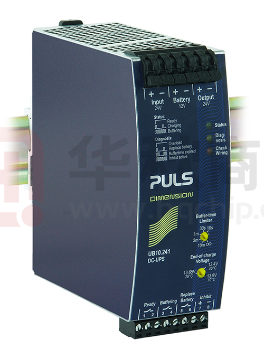
UB10.241
24V, 10A, DC-UPS
U–Series
DC-UPS CONTROL UNIT
•
•
•
•
•
•
•
•
•
PRODUCT DESCRIPTION
This uninterruptible power supply (UPS) controller
UB10.241 is an addition to standard 24V power supplies
to bridge power failures or voltage fluctuations.
Expensive downtimes, long restart cycles and loss of
data can be avoided.
The
DC-UPS
includes
a
professional
battery
management system which charges and monitors the
battery to achieve the longest battery service life as well
as many diagnostic functions that ensure a reliable
operation of the entire system.
A unique feature of the UB10.241 is that only one 12V
battery is required to buffer the 24V output. This makes
matching batteries unnecessary and allows a precise
battery charging and testing.
The UB10.241 requires one external 12V battery for
which two preassembled battery modules are available.
A lightweight 7Ah battery which can be mounted on
the DIN rail and a 26Ah module that can be panel
mounted for longer buffer times.
In addition to the UB10.241, the UBC10.241 UPS
includes the same controller with an integrated 5Ah
battery.
ORDER NUMBERS
Requires Only One 12V Battery for a 24V Output
Stable Output Voltage in Buffer Mode
Superior Battery Management for Longest Battery Life
Comprehensive Diagnostic and Monitoring Functions
Replace Battery Signal Included
Electronically Overload and Short Circuit Protected
50% Power Reserves
Selectable Buffer Time Limiter
3 Year Warranty
SHORT-FORM DATA
Input voltage
range
Output current
Output voltage
nom. 24Vdc
22.5-30Vdc
min.15A
min.10A
typ. 0.23V
lower as input
voltage
22.25V
3.9Ah to 40Ah
-25 to +70°C
Normal mode
Buffer mode
Normal mode
Buffer mode, 10A
VRLA lead acid
Operational
+60°C to +70°C
Derating
0.43A/°C
normal mode
Dimensions
49x124x117mm WxHxD
Buffer time
typ. 6’45”
7Ah battery module
(at 10A)
typ. 55’
26Ah battery module
Typical setup of a DC-UPS system with the UB10.241:
Allowed batteries
Temperature range
DC
AC
24V
Power
Supply
e.g.:
Dimension
24V
DC-UPS
12V
Battery
24V
Load
UB10.241
e.g.:
UZK12.xxx
e.g.: PLC
MAIN APPROVALS
For details and the complete approval list, see chapter19.
DC-UPS
UB10.241
Standard controller
Accessory
UZK12.072
Battery module 12V 7Ah
UZO12.072
Mounting kit w/o battery
UZK12.261
Battery module 12V 26Ah
UZO12.26
Mounting kit w/o battery
ZM1.WALL
Panel/Wall mount bracket
ZM10.WALL
Panel/Wall mount bracket
UL 508
UL 60950-1
Marine
Marine
Aug. 2021 / Rev. 1.5 DS-UB10.241-EN
All parameters are specified at an input voltage of 24V, 10A output load, 25°C ambient and after a 5 minutes run-in time
unless otherwise noted. It is assumed that the input power source can deliver a sufficient output current.
www.pulspower.com Phone +49 89 9278 0
Germany
Class I Div 2
1/30
�UB10.241
24V, 10A, DC-UPS
U–Series
INDEX
1.
2.
3.
4.
5.
6.
7.
8.
9.
10.
11.
12.
13.
14.
15.
16.
PAGE
Intended Use ............................................................. 3
Installation Instructions ............................................ 3
Input .......................................................................... 5
Output in Normal Mode .......................................... 6
Output in Buffer Mode ............................................ 7
Battery Input ............................................................. 8
Buffer Time ............................................................... 9
Efficiency and Power Losses................................... 11
Functional Diagram ................................................ 12
Check Wiring and Battery Quality Tests ............... 13
Relay Contacts and Inhibit Input ........................... 14
Front Side User Elements ....................................... 16
Terminals and Wiring ............................................. 18
Reliability ................................................................ 18
EMC.......................................................................... 19
Environment ........................................................... 20
INDEX
PAGE
17.
18.
19.
20.
21.
22.
23.
Protection Features ................................................ 20
Safety Features ....................................................... 21
Approved, Fulfilled or Tested Standards .............. 22
Regulatory Product Compliance............................ 23
Physical Dimensions and Weight .......................... 24
Installation Notes ................................................... 25
Accessories ......................................................... ….26
23.1. Battery Modules……………………………26
23.2. ZM1.WALL - Wall mounting bracket……26
23.3. ZM10.WALL - Wall mounting bracket…..27
24. Application Notes………………………………………28
24.1. Battery Replacement Intervals……………28
24.2. Parallel and Serial Use……………………..29
24.3. Using the Inhibit Input…………………….30
24.4. Troubleshooting……………………………30
TERMINOLOGY AND ABREVIATIONS
DC-UPS
Uninterruptible power supply with DC-Input.
Normal mode
Describes a condition where the battery is charged, the input voltage is in range and the output is
loaded within the allowed limits.
Buffer mode
Describes a condition where the input voltage is below the transfer threshold level, the unit is
running on battery (buffering) and the output is loaded within the allowed limits.
Charging mode
Describes a condition where the battery is being charged, the input voltage is in range and the
output is loaded within the allowed limits.
Inhibit mode
Describes a condition where buffering is disabled on purpose by using the inhibit input of the DCUPS. (e.g. for service actions, or to save battery capacity)
Buffer time
Same as the term “hold-up time”.
t.b.d.
To be defined, value or description will follow later.
DISCLAIMER
The information presented in this document is believed to be accurate and reliable and may change without notice.
Some parts of this unit are patent by PULS (US patent No 091662,063, Des. 424,529, …).
No part of this document may be reproduced or utilized in any form without permission in writing from the publisher.
Aug. 2021 / Rev. 1.5 DS-UB10.241-EN
All parameters are specified at an input voltage of 24V, 10A output load, 25°C ambient and after a 5 minutes run-in time
unless otherwise noted. It is assumed that the input power source can deliver a sufficient output current.
www.pulspower.com Phone +49 89 9278 0
Germany
2/30
�UB10.241
24V, 10A, DC-UPS
U–Series
1. INTENDED USE
This device is designed for installation in an enclosure and is intended for commercial use, such as in industrial control,
process control, monitoring and measurement equipment or the like.
Do not use this device in equipment where malfunction may cause severe personal injury or threaten human life.
2. INSTALLATION INSTRUCTIONS
Risk of electrical shock, fire, personal injury or death.
-
Turn power off before working on the device and protect against inadvertent re-powering.
Do not open, modify or repair the device.
Use caution to prevent any foreign objects from entering into the housing.
Do not use in wet locations or in areas where moisture or condensation can be expected.
Do not touch during power-on, and immediately after power-off. Hot surface may cause burns.
Obey the following installation instructions:
This device may only be installed and put into operation by qualified personnel.
This device does not contain serviceable parts. The tripping of an internal fuse is caused by an internal defect.
If damage or malfunction should occur during installation or operation, immediately turn power off and send unit to
the factory for inspection.
Turn power off and disconnect the battery fuse before working on the device.
Install the device in an enclosure providing protection against electrical, mechanical and fire hazards.
Install the device onto a DIN rail according to EN 60715 with the input terminals on the top of the unit.
The input can be powered from a regulated power supply or a similar DC source. The voltage between the input and
ground must not exceed 60Vdc continuously. The ripple voltage in the low frequency range between 50Hz and 10kHz
must be negligible when used in marine applications.
The input must be powered from a PELV or SELV source or an “Isolated Secondary Circuit” in order to maintain a SELV
or PELV output.
Use an appropriately sized 24V power supply, which can deliver the additional internal current consumption, required
to charge the battery.
Use only VRLA lead acid batteries with a capacity between 3.9Ah and 40Ah.
Check for correct input and battery polarity. The device will not operate when the voltage is reversed.
Make sure that the wiring is correct by following all local and national codes. Use appropriate copper cables that are
designed for a minimum operating temperature of 60°C for ambient temperatures up to +45°C, 75°C for ambient
temperatures up to +60°C and 90°C for ambient temperatures up to +70°C. Ensure that all strands of a stranded wire
enter the terminal connection.
Do not use wires smaller than 2.5mm2 (or AWG 12) and not longer than 2x1.5m between the battery and the DC-UPS
controller. Longer or smaller gauge wires can change performance of the system. Use a 30A fuse (ATOF® 287 030 from
Little fuse or an UL listed fuse with the same characteristics) in the battery circuit. The battery fuse protects the wires
between the battery and the DC-UPS and shall be located close to the battery.
The device is designed for pollution degree 2 areas in controlled environments. No condensation or frost is allowed.
The device is designed as “Class of Protection III” equipment according to IEC 61140.
The enclosure of the device provides a degree of protection of IP20.
A disconnecting means shall be provided for the input and the battery input of the device.
The device is designed for convection cooling and does not require an external fan. Do not obstruct airflow and do
not cover ventilation grid!
Aug. 2021 / Rev. 1.5 DS-UB10.241-EN
All parameters are specified at an input voltage of 24V, 10A output load, 25°C ambient and after a 5 minutes run-in time
unless otherwise noted. It is assumed that the input power source can deliver a sufficient output current.
www.pulspower.com Phone +49 89 9278 0
Germany
3/30
�UB10.241
24V, 10A, DC-UPS
U–Series
Keep the following minimum installation clearances: 40mm on top, 20mm on the bottom, 5mm left and right side.
Increase the 5mm to 15mm in case the adjacent device is a heat source. When the device is permanently loaded with
less than 50%, the 5mm can be reduced to zero.
The device is designed for altitudes up to 6000m (19685ft).
The maximum surrounding air temperature is +70°C (+158°F). The operational temperature is the same as the
ambient or surrounding air temperature and is defined 2cm below the device.
The device is designed to operate in areas between 5% and 95% relative humidity.
Installation Instructions for Hazardous Location Areas
The device is suitable for use in Class I Division 2 Groups A, B, C, D locations and for use in Group II Category 3 (Zone
2) environments.
Hazardous Location Classification: ATEX: EPS 15 ATEX 1 025 X, II 3G EX ec nC IIC T3 Gc
EXPLOSION HAZARDS!
Substitution of components may impair suitability for this environment.
Do not disconnect the device or change unit settings unless power has been switched off or the area is known to be
non-hazardous.
A suitable enclosure must be provided for the end-product which has a minimum protection of IP54 and fulfils the
requirements of the EN 60079-0.
Aug. 2021 / Rev. 1.5 DS-UB10.241-EN
All parameters are specified at an input voltage of 24V, 10A output load, 25°C ambient and after a 5 minutes run-in time
unless otherwise noted. It is assumed that the input power source can deliver a sufficient output current.
www.pulspower.com Phone +49 89 9278 0
Germany
4/30
�UB10.241
24V, 10A, DC-UPS
U–Series
3. INPUT
Input voltage
Input voltage ranges
nom.
nom.
DC 24V
22.5 - 30Vdc
30 - 35Vdc
35Vdc
0 - 22.5Vdc
Allowed input voltage ripple
max.
Allowed voltage between input
and earth (ground)
Turn-on voltage
max.
Input current **)
typ.
1.5Vpp
1Vpp
60Vdc or
42.4Vac
22.8Vdc
max.
typ.
typ.
23Vdc
120mA
1.1A
External capacitors on the input
Continuous operation, see Fig. 3-1
Temporarily allowed, no damage to the DC-UPS *)
Absolute maximum input voltage with no damage to the
DC-UPS
The DC-UPS switches into buffer mode and delivers
output voltage from the battery if the input was above
the turn-on level before and all other buffer conditions
are fulfilled.
Bandwidth 3A or when long battery cables are used. For all other
situations, use curve C.
Step 3
Use the determined current from Step 2 to find the appropriate curve in Fig. 7-2. The buffer time
(Discharging Time) can be found where this curve meets the dotted line. This is the point where the DCUPS stops buffering due to the under-voltage lockout.
Step 4
Depending on Fig. 7-2, the buffer time needs to be reduced to take aging effects or guaranteed values
into account.
Example:
The buffer current is 7.5A and a battery according Fig. 7-2 is used. The cable between the battery and the DC-UPS is
1m and has a cross section of 2.5mm2. How much is the maximum achievable buffer time.
Answer:
According to Fig. 6-1, the battery current is 18A. Curve A is used since the battery current is > 3A and the
length of the cable is one meter.
According to Fig. 7-2, a buffer time (Discharging Time) of 30 Minutes can be determined. It is recommended
to reduce this figure to approximately 24 minutes for a guaranteed value and to cover aging effects.
Aug. 2021 / Rev. 1.5 DS-UB10.241-EN
All parameters are specified at an input voltage of 24V, 10A output load, 25°C ambient and after a 5 minutes run-in time
unless otherwise noted. It is assumed that the input power source can deliver a sufficient output current.
www.pulspower.com Phone +49 89 9278 0
Germany
10/30
�UB10.241
24V, 10A, DC-UPS
U–Series
8. EFFICIENCY AND POWER LOSSES
Efficiency
Power losses
typ.
typ.
typ.
typ.
97.8%
2.9W
5.5W
5.0W
typ.
2.1W
typ.
18.5W
Normal mode, 10A output current, battery fully charged
Normal mode, 0A output current, battery fully charged
Normal mode, 10A output current, battery fully charged
During battery charging, 0A output current
During battery charging, to be added to power losses in
normal mode, Fig. 8-2
Buffer mode, 10A output current
Fig. 8-1 Efficiency at 24V, typ.
Efficiency vs. output
current in normal mode
98%
97.5
97.0
96.5
96.0
95.5
95.0
94.5
Output Current
3
5
7
9
11
13
15A
Fig. 8-2 Losses at 24V, typ.
Fig. 8-3 Losses, typ.
Power losses in buffer mode, typ.
Power losses versus output
current in normal mode
8W
7
6
5
4
3
2
1
0
20W
15
10
5
Output Current
0
2.5
5
7.5
10
12.5
15A
0
Output Current
0
2
4
6
8
Aug. 2021 / Rev. 1.5 DS-UB10.241-EN
All parameters are specified at an input voltage of 24V, 10A output load, 25°C ambient and after a 5 minutes run-in time
unless otherwise noted. It is assumed that the input power source can deliver a sufficient output current.
www.pulspower.com Phone +49 89 9278 0
Germany
10A
11/30
�UB10.241
24V, 10A, DC-UPS
U–Series
9. FUNCTIONAL DIAGRAM
Fig. 9-1 Functional diagram
DC-UPS Control Unit
+
24V
Power
Supply
Input
-
12V Battery
+
-
Input Fuse
&
Reverse
Polarity
Protection
Battery
Tester
Electronic
Current
Limiter
*
Step-up
Converter
-
Output
Buffered
Load
-
Battery
Charger
Status LED (green)
Diagnosis LED (yellow)
Controller
+
Battery
+
Check Wiring LED (red)
Cut-off
Relay
Buffer-time Limiter
10s, 30s, 1m, 3m, 10m,
End-of-charge Voltage
(7)
(8)
(1)
(2) (3)
(4) (5)
Inhibit +
Inhibit -
(6)
Ready Buffering Replace
Contact Contact Battery
Contact
*)
Return current protection; This feature utilizes a MOSFET instead of a diode in order to minimize the voltage drop and power
losses.
Aug. 2021 / Rev. 1.5 DS-UB10.241-EN
All parameters are specified at an input voltage of 24V, 10A output load, 25°C ambient and after a 5 minutes run-in time
unless otherwise noted. It is assumed that the input power source can deliver a sufficient output current.
www.pulspower.com Phone +49 89 9278 0
Germany
12/30
�UB10.241
24V, 10A, DC-UPS
U–Series
10. CHECK WIRING AND BATTERY QUALITY TESTS
The DC-UPS is equipped with an automatic “Check Wiring” and “Battery Quality” test.
“Check Wiring” test:
Under normal circumstances, an incorrect or bad connection from the battery to the DC-UPS or a missing (or blown)
battery fuse would not be recognized by the UPS when operating in normal mode. Only when back up is required
would the unit not be able to buffer. Therefore, a “check wiring” test is included in the DC-UPS. This connection is
tested every 10 seconds by loading the battery and analysing the response from the battery. If the resistance is too
high, or the battery voltage is not in range, the unit displays “Check Wiring” with the red LED. At the same time the
green “Ready” LED will turn off.
“State of Health” (SoH) test:
The battery has a limited service life and needs to be replaced in a fixed interval which is defined by the specified
service life (acc. to the Eurobat guideline), based on the surrounding temperature and the number of
charging/discharging cycles. If the battery is used longer than the specified service life, the battery capacity will
degrade. Details can be found in chapter 24.1. The battery SoH test can not determine a gradual loss in capacity.
However, it can detect a battery failure within the specified service life of the battery. Therefore, a SoH is included in
the DC-UPS.
The battery quality test consists of different types of tests:
During charging:
If the battery does not reach the ready status (see chapter 12) within 30h, it is considered to be defective.
The reason could be a broken cell inside the battery.
During operation:
Once the battery is fully charged, a voltage drops test and a load test is performed alternately every 8 hours.
Three of the tests must consecutively produce negative results to indicate a battery problem.
A battery problem is indicated with the yellow LED (replace battery pattern) and the relay contact “Replace Battery”.
Please note that it can take up to 50 hours (with the largest size of battery) until a battery problem is reported. This
should avoid nuisance error messages as any urgent battery problems will be reported by the “Check Wiring” test
and create a warning signal. The battery tests require up to 50h uninterrupted operation. Any interruptions in the
normal operation of the DC-UPS may result in the “Replace Battery” test cycle to start over.
When “Replace battery” is indicated, it is recommended to replace battery as soon as possible.
Aug. 2021 / Rev. 1.5 DS-UB10.241-EN
All parameters are specified at an input voltage of 24V, 10A output load, 25°C ambient and after a 5 minutes run-in time
unless otherwise noted. It is assumed that the input power source can deliver a sufficient output current.
www.pulspower.com Phone +49 89 9278 0
Germany
13/30
�UB10.241
24V, 10A, DC-UPS
U–Series
11. RELAY CONTACTS AND INHIBIT INPUT
The DC-UPS is equipped with relay contacts and signal inputs for remote monitoring and controlling of the unit.
Relay contacts:
Ready:
Contact is closed when battery is charged more than 85%, no wiring failure are recognized, input
voltage is enough and inhibit signal is not active.
Buffering:
Contact is closed when unit is buffering.
Replace Battery:
Contact is closed when the unit is powered from the input and the battery quality test (SOH test)
reports a negative result.
Relay contact ratings
Isolation voltage
max.
min.
max.
60Vdc 0.3A, 30Vdc 1A, 30Vac 0.5A resistive load
1mA at 5Vdc min.
500Vac, signal port to power port
Signal input:
Inhibit:
Signal voltage
Signal current
Inhibit threshold
Isolation
The inhibit input disables buffering. In normal mode, a static signal is
required. In buffer mode, a pulse with a minimum length of 250ms is
required to stop buffering. The inhibit is stored and can be reset by
cycling the input voltage. See also chapter 24.1 for application hints.
max.
max.
min.
max.
nom.
7+
3mA
Inhibit
8-
5,1V
35Vdc
6mA, current limited
6Vdc, buffering is disabled above this threshold level
10Vdc
500Vac, signal port to power port
Restriction apply when using the signal and relay contacts in a Haz-Loc environment:
The Buffering, Ready and Replace Battery contact is intended to be used for a separately investigated nonincendive field wiring
and/or field wiring apparatus. The DC-UPS may be located in a Class I, Division 2 (Group A, B, C or D) hazardous (classified)
location. Associated apparatus must be installed in accordance with its manufacturer's control drawing and Article 504 of the
National Electrical Code (ANSI/NFPA 70) for installation in the United States, or chapter 18 of the Canadian Electrical Code for
Installations in Canada.
Selected associated apparatus must be third part listed as providing nonincendive field circuits for the application, and have Voc
not exceeding Vmax, Isc not exceeding Imax.
Non associated non incendive field wiring apparatures shall not be connected in parallel unless this is permitted by the
associated non incendive field wiring apparatures approval.
Aug. 2021 / Rev. 1.5 DS-UB10.241-EN
All parameters are specified at an input voltage of 24V, 10A output load, 25°C ambient and after a 5 minutes run-in time
unless otherwise noted. It is assumed that the input power source can deliver a sufficient output current.
www.pulspower.com Phone +49 89 9278 0
Germany
14/30
�UB10.241
24V, 10A, DC-UPS
U–Series
-
Input
DCUPS
+
+
Fig. 11-1 Contact control drawing for use in Haz-Loc
environments
-
Output
1
Ready
2
3
Buffering
Replace
Battery
Battery
+
Hazardous
Location
-
4
5
6
Non Hazardous
Location
Isc
Voc
Isc
Voc
Isc
Voc
Apparatus
Selected barriers must have entity parameters such that
Voc < V max, Isc < I max,
Ca > Ci + C-cable, La > Li + L-cable
For C-cable and L-cable, if the capacitance per foot
or the inductance per foot is not known, then the
following values shall be used: C-cable = 60pF/foot
and L-cable = 0.2µH/foot.
Contact current : I max = 50mA
Contact voltage : V max. = 35V (DC or AC)
Max. associated circuit capacitance Ci = 0
Max. assoc*) Minimum value includes 20% aging of the battery
and a cable length of 1.5m with a cross section of 2.5mm2
between the
battery and the DC-UPS and requires a fully charged (min. 24h)
battery.
**) Typical value includes 10% aging of the battery and a cable
length of 0.3m with a cross section of 2.5mm2 between the
battery and the DC-UPS and requires a fully charged (min. 24h)
battery.iated circuit inductance Li = 0
No polarity requirement
Aug. 2021 / Rev. 1.5 DS-UB10.241-EN
All parameters are specified at an input voltage of 24V, 10A output load, 25°C ambient and after a 5 minutes run-in time
unless otherwise noted. It is assumed that the input power source can deliver a sufficient output current.
www.pulspower.com Phone +49 89 9278 0
Germany
15/30
�UB10.241
24V, 10A, DC-UPS
U–Series
12. FRONT SIDE USER ELEMENTS
A
Power Port
Quick-connect spring-clamp terminals, connection for input voltage,
output voltage and battery
B
Signal Port
Plug connector with screw terminals, inserted from the bottom.
Connections for the Ready, Buffering, Replace Battery relay contacts and
for the Inhibit input. See details in chapter 11.
C
Green Status LED
Ready: Battery is charged > 85%, no wiring failure is recognized, input
voltage is enough and inhibit signal is not active.
Charging: Battery is charging, and the battery capacity is below 85%.
Buffering: Unit is in buffer mode.
Flashing pattern of the green status LED:
D
ON
OFF
Ready
ON
OFF
Charging
ON
OFF
Buffering
Yellow Diagnosis LED
Overload: Output has switched off due to long overload in buffer mode
or due to high temperatures.
Replace battery: Indicates a battery which failed the battery quality test
(SoH test). Battery should be replaced soon.
Buffer-time expired: Output has switched off due to settings of Buffertimer Limiter. This signal will be displayed for 15 minutes.
Inhibit active: Indicates that buffering is disabled due to an active inhibit
signal.
Flashing pattern of the yellow diagnosis LED:
ON
OFF
Overload
ON
OFF
Replace
Battery
ON
OFF
Buffer time
expired
ON
OFF
Inhibit
active
Aug. 2021 / Rev. 1.5 DS-UB10.241-EN
All parameters are specified at an input voltage of 24V, 10A output load, 25°C ambient and after a 5 minutes run-in time
unless otherwise noted. It is assumed that the input power source can deliver a sufficient output current.
www.pulspower.com Phone +49 89 9278 0
Germany
16/30
�UB10.241
24V, 10A, DC-UPS
U–Series
E
Red Check Wiring LED
This LED indicates a failure in the installation (e.g. too low input voltage), wiring, battery or battery fuse.
F
Buffer-time Limiter:
User accessible dial which limits the maximum buffer time in a buffer event to save battery energy. When the
battery begins to recharge after a discharging event, the process is completed much faster since only the energy
which was taken out of the battery needs to be “refilled”. The following times can be selected: 10 seconds, 30
seconds, 1 minute, 3 minutes, 10 minutes or infinity (until battery is flat) which allows buffering until the deep
discharge protection stops buffering.
G End-of-charge-voltage Selector:
The end-of-charge-voltage shall be set manually according to the expected temperature in which the battery is
located. The dial on the front of the unit allows a continuously adjustment between +10 and +40°C. 10°C will set
the end-of-charge-voltage to 13.9V, 25°C13.65V and 40°C13.4V. If in doubt about the expected temperature,
set the unit to 40°C.
Aug. 2021 / Rev. 1.5 DS-UB10.241-EN
All parameters are specified at an input voltage of 24V, 10A output load, 25°C ambient and after a 5 minutes run-in time
unless otherwise noted. It is assumed that the input power source can deliver a sufficient output current.
www.pulspower.com Phone +49 89 9278 0
Germany
17/30
�UB10.241
24V, 10A, DC-UPS
U–Series
13. TERMINALS AND WIRING
Type
Solid wire
Stranded wire
AWG
Ferrules
Pull-out force
Tightening torque
Wire stripping length
Power terminals
Bi-stable, quick-connect springclamp terminals. IP20 Fingertouch-proof. Suitable for fieldand factory installation. Shipped
in open position.
0.5-6mm2
0.5-4mm2
20-10AWG
Allowed, but not required
10AWG:80N, 12AWG:60N,
14AWG:50N, 16AWG:40N
according to UL486E
Not applicable
10mm / 0.4inch
Signal terminals
Plug connector with screw terminal. Finger-touch-proof
construction with captive screws for 3.5mm slotted
screwdriver. Suitable for field- and factory installation.
Shipped in open position. To meet GL requirements,
unused terminal compartments should be closed.
0.2-1.5mm2
0.2-1.5mm2
22-14AWG
Allowed, but not required
Not applicable
0.4Nm, 3.5lb.in
6mm / 0.24inch
Fig. 13-1 Spring-clamp terminals, connecting a wire
Instructions:
a)
Use appropriate copper cables, that are designed
for an operating temperature of 60°C
b)
Follow national installation codes and regulations!
c)
Ensure that all strands of a stranded wire enter the
terminal connection!
d)
Up to two stranded wires with the same cross
section are permitted in one connection point
14. RELIABILITY
Lifetime expectancy
MTBF SN 29500, IEC 61709
MTBF MIL HDBK 217F
min.
min.
min.
137 400h
> 15 years
> 15 years
886 000h
1 482 000h
397 900
545 000
At 10A output current, 40°C
At 5A output current, 40°C
At 10A output current, 25°C
At 10A output current, 40°C
At 10A output current, 25°C
At 10A output current, 40°C, ground benign GB40
At 10A output current, 25°C, ground benign GB25
The Lifetime expectancy shown in the table indicates the operating hours (service life) and is determined by the
lifetime expectancy of the built-in electrolytic capacitors. Lifetime expectancy is specified in operational hours.
Lifetime expectancy is calculated according to the capacitor’s manufacturer specification. The prediction model allows
a calculation of up to 15 years from date of shipment.
MTBF stands for Mean Time Between Failure, which is calculated according to statistical device failures and indicates
reliability of a device. It is the statistical representation of the likelihood of a unit to fail and does not necessarily
represent the life of a product.
Aug. 2021 / Rev. 1.5 DS-UB10.241-EN
All parameters are specified at an input voltage of 24V, 10A output load, 25°C ambient and after a 5 minutes run-in time
unless otherwise noted. It is assumed that the input power source can deliver a sufficient output current.
www.pulspower.com Phone +49 89 9278 0
Germany
18/30
�UB10.241
24V, 10A, DC-UPS
U–Series
15. EMC
The unit is suitable for applications in industrial environment as well as in residential, commercial and light industry
environment without any restrictions. CE mark is in conformance with EMC guideline 89/336/EEC and 93/68/EEC and
the low-voltage directive (LVD) 73/23/EEC, 93/68/EEC.
A detailed EMC Report is available on request.
EMC Immunity
Electrostatic discharge
EN 61000-6-1, EN 61000-6-2
EN 61000-4-2
Electromagnetic RF field
Fast transients (Burst)
EN 61000-4-3
EN 61000-4-4
Surge voltage
EN 61000-4-5
Conducted disturbance
EN 61000-4-6
Contact discharge
Air discharge
80MHz-1GHz
Out- and input lines
Signal lines**)
Output + Input + + / - housing
0,15-80MHz
Generic standards
8kV
15kV
10V/m
2kV
2kV
500V
500V
500V
10V
Criterion A*)
Criterion A*)
Criterion A
Criterion A
Criterion A
Criterion A
Criterion A
Criterion A
Criterion A
*) DIN rail earthed
**) Tested with coupling clamp
EMC Emission
Conducted emission
EN 61000-6-3, EN 61000-6-4
Generic standards
EN 55032
Input lines
Class B*)
EN 55032
Output lines
Class B*)
Radiated emission
EN 55011, EN 55032
Class B
This device complies with FCC Part 15 rules.
Operation is subjected to the following two conditions: (1) this device may not cause harmful interference, and (2) this
device must accept any interference received, including interference that may cause undesired operation.
*)
Informative measurement with voltage probe
Switching frequencies
Switching frequency of boost converter
Switching frequency of electronic output current limitation
Switching frequency of battery charger
The DC-UPS has three converters with three different
switching frequencies included.
100kHz
Constant frequency
78kHz
Constant frequency
19.5kHz
Constant frequency
Aug. 2021 / Rev. 1.5 DS-UB10.241-EN
All parameters are specified at an input voltage of 24V, 10A output load, 25°C ambient and after a 5 minutes run-in time
unless otherwise noted. It is assumed that the input power source can deliver a sufficient output current.
www.pulspower.com Phone +49 89 9278 0
Germany
19/30
�UB10.241
24V, 10A, DC-UPS
U–Series
16. ENVIRONMENT
Operational temperature
-25°C to +70°C (-13° to +158°F)
Derating
0.43A/°C
0.25A/°C
Storage temperature
Humidity
-40 to +85°C (-40° to +185°F)
5 to 95% r.H.
Vibration sinusoidal
Shock
Altitude
Over-voltage category
2-17.8Hz: ±1.6mm; 17.8-500Hz: 2g
30g 6ms, 20g 11ms
0 to 6000m
II
II
2
Degree of pollution
For the DC-UPS control unit.
Keep battery in a cooler environment!
+60°C to +70°C (+140°F to +158°F),
normal mode see Fig. 16-1
+60°C to +70°C (+140°F to +158°F),
buffer mode see Fig. 16-2
Storage and transportation, except battery
IEC 60068-2-30
Do not energize while condensation is present
IEC 60068-2-6
IEC 60068-2-27
Approvals apply only up to 2000m
EN 50178
EN 50178 above 2000m altitude
EN 50178, not conductive
Fig. 16-1 Output current vs. ambient temperature
Fig. 16-2 Output current vs. ambient temperature
Allowable Output
Current in Normal Mode
Allowable Output
Current in Buffer Mode
15A
15A
continuous
12.5
10
10
7.5
7.5
5
5
2.5
2.5
0
-25
Ambient Temperature
0
20
40
for typ. 5s
12.5
60 70°C
0
-25
continuous
Ambient Temperature
0
20
40
60 70°C
The ambient temperature is defined 2cm below the unit.
17. PROTECTION FEATURES
Output protection
Output over-voltage protection
in buffer mode
Degree of protection
Penetration protection
Reverse battery polarity protection
Wrong battery voltage protection
Battery deep discharge protection
Over temperature protection
Input over-voltage protection
Internal input fuse
Electronically protected against overload, no-load and short-circuits
typ. 32Vdc
In case of an internal defect, a redundant circuitry
max. 35Vdc
limits the maximum output voltage. The output
automatically shuts-down and makes restart attempts.
IP20
EN/IEC 60529
> 3.5mm
E.g. screws, small parts
yes
Max. –35Vdc;
yes
Max. +35Vdc (e.g. 24V battery instead of 12V battery)
yes
The limit is battery current dependent
yes
Output shutdown with automatic restart
yes
Max. 35Vdc, no harm or defect of the unit
25A, blade type
No user accessible part, no service part
Aug. 2021 / Rev. 1.5 DS-UB10.241-EN
All parameters are specified at an input voltage of 24V, 10A output load, 25°C ambient and after a 5 minutes run-in time
unless otherwise noted. It is assumed that the input power source can deliver a sufficient output current.
www.pulspower.com Phone +49 89 9278 0
Germany
20/30
�UB10.241
24V, 10A, DC-UPS
U–Series
18. SAFETY FEATURES
Output voltage
Class of protection
Isolation resistance
Dielectric strength
Touch current (leakage current)
SELV
IEC/EN 60950-1
PELV
EN 60204-1, EN 50178, IEC 60364-4-41
Max. allowed voltage between any input, output or signal pin and ground:
60Vdc or 42.4Vac
III
PE (Protective Earth) connection is not required
> 5MOhm
Power port to housing, 500Vdc
500Vac
Power port to signal port
500Vac
Power port / signal port to housing
The leakage current which is produced by the DC-UPS itself depends on the input
voltage ripple and need to be investigated in the final application.
For a smooth DC input voltage, the produced leakage current is less than 100µA.
Aug. 2021 / Rev. 1.5 DS-UB10.241-EN
All parameters are specified at an input voltage of 24V, 10A output load, 25°C ambient and after a 5 minutes run-in time
unless otherwise noted. It is assumed that the input power source can deliver a sufficient output current.
www.pulspower.com Phone +49 89 9278 0
Germany
21/30
�UB10.241
24V, 10A, DC-UPS
U–Series
19. APPROVED, FULFILLED OR TESTED STANDARDS
UL 508
UL Certificate
Listed equipment for category NMTR - Industrial Control
Equipment
Applicable for US and Canada
E-File: E198865
IEC 60950-1
CB Scheme Certificate
General safety requirements for Information Technology
Equipment (ITE)
UL 60950-1
UL Certificate
Recognized component for category QQGQ - Information
Technology Equipment (ITE)
Applicable for US and Canada
E-File: E137006
ATEX
Agency Certificate (Bureau Veritas)
EN 60079-0 Explosive atmospheres - General requirements
EN 60079-7, EN 60079-15 Equipment protection by type of
protection "e" and "n"
Certificate: EPS 15 ATEX 1 025 X
Temperature Code: T3
Type of Protection: ec nC
IECEx
IECEx Certificate
IEC 60079-0 Explosive atmospheres - General requirements
IEC 60079-7, IEC 60079-15 Equipment protection by type of
protection "e" and "n"
Certificate: IECEx EPS 15.0049 X
Temperature Code: T3
Type of Protection: ec nC
Class I Div 2
CSA Certificate
Power Supplies for Hazardous Location
Applicable for Canada and US
CSA Class: 5318-01 (Canada), 5318-81 (USA)
Temperature Code: T3
Groups: A, B, C and D
Class I Div. 2
UL Certificate
Recognized component for category QQPX - Power Supplies for
Use in Hazardous Locations
Applicable for US and Canada
E-File: E246846
Temperature Code: T3
Groups: A, B, C and D
Marine (DNV)
DNV Certificate
DNV Type approved product
Certificate: TAA00001ST
Temperature: Class D
Humidity: Class B
Vibration: Class C
EMC: Class A
Enclosure: Class A
Marine (ABS)
ABS Design Assessment Certificate
ABS (American Bureau of Shipment) assessed product
Certificate: 17-HG1599236-PDA
Aug. 2021 / Rev. 1.5 DS-UB10.241-EN
All parameters are specified at an input voltage of 24V, 10A output load, 25°C ambient and after a 5 minutes run-in time
unless otherwise noted. It is assumed that the input power source can deliver a sufficient output current.
www.pulspower.com Phone +49 89 9278 0
Germany
22/30
�UB10.241
24V, 10A, DC-UPS
U–Series
IEC 60068-2-60
Manufacturer's Declaration (Online Document)
Environmental Tests, Flowing Mixed Gas Corrosion Test
Test Ke - Method 4
H2S: 10ppb
NO2: 200ppb
Cl2: 10ppb
SO2: 200ppb
Test Duration: 3 weeks, which simulates a service life of 10 years
ISA-71.04 G3
Manufacturer's Declaration (Online Document)
Airborne Contaminants Corrosion Test
Severity Level: G3 Harsh
H2S: 100ppb
NOx: 1250ppb
Cl2: 20ppb
SO2: 300ppb
Test Duration: 3 weeks, which simulates a service life of 10 years.
VDMA 24364
Paint Wetting Impairment Substances Test (or LABS-Test)
Tested for Zone 2 and test class C1 according to VDMA 24364-C1L/W for solvents and water-based paints
20. REGULATORY PRODUCT COMPLIANCE
EU Declaration of
Conformity
REACH Directive
WEEE Directive
KC Korean Certificate
EAC TR Registration
The CE mark indicates conformance with the
- EMC directive
- Low-voltage directive
- RoHS directive
Manufacturer's Statement
EU-Directive regarding the Registration, Evaluation,
Authorization and Restriction of Chemicals
Manufacturer's Statement
EU-Regulation on Waste Electrical and Electronic Equipment
Registered in Germany as business to business (B2B) products.
KC Registration
Korean registration of Broadcasting and Communication
Equipment
Registered under Clause 3, Article 58-2 of Radio Waves Act.
EAC Certificate
EAC EurAsian Conformity - Registration Russia, Kazakhstan and
Belarus
8504408200, 8504409000
Aug. 2021 / Rev. 1.5 DS-UB10.241-EN
All parameters are specified at an input voltage of 24V, 10A output load, 25°C ambient and after a 5 minutes run-in time
unless otherwise noted. It is assumed that the input power source can deliver a sufficient output current.
www.pulspower.com Phone +49 89 9278 0
Germany
23/30
�UB10.241
24V, 10A, DC-UPS
U–Series
21. PHYSICAL DIMENSIONS AND WEIGHT
Width
Height
Depth
Weight
DIN rail
49mm / 1.93’’
124mm / 4.88’’
Plus, height of signal connector plug
117mm / 4.61’’
Plus, depth of DIN rail
530g / 1.17lb
Use 35mm DIN rails according to EN 60715 or EN 50022 with a height of 7.5 or 15mm.
The DIN rail depth must be added to the depth (117mm) to calculate the total required installation
depth.
Electronic files with mechanical data can be downloaded at www.pulspower.com
Fig. 21-1 Side view
Fig. 21-2 Front view
Aug. 2021 / Rev. 1.5 DS-UB10.241-EN
All parameters are specified at an input voltage of 24V, 10A output load, 25°C ambient and after a 5 minutes run-in time
unless otherwise noted. It is assumed that the input power source can deliver a sufficient output current.
www.pulspower.com Phone +49 89 9278 0
Germany
24/30
�UB10.241
24V, 10A, DC-UPS
U–Series
22. INSTALLATION NOTES
Mounting:
The power terminal shall be located on top of the unit. An appropriate electrical and fire end-product enclosure
should be considered in the end use application.
Cooling: Convection cooled; no forced air cooling required. Do not obstruct air flow!
Installation clearances: 40mm on top, 20mm on the bottom, 5mm on the left and right side are recommended
when loaded permanently with full power. In case the adjacent device is a heat source, 15mm clearance are
recommended.
Risk of electrical shock, fire, personal injury or death!
Turn power off and disconnect battery fuse before working on the DC-UPS. Protect against inadvertent re-powering.
Make sure the wiring is correct by following all local and national codes. Do not open, modify or repair the unit.
Use caution to prevent any foreign objects from entering the housing.
Do not use in wet locations or in areas where moisture or condensation can be expected.
Service parts:
The unit does not contain any service parts. The tripping of an internal fuse is caused by an internal fault. If damage
or malfunctioning should occur during operation, immediately turn power off and send unit to the factory for
inspection!
Wiring and installation instructions:
(1) Connect the power supply to the input terminals of the DC-UPS.
(2) Connect the battery to the battery terminals of the DC-UPS. It is recommended to install the battery outside the
cabinet or in a place where the battery will not be heated up by adjacent equipment. Do not install the battery
in airtight housings or cabinets. The battery should be installed according to EN50272-2, which includes enough
ventilation. Batteries store energy and need to be protected against energy hazards. Use a 30A battery fuse typ
ATO® 257 030 (Little fuse) or similar in the battery path. The battery fuse protects the wires between the battery
and the DC-UPS. It also allows the disconnection of the battery from the DC-UPS which is recommended when
working on the battery or DC-UPS. Disconnect battery fuse before connecting the battery.
Please note: Too small or too long wires between the DC-UPS and the battery can shorten the buffer time or can
result in a malfunction of the DC-UPS. Do not use wires smaller than 2.5mm2 (or 12AWG) and not longer than
2x1.5m (cord length 1.5m). Avoid voltage drops on this connection.
(3) Connect the buffered load to the output terminals of the DC-UPS. The output is decoupled from the input
allowing load circuits to be easily split into buffered and non buffered sections. Noncritical loads can be
connected directly to the power supply and will not be buffered. The energy of the battery can then be used in
the circuits which requires buffering.
(4) Install the fuse when the wiring is finished.
Fig. 22-1 Typical wiring diagram
24V
unbuffered
branch
24V
buffered
branch
24V
Power
supply
N
IN BAT OUT
DC-UPS
UB10.241
12V
Battery
-
-
Buffered
load
+
-
+
-
24V 12V 24V
+
-
+
+
-
+
+
-
Unbuffered
load
L PE
Aug. 2021 / Rev. 1.5 DS-UB10.241-EN
All parameters are specified at an input voltage of 24V, 10A output load, 25°C ambient and after a 5 minutes run-in time
unless otherwise noted. It is assumed that the input power source can deliver a sufficient output current.
www.pulspower.com Phone +49 89 9278 0
Germany
25/30
�UB10.241
24V, 10A, DC-UPS
U–Series
23. ACCESSORIES
23.1. BATTERY MODULES
Two pre-assembled battery modules with a single 12V battery are available for different buffer times. As an option, the
mounting brackets are also available without batteries. This option offers more flexibility in selecting an appropriate battery
or can save shipping and logistic costs. See individual datasheets for detailed information.
Battery type
Service life
Dimensions
Weight
DIN rail mountable
Order number
UZK12.072
Standard version
12V, 7Ah
3 to 5years
155x124x112mm
3.2kg
yes
UZK12.072
UZO12.072
UZB12.071
UZK12.261
High current version
12V, 26Ah
10 to 12years
214x179x158mm
9.9kg
no
UZK12.261
UZO12.26
UZB12.261
Fig. 23-1 UZK12.072
VRLA lead-acid maintenance free
battery
According to EUROBAT guideline
Width x height x depth
Battery module
Mounting bracket without battery
Replacement battery only
Fig. 23-2 UZK12.261
23.2. ZM1.WALL - WALL MOUNTING BRACKET
This bracket is used to mount specific Dimension units onto a flat surface without utilizing a DIN rail. The two aluminum
brackets and the black plastic slider of the unit have to be removed, so that the two steel brackets can be mounted.
Fig. 23-3
*)
ZM1.Wall Wall mounting bracket*)
Fig. 23-4
Wall mounting with DIN rail
brackets*)
PSU for illustration purpose only.
Aug. 2021 / Rev. 1.5 DS-UB10.241-EN
All parameters are specified at an input voltage of 24V, 10A output load, 25°C ambient and after a 5 minutes run-in time
unless otherwise noted. It is assumed that the input power source can deliver a sufficient output current.
www.pulspower.com Phone +49 89 9278 0
Germany
26/30
�UB10.241
24V, 10A, DC-UPS
U–Series
23.3. ZM10.WALL - WALL MOUNTING BRACKET
This bracket is used to mount the devices on a wall/panel without utilizing the DIN rail. The bracket can be mounted
without detaching the DIN rail brackets from the power supply. Product for illustration purpose only.
Fig. 23-5
Fig. 23-6
Isometric view
Fig. 23-8 Wall/panel mounting, side
view
Fig. 23-9
Isometric view
Hole pattern for wall
mounting
Fig. 23-7
Fig. 23-10
Wall/panel mounting, side view
Aug. 2021 / Rev. 1.5 DS-UB10.241-EN
All parameters are specified at an input voltage of 24V, 10A output load, 25°C ambient and after a 5 minutes run-in time
unless otherwise noted. It is assumed that the input power source can deliver a sufficient output current.
www.pulspower.com Phone +49 89 9278 0
Germany
Isometric view
27/30
�UB10.241
24V, 10A, DC-UPS
U–Series
24. APPLICATION NOTES
24.1. BATTERY REPLACEMENT INTERVALS
Batteries have a limited lifetime. They degrade slowly beginning from the production and need to be replaced
periodically. The design life figures can be found in the individual datasheets of the batteries and usually is specified
according to the Eurobat guideline or according to the manufacturer’s specifications.
The design life is the estimated life based on laboratory condition and is quoted at 20°C using the manufacturer’s
recommended float voltage condition. According to the Eurobat guideline, design lives have been structured into the
following different groups:
3 - 5 years:
This group of batteries is very popular in standby applications and in small emergency equipment.
This represents a 4 years design life with a production tolerance of ±1 year.
6 - 9 years:
This group of batteries is usually used when an improved life is required.
This represents a 7.5 years design life with a production tolerance of ±1.5 years.
10 - 12 years: This group of batteries is used when in applications where longest life and highest safety level are
required. This represents a 11 years design life with a production tolerance of ±1 year.
A battery failure within the specified design life of the battery usually results in a complete loss of the battery
function (broken cell, defect connection, …) and will be detected and reported by the periodical battery tests which
are included in the UB10.241 DC-UPS control unit.
If the operational parameters differ from those which are specified for the design life, an earlier change of the
battery might be necessary. The “real life” is called service life and is defined as the point at which the cell’s actual
capacity has reached 80% of its nominal capacity. At the end of the service life the capacity degrades much faster, so
that a further use of the battery is not recommended.
Temperature effect:
The temperature has the most impact in the service life. The hotter the temperature, the earlier the wear-out phase
of the battery begins. The wear-out results in a degradation of battery capacity. See Fig. 24-1 for details.
Effect of discharging cycles
The number as well as the depth of discharging cycles is limited. A replacement of the battery might be necessary
earlier than the calculated service life if the battery exceeds the numbers and values of Fig. 24-2.
Other effects which shortens the service life
Overcharging and deep discharging shortens the service life and should be avoided. Thanks to the single
battery concept of the UB10.241, the end-of-charge-voltage can be set very precisely to the required value a
thereby avoiding unnecessary aging effects.
Charge retention is important to get the longest battery life. Stored batteries which are not fully charged
age faster then charged batteries. Batteries which are not in use should be recharged at least once a year.
Excessive float charge ripple across the battery has an effect of reducing life and performance. The UB10.241
does not produce such a ripple voltage. This effect can be ignored when the battery is charged with the
UB10.241.
Guidelines for a long battery service life:
Place the battery in a cool location: E.g. near the bottom of the control cabinet.
Do not place the battery near heat generating devices.
Do not store discharged batteries.
Do not discharge the battery more than necessary. Set buffer time limiter to the required buffer time.
When choosing the battery capacity, always try to get the next higher capacity than required. The depth of
discharge reduces the service life of the battery and limits the number of cycles. See Fig. 24-2.
Aug. 2021 / Rev. 1.5 DS-UB10.241-EN
All parameters are specified at an input voltage of 24V, 10A output load, 25°C ambient and after a 5 minutes run-in time
unless otherwise noted. It is assumed that the input power source can deliver a sufficient output current.
www.pulspower.com Phone +49 89 9278 0
Germany
28/30
�UB10.241
24V, 10A, DC-UPS
U–Series
Example for calculating the service life and the required replacement cycle:
Parameters for the example:
A 7Ah battery with a design life of 3-5 years is used (e.g. Yuasa battery from the battery module UZK12.072)
The average ambient temperature is 30°C
One buffer event consumes approx. 25% of the achievable buffer time.
One buffer event per day
Calculation:
Ambient temperature influence:
According to Fig. 24-1 curve A, a 2 years service life can be expected for an ambient temperature of 30°C.
Number of discharging cycles: 2 years * 365 cycles = 730cycles in 2 years.
According to Fig. 24-2, curve C has to be used (only 25% of battery capacity is required). 730 cycles have only a
negligible influence in a battery degradation and can be ignored.
Result:
The battery shall be replaced after 2 years.
Please note that the battery degrading begins from the production date (check date code on the battery) which may
shorten the replacement intervals.
Fig. 24-1 Service life versus ambient
temperatures, typ *)
Cell Capacity
Service Life in Years
10
9
8
7
6
5
4
3
2
1
20°C
*)
120%
Design Life
of Battery
A: 3-5 Years
B: 6-9 Years
C: 10-12 Years
C
B
Fig. 24-2 Cell capacity degradation vs. discharging
cycles *)
C
100%
80%
B
A
60%
Depth of
discharge
A: 100%
B: 50%
C: 30%
40%
A
20%
Ambient Temperature
25°C
30°C
35°C
40°C 45°C
Number of Discharging Cycles
0
UZK12.071 200
UZK12.261 80
400
160
600
240
800
320
1000 1200
400 480
datasheet figures from battery manufacturer
24.2. PARALLEL AND SERIAL USE
Do not use the DC-UPS in parallel to increase the output power. However, two units of the DC-UPS can be paralleled
for 1+1 redundancy to gain a higher system reliability.
Do not use batteries in parallel, since the battery quality test might create an error message.
Do not connect two or more units in series for higher output voltages.
Do not connect two or more units in a row to get longer hold-up times.
Aug. 2021 / Rev. 1.5 DS-UB10.241-EN
All parameters are specified at an input voltage of 24V, 10A output load, 25°C ambient and after a 5 minutes run-in time
unless otherwise noted. It is assumed that the input power source can deliver a sufficient output current.
www.pulspower.com Phone +49 89 9278 0
Germany
29/30
�UB10.241
24V, 10A, DC-UPS
U–Series
24.3. USING THE INHIBIT INPUT
The inhibit input disables buffering. In normal mode, a static signal is required. In buffer mode, a pulse with a
minimum length of 250ms is required to stop buffering. The inhibit is stored and can be reset by cycling the input
voltage.
For service purposes, the inhibit input can also be used to connect a service switch. Therefore, the inhibit signal can
be supplied from the output of the DC-UPS.
Fig. 24-3 Wiring example for inhibit input
--
Output
Power
Supply
Input
N L PE
+
-+-+-
IN BAT OUT
24V
Buffered
Load
12V 24V
DC-UPS
UB10.241
Signal Port
Inhibit
++
-
-
12V
Battery
+
+
+
-
Service
Switch
24.4. TROUBLESHOOTING
The LEDs on the front of the unit and relay contacts indicate about the actual or elapsed status of the DC-UPS. Please
see also chapter 12.
The following guidelines provide instructions for fixing the most common failures and problems. Always start with
the most likely and easiest-to-check condition. Some of the suggestions may require special safety precautions. See
notes in chapter 22 first.
“Check wiring” LED is on
Check correct wiring between the battery and the DC-UPS
Check battery fuse. Is the battery fuse inserted or blown?
Check battery voltage (must be typically between 7.4V and 15.1V)
Check input voltage (must be typically between 22.8V and 30V)
Check battery polarity
DC-UPS did not buffer
Inhibit input was set
Battery did not have enough time to be charged and is still below the deep discharge
protection limit.
DC-UPS stopped buffering
Buffer time limiter stopped buffering set buffer time limiter to a higher value
Deep discharge protection stopped buffering use a larger battery, or allow
enough time for charging the battery
Output was overloaded or short circuit reduce load
Output has shut down
Cycle the input power to reset the DC-UPS
Let DC-UPS cool down, over temperature protection might have triggered.
DC-UPS constantly switches between normal mode and buffer mode
The supplying source on the input is too small and can not deliver enough current
Use a larger power supply or reduce the output load
Aug. 2021 / Rev. 1.5 DS-UB10.241-EN
All parameters are specified at an input voltage of 24V, 10A output load, 25°C ambient and after a 5 minutes run-in time
unless otherwise noted. It is assumed that the input power source can deliver a sufficient output current.
www.pulspower.com Phone +49 89 9278 0
Germany
30/30
�