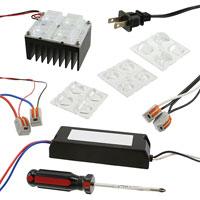
Cree® XLamp® XM-L Wide Area Light Demo
Demo objective: Provide an easy-to-view depiction of a solid-statexlamp
lightingxm-l R
system enabling users the opportunity to view multiple illuminance patterns
utilizing Cree’s revolutionary XLamp XM-L LED. In addition, this demonstration
shows first-hand the benefits of utilizing the XM-L at higher than its binning
current and closer to its maximum rated current, thus using more of the
operating capacity of the LED.
How to use the demo: Lenses can be changed by removing the screw at the
center of the optic. This demo is most effective when in a darkened room and
the demo is on the floor shining up against the ceiling. If this isn’t feasible,
shining the demo against a bare wall with the demo 10-15 ft away from the
wall best replicates how the system will look in an application and the different
light patterns of the various optics.
WARNING: This demo heats up very quickly. Please be careful when
handling the demo and don’t leave the demo on for more than
5 minutes or it will become very hot to the touch.
The Cree XLamp XM-L White LED is the industry’s highest
flux and efficacy single-die component, delivering up
to 160 lumens per watt at 1 W and 350 mA and up to
1000 lumens at 3 A and 10 W, or 100 lumens per watt.
The XM-L is available in color temperatures ranging from
2700K to 8300K and Standard- and High-CRI options. The
XM-L is ideally suited for outdoor and high-bay lighting
applications and indoor directional fixtures.
XM-L White LED
Details on Ledil Optics
C12361_HB 2X2 High-Bay Module
Optimized to create a square, asymmetric light pattern meeting Design Lights
Consortium™ (DLC) high-bay requirements with 70% lm in the 0° - 60° zone
and 35% lm in the 20° - 50° zone.
Optic Diagram
Optic Beam Pattern
C12419-STRADA-2X2-A-T Street Lighting Type II Pattern
Designed to work on roads that are narrower than the height of the pole
and when the spacing is four times the height of the pole. This optic has an
asymmetric design so it can used without tilting the lamp head.
Optic Diagram
Optic Beam Pattern
2010 Cree, Inc. All rights reserved. The information in this document is subject to change without notice.
e logo and XLamp are registered trademarks of Cree, Inc.
�C12361 _HB 2x2 installed (high bay module)
C12360_STRADA-2X2-DNW Street Lighting Type III Pattern
Designed for roads where the pole height
and the
roadway
aretosimilar.
One Screw
change
to width
Lenses
demonstrate
xlamp
This optic has an asymmetric design which often negates the need for
tiltingxm-l R
the head of the lamp.
Optic Diagram
C12419_STRADA-2X2-A-T
(street Optic
lighting,
Type
II pattern)
Beam
Pattern
C12360_STRADA-2X2-DNW
(street lighting, for Type III pattern)
C12362_STRADA-2X2-DWC Street Lighting Type III Pattern
C12362_STRADA-2X2-DWC
Designed for roads with longer pole distances.
This optic can be used in street
(street
lighting,
Type
III height.
pattern) This optic
lighting setups where the pole distance
is six
timesfor
the
pole
also has an asymmetric design that often negates the need to tilt the lamp
head.
Optic Diagram
Optic Beam Pattern
Find out more about these optics at www.ledil.com.
There is a common misconception that the current at which the LED is binned
is the “optimal” or “recommended” current for operating the LED. That is not
the case at all. In fact, if you are operating the LED at the binning current
you are more than likely not getting the full potential of the LED and more
importantly, out of your system overall. The graph below illustrates this very
well. In this example, using the LED at the binning current results in much
lower light output per LED and thus requires more LEDs, and higher LED
costs, for the system compared to a system utilizing less LEDs driven at higher
currents and producing more light output per LED. There are other things to
consider in your design in terms of system efficacy, thermal dissipation and
other trade-offs. It is important to know that the binning current does not limit
how hard you drive an LED.
Good design: Balance design trade-offs
Light Output, Efficacy
$$
$
LED Capacity
$$$$$
LPW efficacy
Light Output
Binning
Current (mA)
Max Drive
Current (mA)
Input Current (If, mA)
Below is an example of a TM-21 Lifetime Report for the Cree XM-L LED. As
you can see from the chart, at 2 amps we have data at a Tsp of 55 °C as
well as 85 °C. The calculated LED lifetime at these temperatures is well over
$ = LED Cost
Cree enables you to optimize your design by matching the
right LED for the application (Price/Optical/Voltage/integration)
�300,000 hours at 55 °C and well over 150,000 at 85 °C. The TM-21 process
also allows interpolation of a lifetime estimate for a temperature between
xlamp xm-l R
the two measured temperatures. So in the example below the calculated
lifetime at 77 °C is 195,000 hours. The TM-21 process also allows calculation
of a lumen maintenance percentage other than the standard L70 level. In
the below example we chose 92% lumen maintenance, i.e., L92. This level
was chosen because a large percentage of the population doesn’t perceive
a less-than-10% change in light level. The calculated L92 lifetime is close to
4.5 years of continuous operation.
What about LED life time – TM21 report: Using the Capacity of the Cre
L92(6K) 39,400 hours (NOT L70!)
Information on the Driver from Xenerqi
The XEL-A025CB is a 25-W constant current LED driver designed for the needs
of today’s lighting fixtures: multi-country, universal input, high efficiency,
PFC, 5-year warranty, lighting suppression, wide output range and no flicker,
among others.
Follow the QR code for product, series and contact information or email us at
Sales@Xenerqi.com
�
很抱歉,暂时无法提供与“WALDEMO-KIT-A1”相匹配的价格&库存,您可以联系我们找货
免费人工找货