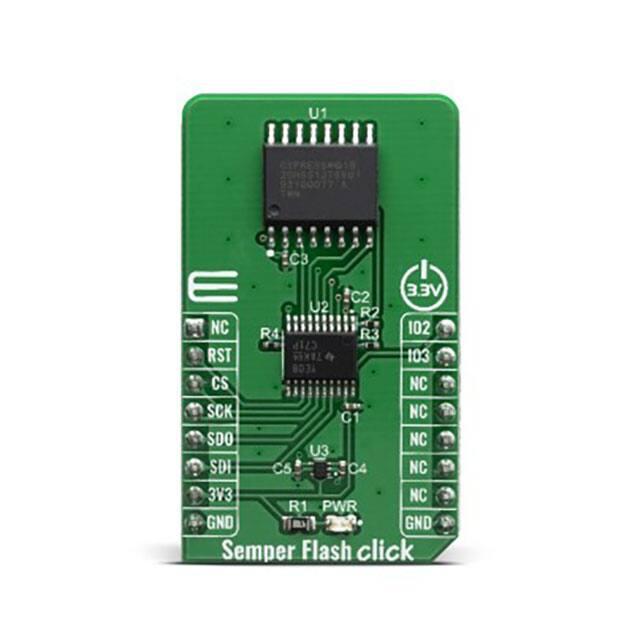
SEMPER FLASH CLICK
PID: MIKROE-3823
Weight: 18 g
The Semper Flash Click is a Click board™ which features the S25HS512T, a perfect solution for the
mass storage option in various embedded applications. With fast performance being one of its key
features, Semper Flash click can also be used for the code shadowing, execute-in-place (XIP), data
logging and data storage. The Cypress Semper Flash with Quad SPI family of products are high-speed
CMOS, MirrorBit NOR flash devices. Semper Flash is designed for Functional Safety with development
according to ISO 26262 standard to achieve ASIL-B compliance and ASIL-D readiness. Built-in Error
Correcting Code (ECC) corrects Single-bit Error and detects Double-bit Error (SECDED) on memory
array data. The 512 Mbit SPI Flash memory module is one of the fastest and most reliable Flash modules
on the market.
The Semper Flash click is supported by a mikroSDK compliant library, which includes functions that
simplify software development. This Click board™ comes as a fully tested product, ready to be used on a
system equipped with the mikroBUS™ socket.
�HOW DOES IT WORK?
The Semper Flash click is memory module based on the S25HS512T a 512 Mbit SPI Flash
memory module, from Cypress. Featuring both normal and double data rates over the
standard, Dual/Quad SPI interface, the improved reliability of the stored information by
utilizing the hardware Error Correction Code (ECC) generation, One-Time Programmable
(OTP) memory block of 1024 bytes, an advanced sector protection, AutoBoot, and much
more, this Click board™ is a perfect solution for the mass storage option in various
embedded applications. Due to its fast performance, Semper Flash click can also be used for
the code shadowing, execute-in-place (XIP), data logging and data storage. An additional
level translator IC allows Semper Flash click to be used with a wide range of MCUs.
The device control logic is subdivided into two parallel operating sections: the Host
Interface Controller (HIC) and the Embedded Algorithm Controller (EAC). The HIC
monitors signal levels on the device inputs and drives outputs as needed to complete read,
program and write data transfers with the host system. The HIC delivers data from the
currently entered address map on read transfers; places write transfer address and data
information into the EAC command memory, and notifies the EAC of power transition, and
write transfers. The EAC interrogates the command memory, after a program or write
transfer, for legal command sequences and performs the related Embedded Algorithms.
Executing code directly from Flash memory is often called Execute-In-Place (XIP). By using
XIP with Semper Flash devices at the higher clock rates with Quad or DDR Quad SPI
transactions, the data transfer rate can match or exceed traditional parallel or
asynchronous NOR flash memories while reducing signal count dramatically.
The advanced MirrorBit® technology allows storing of two data bits in each memory array
transistor (memory cell), effectively doubling the capacity of a single storage cell this way.
The Eclipse™ architecture is responsible for the greatly improved erase and programming
performance, compared to other Flash modules of the previous generation. Due to a higher
speed, an execute-in-place (XIP), as well as the data shadowing is possible with the Semper
Flash click.
�One of the key features of the S25HS512T is certainly the AutoBoot feature. It allows the
module to automatically initiate the memory transfer from the predefined location
(memory read operation) after the reset cycle. Considering a typical communication
scenario, where READ command followed by the one or more address bytes need be used,
AutoBoot allows the host MCU to pull down the #CS (Chip Select) pin and start receiving a
data stream over the SPI interface for as long as the #CS pin is held LOW, without any
wasted cycles. As soon as the #CS pin is released, the S25HS512T returns to a normal
operation.
The Advanced Sector Protection (ASP) is a powerful protection model that incorporates a
set of various software and hardware methods to enable or disable programming or erase
operations within a sector or an entire memory. A specialized ASP OTP register offers a
password protection mode or a persistent protection mode, allowing an increased
flexibility of the protection. Using the OTP memory allows the protection mode to remain in
place for the whole life-cycle of the device.
The SPI interface pins are routed to the mikroBUS™ so that the interfacing with the
microcontroller unit (MCU) is easy and straightforward. Additional pins routed to the
mikroBUS™ include the #WP/IO2 pin routed to the mikroBUS™ PWM pin and labeled as
IO2, and #HOLD/IO3 pin routed to the mikroBUS™ INT pin and labeled as IO3. There is also
the RESET pin, routed to the RST pin of the mikroBUS™, which performs a reset of the Flash
module, initiating an AutoBoot sequence if enabled.
EnduraFlex Architecture provides system designers the ability to customize the NOR Flash
endurance and retention for their specific application. The host defines partitions for high
endurance or long retention, providing up to 1+ million cycles or 25 years of data retention.
Data Integrity Check transactions in Semper Flash perform a hardware accelerated Cyclic
Redundancy Check (CRC) calculation over a user defined address range in the memory
array. The SafeBoot feature allows Status Register polling to detect an embedded
microcontroller initialization failure or configuration register corruption through error
signatures.
SPECIFICATIONS
Type
FLASH
Applications
Mass storage option in multimedia devices, data drives, non-volatile data
storage in embedded applications, secure storage, and similar applications
that require reliable permanent storage of digital information.
�On‐board
modules
S25HS512T, a 512 Mbit SPI Flash memory module, from Cypress
Key Features
High durability of 1+ million cycles, Advanced Sector Protection (ASP), secure
OTP memory block, high transfer speed, SFDP mode for easy retrieval of ICspecific information, AutoBoot function for improved startup performance
Interface
QSPI,SPI
Input Voltage
3.3V
PINOUT DIAGRAM
This table shows how the pinout on Semper Flash click corresponds to the pinout on the
mikroBUS™ socket (the latter shown in the two middle columns).
Notes
Pin
Pin
Notes
NC
1
AN
PWM
16
IO2
Write Protect/IO2
RST
2
RST
INT
15
IO3
Hold/IO3
CS
3
CS
RX
14
NC
SPI Clock
SCK
4
SCK
TX
13
NC
SPI Data OUT/SO1
SDO
5
MISO
SCL
12
NC
SPI Data IN/SO0
SDI
6
MOSI
SDA
11
NC
Power Supply
3.3V
7
3.3V
5V
10
NC
Ground
GND
8
GND
GND
9
GND
Reset
Chip Select
Ground
�ONBOARD SETTINGS AND INDICATORS
Label
Name
Default
LD1
PWR
-
Description
Power LED Indicator
SOFTWARE SUPPORT
We provide a library for the Semper Flash Click on our LibStock page, as well as a demo
application (example), developed using MikroElektronika compilers. The demo can run on
all the main MikroElektronika development boards.
Library Description
Library provides functions for using SPI module, changing pin states. Also it gives you
function for controlling memory of device.
Key functions:
void semperflash_send_cmd ( uint8_t cmd ) - Function for sending one byte of data
void semperflash_transfer_data ( uint8_t *write_buf, uint8_t *read_buf, uint16_t buf_size
) - Function for transfering data via SPI module
void semperflash_write_data ( uint8_t *data_buf, uint16_t buf_size ) - Function for writing
void semperflash_write_config ( seperflash_cfg_t *cfg_data ) - Function for writing new config
uint8_t semperflash_read_memory ( uint32_t addr, uint8_t *data_buf, uint16_t buf_size ) -
uint8_t semperflash_write_memory ( uint32_t addr, uint8_t *data_buf, uint16_t buf_size ) -
data via SPI module
to device
Function for reading memory from specific address
Function for writing memory to specific address
Examples description
The application is composed of three sections :
System Initialization - Initialization of SPI module and setting pins to output
Application Initialization - Configure device reads manufacturer id and device id and writes device id
Application Task - Erases memory of one address and then on one cycle writes one buffer and on the
other writes other one
void application_task ( )
{
memset( &read_buf_data[ 0 ], 0, 13 );
semperflash_send_cmd( SEMPERFLASH_WRITE_ENABLE );
� semperflash_erase_memory( ADRESS_MEMORY );
Delay_ms( 1000 );
if ( COMPANY_FLAG == txt_flag )
{
semperflash_send_cmd( SEMPERFLASH_WRITE_ENABLE );
status_data = semperflash_write_memory( ADRESS_MEMORY, &write_data_com[ 0 ], 7 );
error_handler( status_data );
status_data = semperflash_read_memory( ADRESS_MEMORY, &read_buf_data[ 0 ], 7 );
error_handler( status_data );
mikrobus_logWrite( read_buf_data, _LOG_LINE );
txt_flag = CLICK_FLAG;
}
else if ( CLICK_FLAG == txt_flag )
{
semperflash_send_cmd( SEMPERFLASH_WRITE_ENABLE );
status_data = semperflash_write_memory( ADRESS_MEMORY, &write_data_clk[ 0 ], 13 );
error_handler( status_data );
status_data = semperflash_read_memory( ADRESS_MEMORY, &read_buf_data[ 0 ], 13 );
error_handler( status_data );
mikrobus_logWrite( read_buf_data, _LOG_LINE );
txt_flag = COMPANY_FLAG;
}
mikrobus_logWrite( "....................", _LOG_LINE );
Delay_ms( 2000 );
}
Additional Functions :
void error_handler ( uint8_t stat ) - Proceses return of the function and if it is error logs witch one it is
The full application code, and ready to use projects can be found on our LibStock page.
Other mikroE Libraries used in the example:
SPI
Conversions
�Additional notes and informations
Depending on the development board you are using, you may need USB UART click, USB
UART 2 click or RS232 click to connect to your PC, for development systems with no UART
to USB interface available on the board. The terminal available in all MikroElektronika
compilers, or any other terminal application of your choice, can be used to read the
message.
MIKROSDK
This Click board™ is supported with mikroSDK - MikroElektronika Software Development
Kit. To ensure proper operation of mikroSDK compliant Click board™ demo applications,
mikroSDK should be downloaded from the LibStock and installed for the compiler you are
using.
For more information about mikroSDK, visit the official page.
https://www.mikroe.com/semper‐flash‐click /11‐27‐19
�